When researchers at the University of Copenhagen tracked what happened to body composition during GLP-1 receptor agonist therapy, they found something that should concern every man on semaglutide or tirzepatide: up to 40% of the weight lost during GLP-1 treatment can come from lean muscle mass, not fat. That’s not a minor side effect — that’s a metabolic liability. The drug works. The appetite suppression is real. But if you’re eating 1,000 calories a day of whatever happens to sound tolerable while your stomach empties at a crawl, you’re not optimizing your results. You’re potentially setting yourself up for a body composition outcome that looks worse than the one you started with.
This is where a structured GLP-1 meal planner becomes less of a nice-to-have and more of a clinical necessity. Not because eating on these medications is complicated — but because the drug removes the hunger cues that normally prompt you to eat enough protein, hit your micronutrient targets, and maintain the caloric floor your metabolism needs to function. The meal planning isn’t about restriction. It’s about strategy.
Why GLP-1 Medications Change Everything About How You Need to Eat
GLP-1 receptor agonists like semaglutide (Ozempic, Wegovy) and tirzepatide (Mounjaro, Zepbound) work primarily by slowing gastric emptying and amplifying satiety signaling in the hypothalamus. Research confirms that these drugs significantly delay gastric emptying, which means food sits in your stomach far longer than usual. A meal that would have cleared your system in three to four hours might take six to eight. The practical result is that you feel full for extended periods — sometimes so full that eating feels like a chore.
This gastric slowdown creates a cascade of nutritional challenges that most prescribers don’t spend enough time addressing. First, total caloric intake drops dramatically — often below 1,200 to 1,400 calories per day for men who aren’t actively planning their meals. Second, the foods that become most tolerable on GLP-1 therapy tend to be soft, easily digestible carbohydrates — crackers, toast, applesauce, broth. These are not the foods that preserve muscle, support testosterone production, or fuel training sessions. Third, protein absorption may be further compromised by the slower gastric transit, making it even harder to hit daily protein targets from whole food sources alone.
The men who get the best results on GLP-1 therapy — the ones who lose primarily fat, maintain or even build muscle, and feel strong enough to train consistently — are the ones who treat their meal plan as the foundation and the medication as a tool that sits on top of it. The drug creates the caloric deficit. The meal plan determines what that deficit is built from.
The Core Architecture of a GLP-1 Meal Plan
Building an effective meal plan for GLP-1 use requires prioritizing three things above everything else: protein at every eating opportunity, nutrient density per calorie, and meal timing that works with the drug’s satiety window rather than against it.
Start with protein, because it is non-negotiable. Research consistently shows that protein intakes of 1.6 grams per kilogram of body weight or higher are necessary to preserve lean mass during caloric restriction. For a 200-pound man, that’s roughly 145 grams of protein per day — a target that becomes genuinely difficult to hit when you’re eating two small meals and a snack. The solution is to front-load protein in every meal before eating anything else. Chicken breast, eggs, Greek yogurt, cottage cheese, canned fish, lean ground beef — these should be the first thing on your plate and the first food consumed. When GLP-1-induced fullness arrives mid-meal, you want the protein already in your system, not sitting untouched while you finished the carbohydrates.
Meal frequency matters more on GLP-1 therapy than it does under normal dietary conditions. Most men on these medications naturally gravitate toward one or two meals per day because hunger is simply absent. While this isn’t inherently dangerous, it makes it structurally very difficult to distribute protein effectively across the day. Studies on muscle protein synthesis show that spreading protein intake across three to four meals produces superior muscle-building signals compared to consuming the same total amount in one or two large sittings. Practically, this means scheduling meals — setting a phone alarm if necessary — even when hunger is nowhere to be felt. Three meals with 40 to 50 grams of protein each is a reasonable daily structure for most men on GLP-1 therapy.
Portion architecture within each meal also requires a different approach. Because gastric emptying is slow, large meals create extended discomfort that can make eating feel aversive. The solution is higher-density, lower-volume meals. A palm-sized piece of salmon with half an avocado and a small portion of quinoa delivers significant protein, healthy fats, and complex carbohydrates in a volume that won’t trigger prolonged nausea. Compare that to a large mixed salad with grilled chicken — technically nutritious, but the volume of raw vegetables on a slow GLP-1 stomach can be genuinely miserable. During active GLP-1 therapy, cooked vegetables, lean proteins, and moderate portions of whole grains will serve you far better than raw, high-fiber, high-volume foods.
Hydration deserves specific mention here because it’s consistently underestimated on GLP-1 therapy. Dehydration is a documented risk during rapid weight loss, and GLP-1 users who aren’t thirsty — because appetite and thirst signals often travel together — frequently under-consume fluids. Targeting a minimum of 2.5 to 3 liters of water per day is a reasonable baseline. Electrolyte supplementation with sodium, potassium, and magnesium becomes especially relevant if you’re exercising consistently while in a significant caloric deficit.
What a Real GLP-1 Meal Plan Looks Like in Practice
Theory is useful. A concrete framework is more useful. A practical GLP-1 meal plan for a man focused on fat loss and muscle preservation typically follows this architecture across the day.
The first meal, ideally within 90 minutes of waking, should be protein-anchored regardless of hunger level. Three to four whole eggs scrambled with two ounces of smoked salmon and a small portion of roasted sweet potato delivers roughly 40 grams of protein, adequate omega-3 fatty acids, and enough carbohydrate to support morning training without creating excessive volume. If solid food feels difficult early in the day, a protein shake blended with Greek yogurt, frozen berries, and a tablespoon of almond butter achieves a similar macronutrient profile in a more tolerable liquid format.
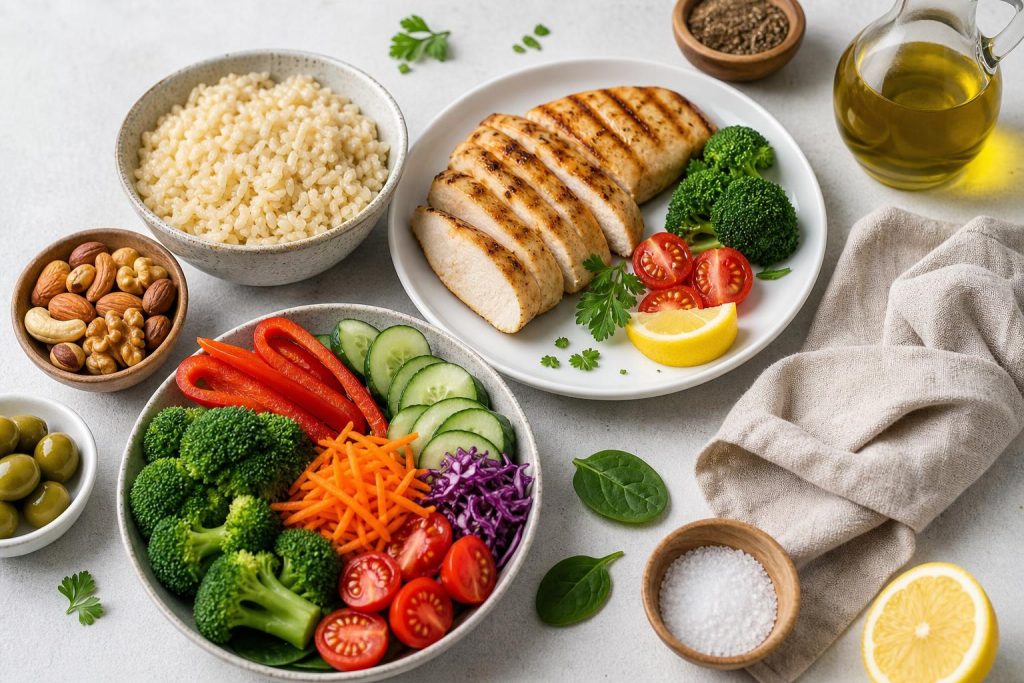
The midday meal is typically the most important eating window on GLP-1 therapy because it falls when the medication’s satiety effect is often at its most manageable. This is where you want your most nutrient-dense, calorie-complete meal. A base of six ounces of grilled chicken breast or lean ground turkey, a serving of cooked vegetables such as roasted zucchini or steamed broccoli, and a half-cup of brown rice or lentils covers protein, fiber, and complex carbohydrates without excessive volume. Adding a tablespoon of olive oil for cooking or drizzling adds caloric density and supports fat-soluble vitamin absorption — something research has flagged as a genuine concern during GLP-1-driven caloric restriction.
The evening meal should be lighter in volume but still protein-forward. A piece of white fish or a serving of cottage cheese with a small mixed salad dressed with olive oil accomplishes this efficiently. If you’re training in the evening, adding a modest portion of complex carbohydrates — half a cup of cooked oats, a small potato — around the workout window supports recovery without meaningfully expanding meal volume.
Between meals, high-protein snacks like string cheese, hard-boiled eggs, a small portion of edamame, or a protein bar with at least 20 grams of protein and minimal added sugar serve as protein distribution tools rather than treats. On GLP-1 therapy, snacking isn’t about cravings — it’s about hitting your daily protein architecture when large meals aren’t feasible.
One category of food to minimize deliberately during GLP-1 therapy is ultra-processed, high-fat, high-sugar combinations — not because of moral nutrition rules, but because of physiology. High-fat meals significantly further slow gastric emptying, which compounds the drug’s already pronounced effect and dramatically increases the likelihood of nausea, reflux, and prolonged discomfort. Fried foods, fast food, cream sauces, and pastries are the categories most commonly reported to cause severe GI side effects in GLP-1 users — and structurally, they offer the least nutritional return per calorie of any food group.
The Takeaway
GLP-1 medications are genuinely powerful metabolic tools, but they don’t come with a built-in nutritional strategy — and the absence of hunger is not the same as optimal nutrition. The men who leverage these drugs most effectively are the ones who recognize that a structured meal plan is what converts pharmacological appetite suppression into actual body composition change. Protein first, nutrient density over volume, consistent meal timing even without hunger, and deliberate attention to hydration and micronutrients — these are the variables that determine whether you end GLP-1 therapy leaner and stronger, or simply lighter. The drug does the heavy lifting on appetite. The meal plan determines what that appetite suppression actually builds.