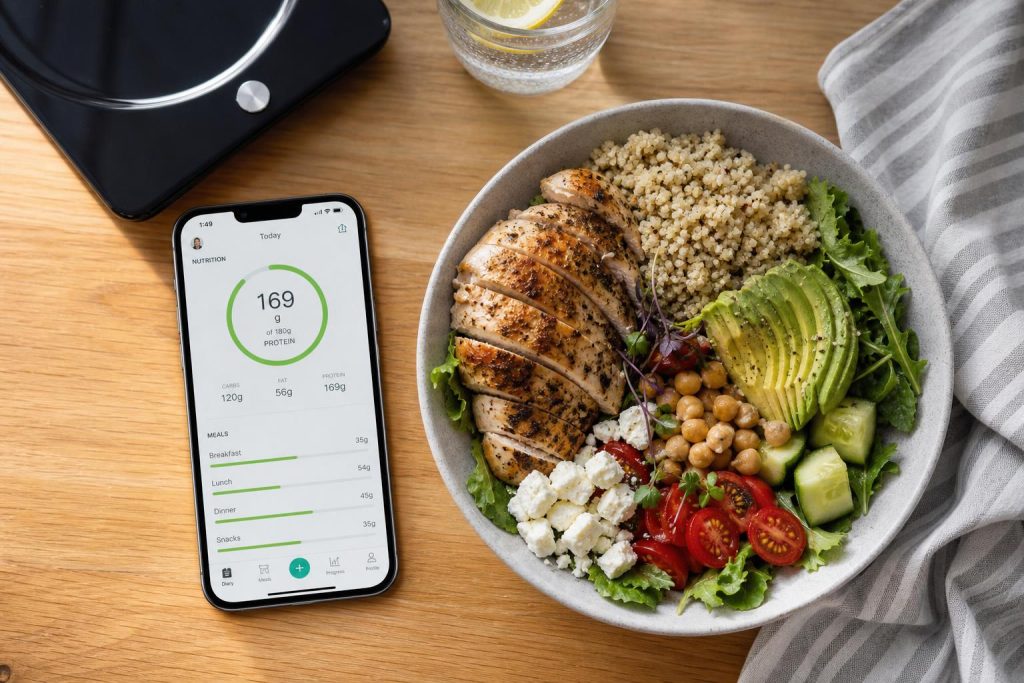
When semaglutide (Ozempic/Wegovy) first started making headlines for its dramatic weight loss results, the conversation centered almost entirely on the scale — how many pounds, how fast. What that conversation largely missed was the question of what you were actually losing. Because weight loss and fat loss are not the same thing, and the difference between them often comes down to one variable: how much protein you’re eating every day.
Here’s the clinical reality. Research published in Molecular Metabolism in 2024 confirmed what exercise physiologists have long suspected — GLP-1 receptor agonists like semaglutide produce significant decreases in both fat mass and muscle mass during calorie restriction. In the study, obese mice treated with semaglutide showed potent total body weight reduction, but that weight came from both fat and lean tissue. The researchers were frank about the implication: losing lean mass alongside fat is not a desirable outcome, and it’s a pattern seen across virtually all calorie-deficit approaches, not just GLP-1 therapy.
This isn’t a reason to avoid Ozempic. It’s a reason to get your protein right. Whether you’re using semaglutide, counting macros, intermittent fasting, or just hitting the gym four days a week, the principle is the same — protein is the nutritional anchor that determines whether your weight loss looks like a leaner, stronger version of yourself or a smaller, weaker one.
What Ozempic Does to Your Appetite — and Why That Creates a Protein Problem
To understand the protein challenge on semaglutide, you first need to understand what the drug does to eating behavior at a physiological level. Drucker’s landmark 2022 review in Molecular Metabolism outlines the mechanism clearly: GLP-1 receptor agonists reduce food intake through central nervous system pathways, augment insulin release in response to glucose, suppress glucagon secretion, and significantly slow gastric emptying. The result is a profound and sustained reduction in appetite and caloric intake — which is precisely why these drugs work so well for weight loss.
But here’s where the problem emerges for body composition. When a drug reliably suppresses your appetite by 20 to 40 percent — which is what clinical trial data on semaglutide consistently shows — the macronutrient you’re most likely to under-consume is protein. Carbohydrates and fats are calorie-dense and easy to eat even in small amounts. Protein requires deliberate effort under normal conditions, and on a drug that makes you feel full after a few bites, hitting an adequate daily protein target becomes a genuine nutritional challenge that most users and their prescribing physicians never fully address.
The gastric emptying effect described by Nauck and colleagues in their 2021 state-of-the-art GLP-1 review compounds this further. Slower gastric emptying means food stays in your stomach longer, prolonging satiety signals and making the idea of eating a high-protein meal feel even less appealing. For a man trying to consume 150 to 180 grams of protein per day — a reasonable target for muscle preservation during fat loss — this is a real obstacle, not a theoretical one.
The downstream consequence is what exercise scientists call anabolic resistance: a state in which muscle tissue becomes progressively less responsive to the signals that would normally trigger repair and growth. A 2024 retrospective analysis published in Nutrients examined older men undergoing a combined resistance exercise and protein supplementation protocol and found that obesity and metabolic syndrome were the strongest negative predictors of lean mass gain — even when total daily protein exceeded current treatment guidelines. The authors concluded that anabolic resistance in the context of obesity and metabolic dysfunction means you likely need more protein than a lean, metabolically healthy person, not less.
Read that again. The population most likely to be prescribed Ozempic — men who are overweight, metabolically compromised, and dealing with insulin resistance — is also the population with the greatest impairment in their ability to use dietary protein to build and preserve muscle. This is not an academic footnote. It changes how you should be approaching your daily intake numbers.
The Actual Numbers: How Much Protein You Need on Ozempic
The standard RDA for protein is 0.8 grams per kilogram of body weight — a figure designed to prevent deficiency in sedentary adults, not to optimize body composition during medically induced calorie restriction. For men on semaglutide who want to preserve muscle while losing fat, this number is dangerously inadequate.
The current evidence-based consensus for men in a calorie deficit, particularly those who are resistance training, falls between 1.6 and 2.4 grams of protein per kilogram of body weight per day — or roughly 0.7 to 1.1 grams per pound. For a 220-pound man, that translates to approximately 154 to 242 grams of protein daily. The upper end of that range is supported in populations with anabolic resistance, obesity, and metabolic dysfunction — precisely the profile of most men using Ozempic.
A practical starting point for most men on semaglutide is 1 gram per pound of goal body weight, not current body weight. This approach is useful because it accounts for the lean mass you’re trying to protect while not inflating targets unrealistically for men who are significantly overweight. A 220-pound man with a goal weight of 185 pounds should target roughly 185 grams of protein per day. That’s the floor, not the ceiling.
The Nutrients study made one additional finding worth highlighting here: not all protein sources are created equal under conditions of anabolic resistance. The researchers found that a whey and casein-based multi-ingredient supplement outperformed a collagen-based alternative for maintaining lean mass — a relevant distinction for men who rely on protein supplements to hit their daily targets, which on Ozempic will often be a necessity rather than a convenience. Whey protein delivers a rapid leucine spike that activates muscle protein synthesis efficiently; casein provides a slower, sustained release that reduces overnight muscle protein breakdown. Using both strategically throughout the day is a legitimate body composition tool, especially when whole-food appetite is suppressed.
Practically, this means structuring your eating around protein first, every meal, every time. On Ozempic, the drug dictates how much you can eat — but you dictate what goes in first. A chicken breast before the rice. Greek yogurt before the fruit. A protein shake as your first caloric input of the day. When you only have room for 400 calories at a sitting, those calories should deliver 40 to 50 grams of protein before anything else fills the space.
Muscle Loss on Ozempic Is Real — Here’s How Protein and Training Change the Equation
The 2024 Molecular Metabolism study on semaglutide and body composition didn’t just identify the problem of lean mass loss — it pointed toward a solution. Researchers testing bimagrumab, an antibody that blocks activin type II receptors (the receptors through which myostatin suppresses muscle growth), found that combining ActRII blockade with semaglutide led to superior fat mass loss while simultaneously preserving lean mass despite the reduced food intake driven by the GLP-1 receptor agonist. Animals in the combination group also showed improved metabolic outcomes and better exercise performance.
Bimagrumab is not a medication available at a retail pharmacy — it’s an experimental therapy. But the mechanism it works through is instructive, because resistance training and adequate protein intake achieve overlapping results through overlapping pathways. Progressive resistance exercise downregulates myostatin activity, stimulates muscle protein synthesis via the mTORC1 pathway, and creates a powerful anabolic stimulus that dietary protein then fulfills. In the absence of resistance training, even optimal protein intake will only slow muscle loss. With it, preservation — and in some cases modest gain — becomes achievable even in a significant calorie deficit.
This is why the clinical recommendation for men on Ozempic shouldn’t just be “eat more protein” — it should be “eat more protein and lift weights.” The two interventions are synergistic. Resistance training sensitizes muscle tissue to amino acids, partially counteracting the anabolic resistance associated with obesity and metabolic syndrome identified in the Nutrients study. Protein provides the raw material that trained muscle tissue can actually use. Remove either variable and the outcome degrades.
A practical resistance training minimum for muscle preservation during Ozempic-assisted weight loss is two to three full-body or upper/lower split sessions per week, with compound movements — squats, deadlifts, rows, presses — forming the core of each session. Volume doesn’t need to be high. Intensity does. Lifting close to failure with adequate protein on board is the stimulus the body needs to interpret weight loss as fat loss rather than starvation-driven tissue catabolism.
It’s also worth noting the liver benefits emerging in the semaglutide research. A 2024 study in the International Journal of Molecular Sciences found that semaglutide reduced hepatic steatosis, improved liver dysfunction markers, and modulated lipid composition in a diabetic obesity model — effects that appeared to operate partly independently of caloric intake, suggesting a direct hepatic mechanism. For men with non-alcoholic fatty liver disease or elevated liver enzymes, this is clinically meaningful. High protein intake, particularly from animal sources, has been a source of concern in some liver disease contexts, but current evidence does not support restricting protein in men with metabolic-dysfunction-associated steatotic liver disease who are otherwise healthy enough to exercise. If you have significant liver pathology, work with your physician — but protein restriction is not a standard recommendation for most men on Ozempic with early-stage liver involvement.
Building a Daily Protein Strategy That Actually Works on Ozempic
Knowing your target number and consistently hitting it are two very different things when a GLP-1 medication has fundamentally altered your relationship with hunger. The men who successfully preserve muscle on Ozempic are the ones who treat protein intake as a non-negotiable daily practice — not something they achieve passively through normal eating patterns.
The most reliable approach is to distribute protein across three to four eating windows throughout the day, prioritizing leucine-rich sources at each. Research on muscle protein synthesis consistently shows that spreading intake across meals — roughly 40 to 50 grams per meal — produces superior muscle protein synthesis compared to consuming the same total amount in one or two large meals. On Ozempic, where meal sizes are naturally reduced, this distribution strategy also happens to be more feasible: smaller, more frequent protein-forward meals align with the drug’s satiety profile better than two large meals ever could.
High-density protein sources should anchor every eating window. Eggs, Greek yogurt, cottage cheese, chicken breast, lean beef, salmon, and whey protein isolate all deliver 25 to 50 grams of protein in modest volumes — a critical advantage when stomach capacity is limited. A morning shake with 40 grams of whey, a midday meal built around 6 to 8 ounces of chicken or salmon, an afternoon cottage cheese or Greek yogurt snack, and an evening meal centered on lean red meat or eggs can reliably deliver 160 to 200 grams of protein without requiring large meal volumes at any single sitting.
Protein supplements are not a shortcut on Ozempic — they’re a legitimate clinical tool. When whole-food appetite is suppressed, the ability to consume 40 grams of protein in liquid form without triggering nausea or satiety walls is genuinely useful. The key, per the Nutrients study data, is choosing whey or casein-based products over collagen-heavy alternatives marketed as protein powders. Collagen is incomplete in its amino acid profile and lacks sufficient leucine to robustly stimulate muscle protein synthesis — a distinction that matters significantly under conditions of anabolic resistance.
Hydration also interacts with protein metabolism in a way Ozempic users specifically need to manage. The drug’s effects on gastric emptying can reduce thirst signaling and overall fluid consumption, and dehydration impairs protein synthesis and recovery. Targeting at least half your body weight in ounces of water daily — and more on training days — is a practical baseline that supports both protein utilization and the overall metabolic benefits semaglutide provides.
The Takeaway
Ozempic can produce meaningful, sustained fat loss — but fat loss is only half the goal. The research is clear that semaglutide-driven calorie restriction produces lean mass losses alongside fat loss, that men with obesity and metabolic dysfunction have impaired anabolic responses to protein even under optimal conditions, and that the solution to both problems is the same: prioritize high-quality protein at every meal, target at least 1 gram per pound of goal body weight daily, and pair that intake with consistent resistance training.
The drug changes what you want to eat. Your job is to eat what your body actually needs. Protein isn’t optional, and it isn’t a nice-to-have supplement strategy — it’s the primary nutritional variable that separates transformative fat loss from the kind of weight loss that leaves you smaller but metabolically weaker. Get the protein right, lift with intention, and semaglutide becomes a powerful tool for body recomposition rather than just a number on a scale moving in one direction.
Scientific References
-
Drucker et al. (2022).
GLP-1 physiology informs the pharmacotherapy of obesity..
Molecular metabolism.
View on PubMed → -
Nauck, Quast, Wefers et al. (2021).
GLP-1 receptor agonists in the treatment of type 2 diabetes – state-of-the-art..
Molecular metabolism.
View on PubMed → -
Nunn, Jaiswal, Gavin et al. (2024).
Antibody blockade of activin type II receptors preserves skeletal muscle mass and enhances fat loss during GLP-1 receptor agonism..
Molecular metabolism.
View on PubMed → -
Soto-Catalán, Opazo-Ríos, Quiceno et al. (2024).
Semaglutide Improves Liver Steatosis and De Novo Lipogenesis Markers in Obese and Type-2-Diabetic Mice with Metabolic-Dysfunction-Associated Steatotic Liver Disease..
International journal of molecular sciences.
View on PubMed → -
Nilsson, Xhuti, de Maat et al. (2024).
Obesity and Metabolic Disease Impair the Anabolic Response to Protein Supplementation and Resistance Exercise: A Retrospective Analysis of a Randomized Clinical Trial with Implications for Aging, Sarcopenic Obesity, and Weight Management..
Nutrients.
View on PubMed →