Tirzepatide is doing something genuinely remarkable in clinical settings. The SUMMIT trial’s cardiac MRI substudy found that tirzepatide therapy reduced left ventricular mass by 11 grams and shrank paracardiac adipose tissue by 45 milliliters compared to placebo over 52 weeks — changes that correlated directly with how much body weight each patient lost. That’s not just a number on a scale improving. That’s fat coming off the heart. But here’s the part most people skip past: the drug doesn’t decide what you eat. You do. And what you eat determines whether tirzepatide becomes a transformative tool or a shortcut that quietly erodes your muscle, crashes your energy, and leaves you metabolically worse off than when you started.
The mechanism matters here. Tirzepatide works as a dual GIP and GLP-1 receptor agonist, and one of its primary effects is dramatically slowing gastric emptying — meaning food moves through your stomach more slowly, you feel full faster, and appetite signals are suppressed for longer. Research on incretin-based therapies confirms that this retardation of gastric emptying is a core contributor to the weight loss response, not just a side effect. That’s powerful. It’s also why men on tirzepatide often eat dramatically less without feeling deprived — sometimes dangerously less. A published case report documented starvation ketosis in a patient using tirzepatide who had reduced caloric intake so severely that serum 3-hydroxybutyrate climbed to over 2,000 µmol/L despite normal blood glucose — a metabolic state driven not by intentional keto dieting but by inadequate nutrition. When the drug quiets hunger this effectively, eating enough of the right things becomes an active responsibility, not a passive one.
Build Your Plate Around Protein — Every Single Meal
When calories drop sharply — which they will on tirzepatide, often without you realizing it — the body doesn’t automatically protect muscle. It burns whatever is most available. If protein intake is low and you’re in a significant caloric deficit, lean tissue loss accelerates. For men specifically, preserving skeletal muscle mass isn’t just an aesthetic concern. It’s directly tied to insulin sensitivity, resting metabolic rate, long-term metabolic health, and functional strength as you age. This is why protein has to be the non-negotiable anchor of your diet while on this medication.
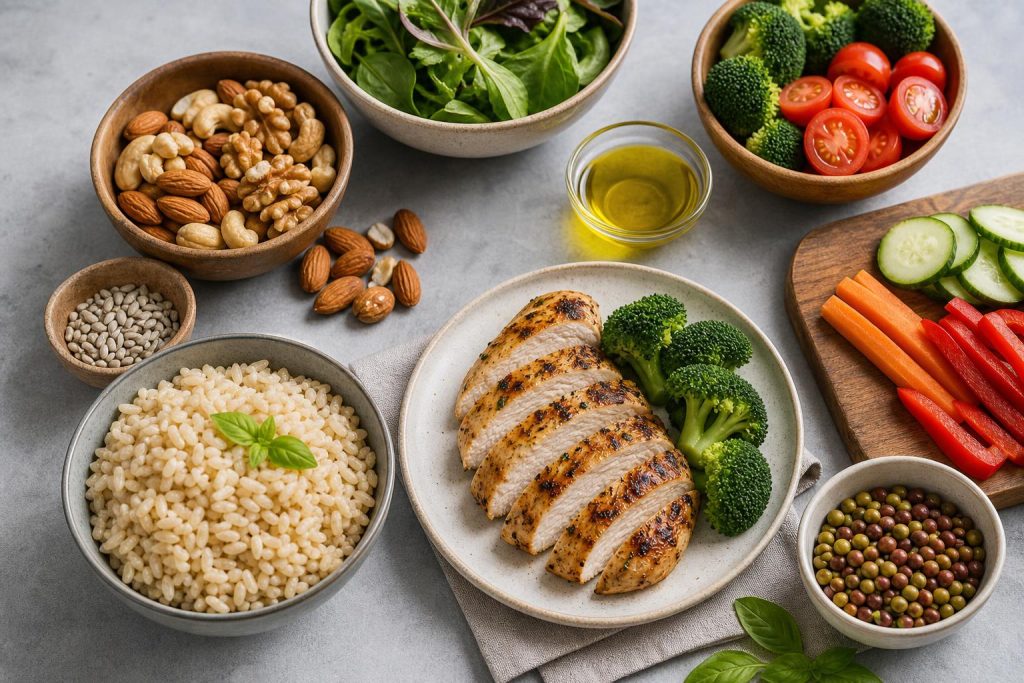
Aim for a minimum of 0.7 to 1 gram of protein per pound of bodyweight — or closer to 1 gram per pound if you’re training consistently. Since portion sizes will naturally shrink due to early satiety, protein needs to come first in every meal, not last. Prioritizing it structurally means eating it before vegetables or carbohydrates when stomach capacity is limited. Lean animal proteins — chicken breast, eggs, Greek yogurt, cottage cheese, fatty fish like salmon, lean beef — provide complete amino acid profiles and should anchor most meals. Whey protein or a high-quality blend can fill gaps on lower-appetite days without requiring significant stomach volume.
The science behind tirzepatide’s broader effects reinforces why this matters at a mechanistic level. Research confirms that human epicardial adipose tissue expresses GIP and GLP-1 receptors, and that activation of these receptors influences fatty acid oxidation, adipogenesis, and fat depot remodeling in ways that go well beyond simple caloric restriction. The drug is reshaping your metabolic environment. Your nutrition plan needs to take advantage of that environment — not squander it by letting muscle atrophy fill the void left by shrinking fat stores.
Whole Foods Over Ultra-Processed Ones — Non-Negotiable
When you’re eating less overall, food quality stops being a lifestyle preference and becomes a nutritional survival strategy. Every meal is an opportunity to deliver micronutrients, fiber, anti-inflammatory compounds, and quality macronutrients. Ultra-processed foods — even in small quantities — displace those nutrients while contributing refined carbohydrates, industrial seed oils, and additives that do nothing positive for metabolic health. The math is simple and unforgiving: if tirzepatide cuts your daily intake from 2,800 calories to 1,600, you cannot afford for 600 of those calories to come from chips, protein bars loaded with sugar alcohols, or fast food.
Vegetables deserve a prominent place on your plate, though their volume should be managed in light of how gastric slowing affects fullness. Non-starchy options — broccoli, spinach, zucchini, asparagus, bell peppers — are nutrient-dense without demanding significant caloric space. For carbohydrates, choose sources that deliver fiber and slow glucose absorption: oats, sweet potatoes, legumes, and whole grains. These are particularly important for men using tirzepatide who are also training, since glycogen availability supports performance, recovery, and the anabolic response to resistance exercise.
Healthy fats from whole food sources — avocados, olive oil, fatty fish, nuts — should round out meals. Beyond their macronutrient role, these foods carry fat-soluble vitamins and omega-3 fatty acids that support the cardiovascular remodeling tirzepatide appears to facilitate. The drug’s cardiovascular effects — including its influence on epicardial fat — are mediated through receptor pathways that research suggests may represent a beneficial balance between adipose tissue remodeling and reduced ectopic fat accumulation. Your diet can either complement those mechanisms or work against them.
Hydration is frequently underestimated. Because food intake drops and many whole foods are significant water sources, dehydration becomes a real risk. Gastrointestinal side effects — nausea, vomiting, delayed gastric emptying — compound fluid losses. Aim for consistent water intake throughout the day, and consider electrolyte supplementation if GI symptoms are present. Sodium, potassium, and magnesium all matter, and men who are training hard while in a caloric deficit are particularly vulnerable to deficits in these minerals.
Eat Smaller, More Strategic Meals
The traditional three large meals a day model doesn’t work well when gastric emptying is significantly slowed. Large meals on tirzepatide frequently trigger nausea, excessive fullness, and in some cases vomiting — side effects that are often dietary in origin rather than purely pharmacological. The practical solution is restructuring meal size and frequency. Eating smaller meals more frequently — four to five times across the day — maintains protein distribution, prevents the bloating and nausea that come with volume overload, and ensures total daily nutrient targets are met even when appetite is suppressed.
Soft, easy-to-digest meals are better tolerated during dose escalation phases. Soups, stews, scrambled eggs, smoothies with protein powder, and yogurt-based meals are practical options that don’t demand significant gastric volume but still deliver meaningful nutrition. As the body adapts to the medication — usually within a few weeks at each dose level — most men find they can return to more normal textures and meal structures. The goal is to get adequate nutrition through the adjustment period without triggering side effects that then compromise intake further.
It’s also worth being honest about the risk of under-eating. The case report linking unsupervised tirzepatide use to starvation ketosis is a clinical extreme, but the underlying mechanism — appetite suppression so strong that caloric intake falls dangerously low — is a real risk even in supervised settings. Tracking intake, at least loosely, gives you objective data. If you’re consistently under 1,400 calories with no intentional effort to restrict and you’re not hitting protein targets, that’s a problem requiring adjustment regardless of how satisfied you feel.
The Takeaway
Tirzepatide is a powerful metabolic tool, and the research supporting its effects on body composition and cardiovascular health is genuinely compelling. But the medication works within a biological system that still requires fuel, protein, micronutrients, and structure to produce the best outcomes. The drug reduces appetite — your job is to make every calorie that does go in count. Prioritize protein ruthlessly. Eat whole, nutrient-dense foods at smaller meal sizes. Stay hydrated. Train with weights to preserve muscle. And treat the reduced caloric intake not as license to eat carelessly, but as a mandate to eat more deliberately than you ever have. That’s when tirzepatide stops being a shortcut and starts being a legitimate turning point.
Scientific References
-
Kramer, Borlaug, Zile et al. (2025).
Tirzepatide Reduces LV Mass and Paracardiac Adipose Tissue in Obesity-Related Heart Failure: SUMMIT CMR Substudy..
Journal of the American College of Cardiology.
View on PubMed → -
Iacobellis et al. (2025).
Epicardial Fat Inflammation and GLP-1/GIP Receptor Analogs: Are we Shifting our Perspective?.
Current cardiology reports.
View on PubMed → -
Malavazos, Iacobellis, Dozio et al. (2023).
Human epicardial adipose tissue expresses glucose-dependent insulinotropic polypeptide, glucagon, and glucagon-like peptide-1 receptors as potential targets of pleiotropic therapies..
European journal of preventive cardiology.
View on PubMed → -
Camilleri et al. (2024).
The role of gastric function in control of food intake (and body weight) in relation to obesity, as well as pharmacological and surgical interventions..
Neurogastroenterology and motility.
View on PubMed → -
Yasui-Furukori, Tasaki, Kaiga et al. (2026).
Starvation ketosis following self-administered tirzepatide obtained via online services in a young woman later diagnosed with anorexia nervosa: a case report..
Journal of eating disorders.
View on PubMed →