When researchers gave tirzepatide to people with obesity and measured what actually happened to their metabolism, the results were clarifying. The 2025 Cell Metabolism study by Ravussin, Sanchez-Delgado, Martin and colleagues found that the drug increased fat oxidation and reduced ad libitum calorie intake — but it didn’t magically reprogram your metabolism. What it did was create the conditions for better food choices to actually work. That distinction matters enormously when you’re trying to build a meal plan around GLP-1 therapy, because the medication is the setup, not the solution. Nutrition is still doing the heavy lifting.
Whether you’re on semaglutide, tirzepatide, or just eating your way to a leaner, healthier body the old-fashioned way, the principles of a smart GLP-1-aligned meal plan come down to one core challenge: eating less without losing muscle, stalling your metabolism, or running on nutritional fumes. That’s harder than it sounds when appetite suppression cuts your intake dramatically and every meal has to work harder to cover your nutritional bases.
What Your Body Actually Needs When Calories Drop
GLP-1 receptor agonists are extraordinarily effective at reducing how much you want to eat. That’s the mechanism — appetite suppression through slowed gastric emptying and signaling in the brain’s satiety centers. The problem is that when calorie intake drops sharply, protein is often the first casualty. Men on GLP-1 medications who aren’t deliberate about their diet frequently under-eat protein while simultaneously losing muscle alongside fat — a combination that undermines both their physique and their long-term metabolic health.
The research is unambiguous here. A 2026 randomized controlled trial published in Sports Medicine followed 193 adults with obesity through a structured weight loss intervention and found that liraglutide alone did not improve physical fitness. Cardiorespiratory fitness and functional performance only meaningfully improved when exercise was added to the equation. Relative muscle strength held up better with the drug than with placebo — largely because participants weighed less — but absolute strength didn’t grow. The takeaway is that GLP-1 medications preserve the opportunity to build a better body; they don’t build it for you. Diet structure and training are still the architects.
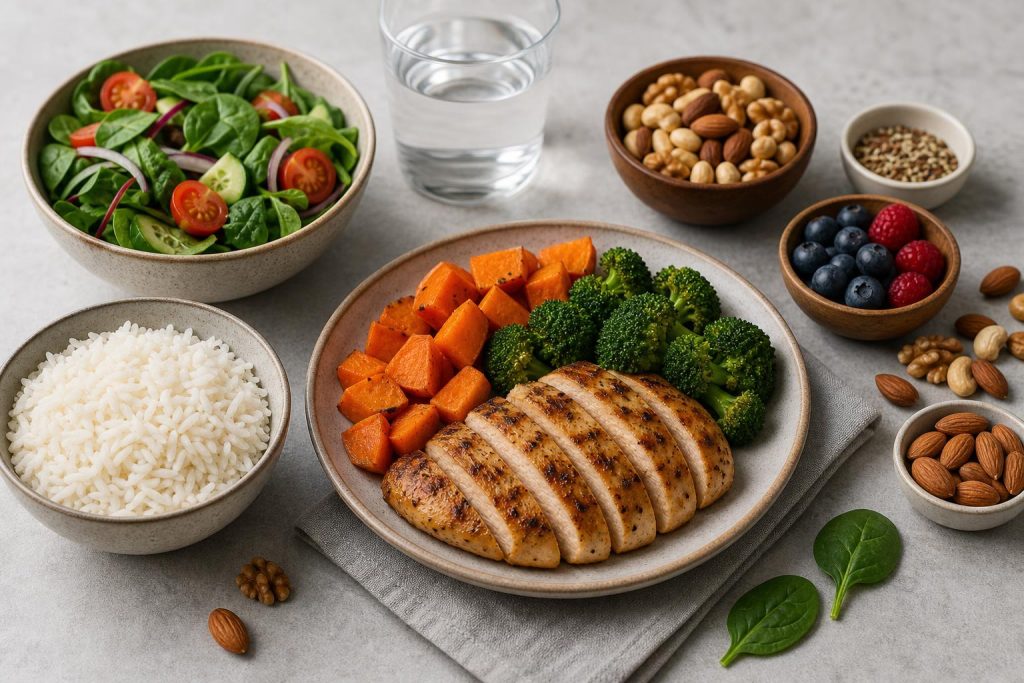
So what does a properly structured GLP-1 meal plan actually look like? It starts with protein — aggressive, intentional, prioritized at every meal. Aim for a minimum of 0.7 to 1.0 grams of protein per pound of target body weight daily. On GLP-1 therapy, when you might only comfortably eat two moderate-sized meals a day, front-loading protein at each sitting becomes essential. Chicken breast, eggs, Greek yogurt, cottage cheese, salmon, lean beef, and whey protein all fit the framework. Eat your protein first at every meal. When appetite is suppressed and you hit your limit mid-plate, you want the muscle-protecting macronutrient to be the one you already finished.
Carbohydrates should come from whole, fiber-dense sources — vegetables, legumes, sweet potatoes, oats — rather than refined grains and sugar. This matters not just for blood sugar management, but because fiber supports gut health and satiety independently of the medication. Fat intake doesn’t need to be dramatically restricted, but ultra-processed high-fat foods — the ones that combine fat and refined carbs — are exactly what triggers overconsumption even in the presence of GLP-1-mediated appetite suppression. Build meals around real food with a clear macronutrient identity.
Exercise Isn’t Optional — It Changes the Biology
One of the more compelling findings in recent GLP-1 research is that exercise doesn’t just complement the medication — it actually alters the hormonal environment in ways the drug cannot replicate. A 2026 study in Obesity tracking 195 adults through a year-long intervention found that one year of moderate-to-vigorous exercise increased late-phase postprandial GLP-1 secretion by 37% compared to baseline — a 25% greater response than the usual activity control group. Liraglutide treatment, by contrast, did not increase endogenous GLP-1 secretion. In other words, structured exercise trains your body to produce more of its own appetite-regulating hormone, which matters enormously for long-term weight maintenance — especially if you ever taper or discontinue medication.
This means your meal plan and your training schedule are inseparable. On training days, eat more — particularly more protein and carbohydrates timed around your workout. On rest days, keep calories slightly lower and lean into vegetables and lean protein. This kind of flexible cycling keeps your metabolism engaged and supports muscle protein synthesis even in a caloric deficit. The specific numbers matter less than the habit: eat more when you demand more of your body, eat less when you don’t.
Meal timing also deserves attention. GLP-1 medications slow gastric emptying, which can make large meals uncomfortable and eating immediately before or after exercise feel worse than usual. Many men do better with two to three smaller, protein-anchored meals spread across the day rather than the traditional three squares. A morning meal of eggs with vegetables and some avocado, a midday meal built around a substantial protein source with fiber-rich carbs, and an evening meal that mirrors the midday structure is a simple, repeatable framework that most men can sustain without tracking obsessively.
Making the Weight Loss Stick Long-Term
Here’s the part nobody talks about enough: what happens when the medication changes, the dose adjusts, or you decide to stop. A 78-week randomized trial published in Clinical Nutrition found that structured dietary strategies — specifically a 5:2 total diet replacement approach — successfully prevented weight regain even after GLP-1 agonist withdrawal, maintaining over 15 kilograms of weight loss for the full study duration. The method that failed was passive maintenance without structure. The lesson is simple: the habits you build during GLP-1 therapy are what determine whether the results last.
This means the meal plan isn’t a temporary accessory to the medication — it’s the long game. Use the reduced appetite window that GLP-1 therapy provides to build genuine food habits: learning what a protein-adequate meal looks like, understanding hunger signals versus boredom, practicing meal prep, and developing tolerance for simpler, less hyper-palatable food. These are the behaviors that outlast any prescription.
The Takeaway
A GLP-1 meal plan isn’t complicated, but it has to be intentional. Prioritize protein at every meal, build around whole food carbohydrates and healthy fats, train consistently to preserve muscle and boost your own GLP-1 response, and structure your eating in a way you can sustain well beyond the medication. The drug changes the conditions. The plan determines the outcome.
Scientific References
-
Ravussin, Sanchez-Delgado, Martin et al. (2025).
Tirzepatide did not impact metabolic adaptation in people with obesity, but increased fat oxidation..
Cell metabolism.
View on PubMed → -
Jensen, Fiorenza, Juhl et al. (2026).
Physical Fitness with Exercise and GLP-1 Receptor Agonist Treatment Alone or Combined After Diet-Induced Weight Loss: A Secondary Analysis of a Randomized Controlled Trial in Adults with Obesity..
Sports medicine (Auckland, N.Z.).
View on PubMed → -
Holt, Sandsdal, Byberg et al. (2026).
One Year of Exercise After Weight Loss Increases Postprandial GLP-1 Secretion in Contrast to Usual Activity or GLP-1 Receptor Agonist Treatment..
Obesity (Silver Spring, Md.).
View on PubMed → -
Toledo, Li, Wang et al. (2025).
Pancreatic cancer-related diabetes and type 2 diabetes differ in multiple aspects of glucose homeostasis..
Diabetologia.
View on PubMed → -
Brosnahan, Hankey, Leeds et al. (2025).
Diet strategies for maintaining substantial therapeutic weight loss: 78-week mixed methods randomised trial..
Clinical nutrition (Edinburgh, Scotland).
View on PubMed →