Tirzepatide doesn’t just suppress appetite — it fundamentally reshapes how your body handles food. This review summarizes evidence that gastric motor functions are relevant to postprandial fullness and to interventions aimed at weight loss in people with obesity. that dual GIP/GLP-1 receptor agonists like tirzepatide actively slow gastric emptying, extending the time food stays in your stomach and amplifying satiety signals to your brain. That’s powerful for weight loss — but it also means what you eat matters more than ever. When your appetite is blunted and your caloric intake drops significantly, every bite has to pull serious nutritional weight.
The risk most men underestimate is this: tirzepatide will reduce how much you eat, but it won’t tell your body what to eat. Eat poorly on a reduced calorie budget and you’ll lose muscle alongside fat, slow your metabolism, and set yourself up for nutritional deficiencies. A published case report documented starvation ketosis in a tirzepatide user who ate too little without adequate nutritional support — a stark reminder that appetite suppression without dietary intention is a liability, not a strategy.
Build Every Meal Around Protein First
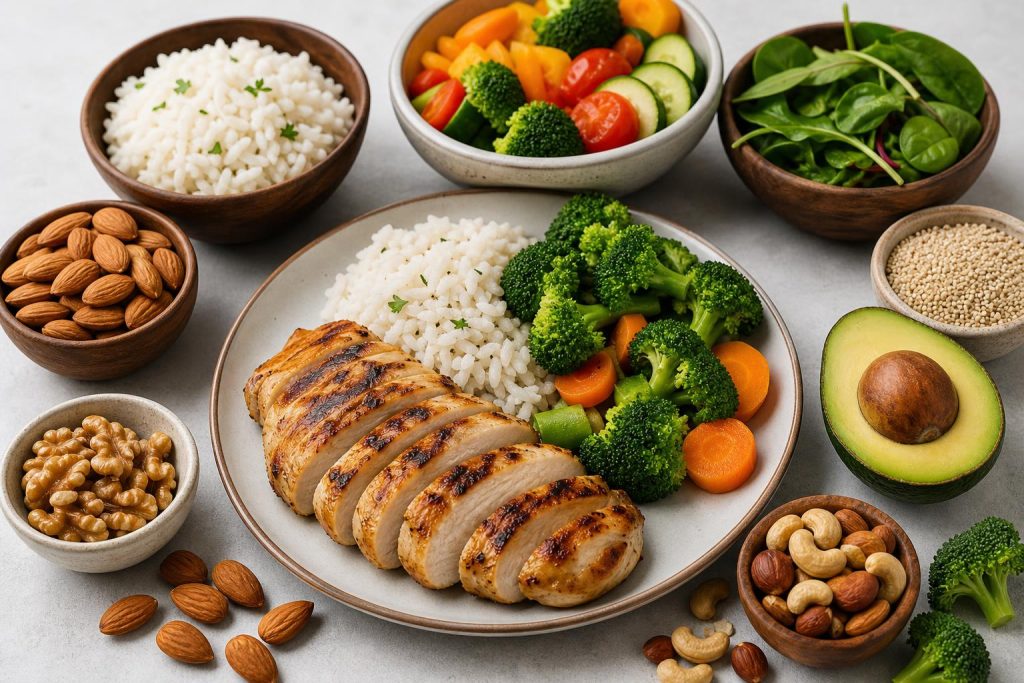
If there is one non-negotiable on tirzepatide, it is prioritizing protein at every single meal. When you’re eating significantly less total food, your body is at risk of entering a catabolic state — burning muscle for fuel alongside fat. Protein is your primary defense against that. Aim for a minimum of 1.2 to 1.6 grams of protein per kilogram of bodyweight daily, and if you’re actively resistance training, push toward the higher end of that range.
Practical protein anchors include eggs, Greek yogurt, cottage cheese, chicken breast, lean ground beef, salmon, shrimp, and protein shakes when solid food feels unappealing. Because tirzepatide slows gastric emptying, large high-fat meals can feel intensely uncomfortable. Smaller, protein-forward meals spaced throughout the day tend to work better — not because of some metabolic magic, but because they’re easier to actually eat and digest when your appetite is suppressed and your stomach empties slowly.
Fiber-rich vegetables — broccoli, spinach, zucchini, peppers, cucumbers — should fill the rest of your plate. They add volume and micronutrients without adding significant calories, and they support the gut motility that tirzepatide can slow down. Constipation is a real and common side effect; a high-fiber diet paired with adequate hydration is your first line of defense.
The Cardiovascular Case for Eating Clean
Here’s where the science gets genuinely compelling. Tirzepatide isn’t just a weight loss drug — it’s showing meaningful cardiovascular benefits that appear to be driven, at least in part, by its effects on fat depots around the heart. The SUMMIT CMR substudy found that tirzepatide reduced left ventricular mass by an average of 11 grams and decreased paracardiac adipose tissue by 45 mL compared to placebo in patients with obesity-related heart failure — and these changes tracked closely with weight loss itself.
Researchers have also identified that epicardial adipose tissue directly expresses GIP and GLP-1 receptors, meaning tirzepatide may act on heart fat directly — not just through systemic weight loss. suggests these receptor activations can shift epicardial fat toward a more metabolically healthy state, reducing ectopic fat accumulation around the heart.
What does this mean for your diet? It means doubling down on foods that support cardiovascular and metabolic health isn’t just good practice — it amplifies what tirzepatide is already doing mechanistically. Prioritize omega-3 rich fish like salmon and sardines at least twice a week. Incorporate extra virgin olive oil, avocado, nuts, and seeds as your primary fat sources. Limit ultra-processed foods, refined carbohydrates, and added sugars — not because they’ll cancel the medication, but because your reduced calorie budget is too valuable to waste on foods that do nothing for your heart, your hormones, or your muscle tissue.
Alcohol deserves a specific mention: tirzepatide slows gastric emptying, which can alter alcohol metabolism unpredictably. Many men report becoming intoxicated faster and more intensely. Beyond that, alcohol is calorie-dense, suppresses protein synthesis, and disrupts sleep — three strikes when you’re already working against a reduced food intake. Keep it minimal or cut it out entirely while your body adjusts.
The Takeaway
Tirzepatide creates an opportunity — a narrower caloric window that, used strategically, accelerates fat loss and improves cardiometabolic markers that diet alone rarely moves this quickly. But the medication does not choose what goes in your mouth. Anchor every meal around protein, fill the rest of your plate with fiber-dense whole foods, lean into heart-healthy fats, and treat every calorie as an investment rather than an afterthought. The drug suppresses appetite. You still have to provide the nutrition.
Scientific References
-
Kramer, Borlaug, Zile et al. (2025).
Tirzepatide Reduces LV Mass and Paracardiac Adipose Tissue in Obesity-Related Heart Failure: SUMMIT CMR Substudy..
Journal of the American College of Cardiology.
View on PubMed → -
Iacobellis et al. (2025).
Epicardial Fat Inflammation and GLP-1/GIP Receptor Analogs: Are we Shifting our Perspective?.
Current cardiology reports.
View on PubMed → -
Malavazos, Iacobellis, Dozio et al. (2023).
Human epicardial adipose tissue expresses glucose-dependent insulinotropic polypeptide, glucagon, and glucagon-like peptide-1 receptors as potential targets of pleiotropic therapies..
European journal of preventive cardiology.
View on PubMed → -
Camilleri et al. (2024).
The role of gastric function in control of food intake (and body weight) in relation to obesity, as well as pharmacological and surgical interventions..
Neurogastroenterology and motility.
View on PubMed → -
Yasui-Furukori, Tasaki, Kaiga et al. (2026).
Starvation ketosis following self-administered tirzepatide obtained via online services in a young woman later diagnosed with anorexia nervosa: a case report..
Journal of eating disorders.
View on PubMed →