Most men who’ve been through a serious cut — whether driven by diet alone, hard training, or a GLP-1 medication — know the frustration of stepping on the scale and wondering how much of that lost weight was actually fat. Research published in Advances in Nutrition confirms what many lifters have suspected: weight loss without a deliberate strategy to protect lean mass can significantly increase the risk of sarcopenia — the progressive loss of muscle mass and function that erodes strength, metabolic rate, and quality of life. The good news is that muscle loss during weight loss is not inevitable. It is, in large part, a problem that can be engineered away.
The Biological Forces Working Against Your Muscle
Understanding why muscle breaks down during a caloric deficit is the first step toward stopping it. When the body is in an energy-deprived state, it turns to stored fuel — and while body fat is the preferred target, muscle tissue is always on the table. The degree to which your body cannabilizes muscle depends on several factors: how aggressive your deficit is, how much protein you’re eating, how often you’re training, and even your hormonal environment.
At the molecular level, muscle loss is regulated by atrophy pathways that can be triggered by more than just dieting. A 2024 study in Advanced Biology identified how increased expression of miRNA-1 under physiological stress activates muscle degradation genes including FOXO3, myostatin, and atrogin — a cascade that accelerates skeletal muscle protein loss. While this study examined extreme hypoxia, the pathway itself is relevant to anyone under significant physiological stress, including prolonged caloric restriction. The message is clear: your body has built-in mechanisms to break muscle down, and it doesn’t take much to activate them.
Exercise itself also introduces a form of controlled muscle damage. Classic work by Armstrong in Medicine and Science in Sports and Exercise established that high-tension contractions — particularly eccentric movements like lowering a barbell or walking downhill — cause structural damage at the cellular level, disrupt calcium homeostasis, and trigger a localized inflammatory response. This is normal and necessary for adaptation. But without proper recovery nutrition and rest, repeated muscle damage without repair tips the balance toward net muscle loss rather than net muscle gain.
The Strategies That Actually Work
Resistance training is non-negotiable. It is the single most powerful stimulus for preserving lean mass during a cut. Lifting heavy — or at minimum, lifting with sufficient intensity — sends a survival signal to muscle tissue that diet alone cannot replicate. Compound movements like squats, deadlifts, rows, and presses should anchor your program. Frequency matters too: training each muscle group at least twice per week appears superior to once-weekly approaches for maintaining muscle protein synthesis when calories are restricted.
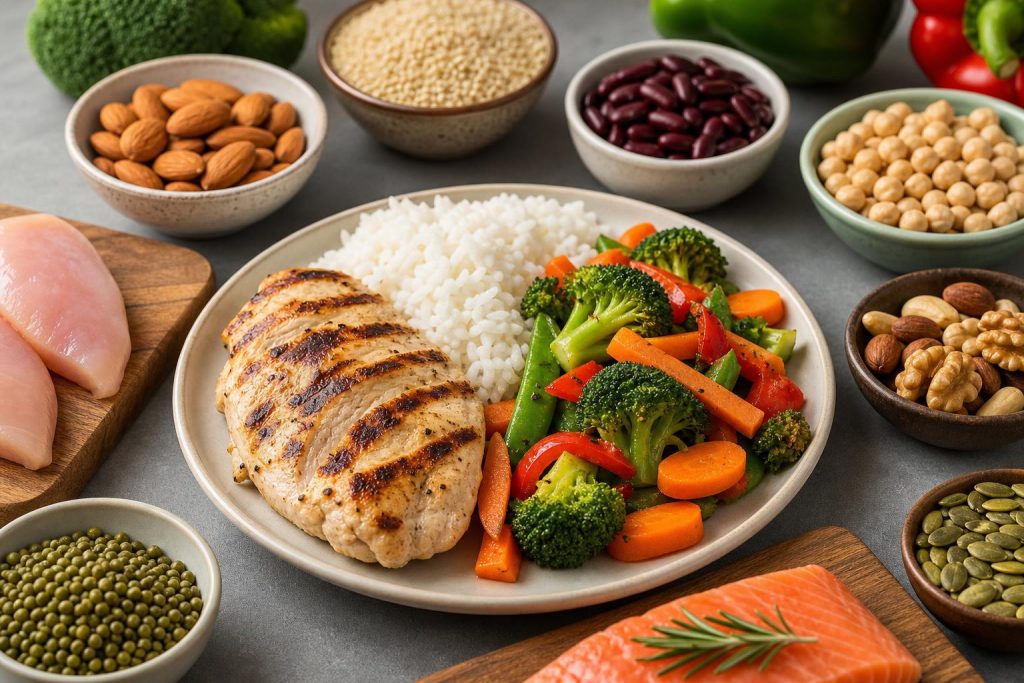
Protein intake is the next critical lever. The evidence consistently supports intakes of 1.6 to 2.2 grams of protein per kilogram of bodyweight per day when in a deficit — and some research suggests erring toward the higher end if you’re lean, older, or in an aggressive cut. Spreading protein across three to four meals, rather than concentrating it in one or two, helps maximize muscle protein synthesis throughout the day. Leucine-rich sources — eggs, chicken, beef, Greek yogurt, whey — should form the core of your intake.
Exercise also triggers the release of irisin, a myokine with remarkable muscle-protective effects. A comprehensive 2024 review in the International Journal of Molecular Sciences found that irisin improves mitochondrial function, reduces oxidative stress, and plays a role in the muscle-bone axis — with levels elevated in healthy, active individuals and reduced in disease states and sedentary populations. You don’t need a supplement to raise irisin; consistent resistance and aerobic exercise is the mechanism.
On the supplement side, creatine monohydrate has earned its reputation. A 2021 systematic review and meta-analysis in the Journal of Food Biochemistry found that creatine supplementation meaningfully supports recovery from exercise-induced muscle damage, reducing soreness and improving the rate at which muscle function is restored. At three to five grams per day, it remains one of the most cost-effective tools in any man’s stack. Sleep, often underestimated, is equally important — it is during deep sleep that growth hormone peaks and tissue repair accelerates. Cutting calories while shorting yourself on sleep is a reliable way to lose more muscle and less fat.
The Takeaway
Muscle loss during weight loss is common, but it is not mandatory. The men who come out of a cut leaner and stronger — not just lighter — are the ones who train with intention, hit their protein targets without compromise, recover seriously, and use evidence-backed supplements strategically. Whether you’re dieting through sheer discipline, a structured program, or with medical support, the fundamentals don’t change. Protect the muscle. Lose the fat. The biology will follow.
Scientific References
-
Cava, Yeat, Mittendorfer et al. (2017).
Preserving Healthy Muscle during Weight Loss..
Advances in nutrition (Bethesda, Md.).
View on PubMed → -
Paoletti, Coccurello et al. (2024).
Irisin: A Multifaceted Hormone Bridging Exercise and Disease Pathophysiology..
International journal of molecular sciences.
View on PubMed → -
Armstrong et al. (1984).
Mechanisms of exercise-induced delayed onset muscular soreness: a brief review..
Medicine and science in sports and exercise.
View on PubMed → -
Jiaming, Rahimi et al. (2021).
Creatine supplementation effect on recovery following exercise-induced muscle damage: A systematic review and meta-analysis of randomized controlled trials..
Journal of food biochemistry.
View on PubMed → -
Srivastava, Mondal, Rathor et al. (2024).
Increased Expression of MiRNA-1 Contributes to Hypobaric Hypoxia-Induced Skeletal Muscle Loss..
Advanced biology.
View on PubMed →