Muscle doesn’t disappear overnight — but it erodes faster than most men realize. Whether you’re cutting calories, aging past 40, recovering from illness, or simply not training with enough intention, the body is surprisingly willing to cannibalize its own lean tissue. What’s alarming is that research on spaceflight-induced muscle atrophy shows that even healthy, fit individuals can experience rapid sarcopenia when the right conditions — immobility, inflammation, caloric stress — align against them. The same molecular mechanisms that age astronauts in orbit are working on you right now, quietly, in the background. The good news: they’re not unstoppable.
Fighting muscle loss isn’t about one magic supplement or a single training hack. It’s about understanding the biology well enough to stack the deck in your favor — through protein timing, resistance training, and managing the inflammatory environment that quietly accelerates breakdown. Here’s what the evidence actually supports.
Protein Is Your First Line of Defense
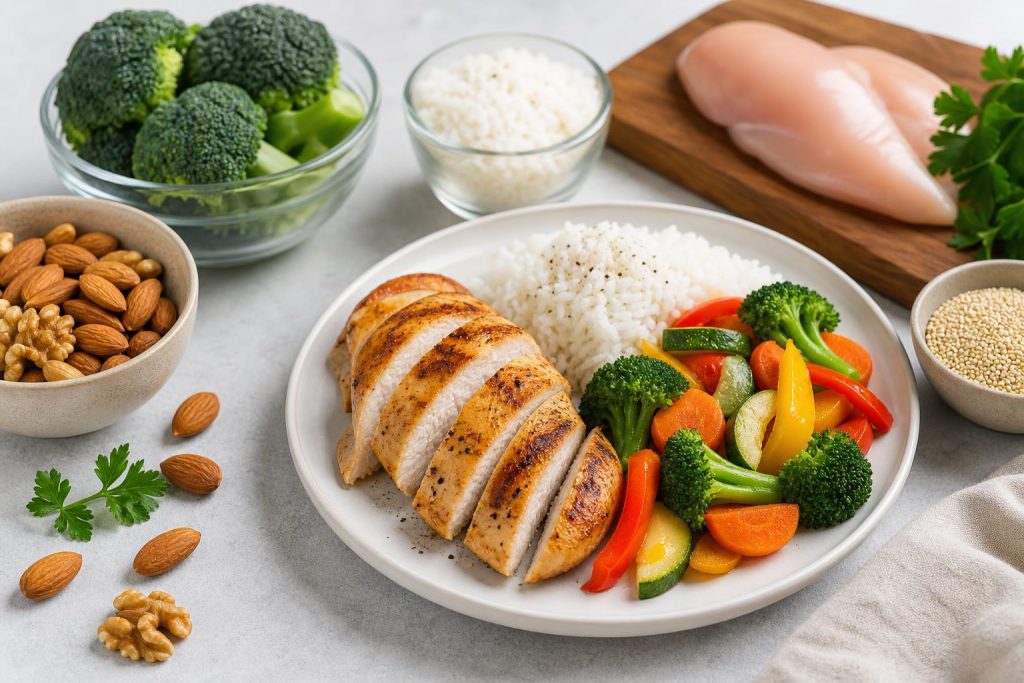
If there’s one variable that separates men who hold onto muscle during a fat loss phase from those who don’t, it’s protein — specifically, how much they eat and when they eat it. The research is clear enough that even guidelines written for female athletes underscore the universal principle: consuming high-quality protein as close to your training window as possible meaningfully reduces exercise-induced amino acid oxidative losses and accelerates muscle protein remodeling. The International Society of Sports Nutrition recommends doses in the range of 0.32–0.38 g per kilogram of bodyweight per meal around exercise — a target that translates to roughly 25–40 grams of a complete protein source like eggs, chicken, whey, or Greek yogurt for most men.
Beyond the peri-workout window, total daily protein intake matters enormously, especially during caloric restriction. Most evidence supports a target of 1.6 to 2.2 grams per kilogram of bodyweight per day for men actively trying to preserve or build lean mass. Spreading that across three to four meals — rather than front-loading or back-loading — keeps muscle protein synthesis elevated throughout the day and limits the catabolic valleys that emerge between meals.
Train to Send the Right Signal
Resistance training is the most powerful anabolic signal the human body responds to. Without it, no amount of protein will fully prevent lean tissue loss during a prolonged caloric deficit. The mechanism is straightforward: mechanical loading triggers intracellular pathways — primarily mTOR — that tell muscle cells to synthesize new protein rather than break it down. Dieting without lifting is essentially running muscle preservation on one engine instead of two.
For men focused on fat loss, two to four resistance training sessions per week, emphasizing compound movements like squats, deadlifts, rows, and presses, is enough stimulus to preserve — and in many cases grow — muscle tissue even in a meaningful caloric deficit. The key is progressive overload: your muscles need a reason to stay. If the training stimulus doesn’t challenge them, the body sees no metabolic argument for maintaining expensive tissue.
It’s also worth noting that dietary strategy interacts with training outcomes. Research on ketogenic diets and exercise performance suggests that while low-carb approaches can support fat loss and certain metabolic markers, they may present tradeoffs for high-intensity training capacity — which matters if your sessions are demanding enough to drive hypertrophy. Carbohydrate availability around training supports performance and, in turn, the muscle-preserving stimulus you’re after. Choose your dietary approach intentionally, knowing it affects how hard you can train.
Chronic inflammation is the underappreciated enemy of lean mass. Research on muscle wasting in catabolic states highlights that when inflammatory signaling pathways — particularly myostatin and activin — go unchecked, muscle breakdown accelerates regardless of caloric intake. You don’t need a disease state for inflammation to cost you muscle. Poor sleep, chronic stress, ultra-processed food, and sedentary behavior all elevate systemic inflammatory markers. Managing these variables through consistent sleep of seven to nine hours, stress reduction, and an anti-inflammatory dietary foundation — built on whole foods, omega-3 fats, and adequate micronutrients — is muscle preservation strategy as much as anything you do in the gym.
What This Means For You
Muscle loss is not inevitable — it’s a default that happens when you’re not actively working against it. Eat enough protein, time it around your training, lift with consistency and progressively increasing challenge, and address the lifestyle factors that keep inflammation chronically elevated. These aren’t complicated interventions. They’re the fundamentals that the research keeps returning to, regardless of whether you’re on a GLP-1, deep into a keto cut, or simply trying to stay strong as you age. The biology is the same. The response to the right inputs is reliable. Start there.
Scientific References
-
Sims, Kerksick, Smith-Ryan et al. (2023).
International society of sports nutrition position stand: nutritional concerns of the female athlete..
Journal of the International Society of Sports Nutrition.
View on PubMed → -
Little, Llorián-Salvador, Tang et al. (2020).
Macrophage to myofibroblast transition contributes to subretinal fibrosis secondary to neovascular age-related macular degeneration..
Journal of neuroinflammation.
View on PubMed → -
Lee, Glass et al. (2011).
Treating cancer cachexia to treat cancer..
Skeletal muscle.
View on PubMed → -
Capri, Conte, Ciurca et al. (2023).
Long-term human spaceflight and inflammaging: Does it promote aging?.
Ageing research reviews.
View on PubMed → -
Harvey, Holcomb, Kolwicz et al. (2019).
Ketogenic Diets and Exercise Performance..
Nutrients.
View on PubMed →