Here’s a number that should reframe how you think about weight loss on a GLP-1 medication: in a landmark 2021 trial published in The New England Journal of Medicine, participants using semaglutide lost an average of 14.9% of their body weight — but a significant portion of that loss included lean mass, not just fat. Research confirms that without deliberate nutritional strategy, aggressive caloric restriction — drug-assisted or not — can erode the muscle you’ve spent years building. That’s the real conversation nobody is having about Ozempic, and it applies just as much to anyone running a hard calorie deficit through traditional dieting.
Whether you’re using semaglutide, tirzepatide, or just grinding through a disciplined cut the old-fashioned way, the metabolic math is unforgiving. Eat too little without tracking what you’re eating, and your body will happily cannibalize muscle tissue for fuel. The appetite suppression that makes GLP-1 medications so effective is also what makes them nutritionally dangerous in the hands of someone who isn’t paying attention — because when you’re not hungry, you’re not just skipping calories, you’re skipping protein, micronutrients, and the raw material your muscles need to survive a deficit. But this isn’t just a GLP-1 problem. Any man running a significant calorie deficit without a structured macro framework is gambling with his body composition.
Macro tracking — logging your protein, carbohydrates, and fat intake against defined targets — is the infrastructure that separates a successful cut from a metabolic disaster. It’s not about obsession or perfection. It’s about giving yourself the data to make smart decisions when your hunger signals are suppressed, unreliable, or just plain noisy.
Understanding Your Calorie Deficit: How Deep Is Too Deep?
The foundational question in any fat loss phase is how large your deficit should be. Most evidence-based practitioners land somewhere between 300 and 700 calories below your total daily energy expenditure (TDEE) as the productive range for fat loss without excessive muscle catabolism. A 2017 meta-analysis found that more aggressive deficits beyond 700 calories per day significantly increased the proportion of lean mass lost relative to fat mass, which is the exact opposite outcome most men are chasing.
For GLP-1 users, this calculation becomes more complicated because the medication suppresses appetite to a degree that many men find themselves eating 1,000 to 1,400 calories per day without intending to — not out of discipline, but simply because they have no drive to eat. That kind of deficit, sustained over weeks or months, is a fast track to metabolic adaptation, muscle loss, fatigue, and nutritional deficiency. The medication is doing the appetite suppression work beautifully; the problem is that there’s no equivalent signal telling you when you’ve eaten enough of the right things.
The practical solution is to calculate your TDEE using a validated tool — the Mifflin-St Jeor equation remains one of the most accurate for men — and then set your calorie target deliberately, rather than letting hunger (or its absence) dictate intake. The Mifflin-St Jeor equation has been validated in multiple studies as the most accurate predictor of resting metabolic rate in overweight and normal-weight individuals. From there, apply a moderate deficit of 400 to 600 calories, and use macro tracking to ensure that every calorie you do consume is pulling maximum compositional weight.
For men who aren’t on GLP-1 medications, the same logic applies with a different set of challenges. Without appetite suppression, the deficit is harder to sustain behaviorally. Hunger wins most battles against willpower. This is precisely why macro tracking works so well as a behavioral anchor — it gives you something concrete to hit rather than relying on subjective feelings of fullness or deprivation. When you know you’ve hit your protein and fiber targets for the day, the structure itself reduces decision fatigue and late-night dietary implosion.
The Macro Framework That Protects Muscle During a Cut
If there is one macro that deserves to be treated as non-negotiable during any calorie deficit, it’s protein. The research is unambiguous and has been replicated across dozens of controlled trials. A 2012 study published in the American Journal of Clinical Nutrition demonstrated that higher protein intakes during caloric restriction — around 1.2 to 1.6 grams per kilogram of body weight — significantly attenuated lean mass loss compared to standard protein recommendations. For a 200-pound man, that translates to roughly 108 to 145 grams of protein per day at minimum — and many sports nutrition researchers now advocate pushing toward 1.8 to 2.2 grams per kilogram for men who are actively resistance training while in a deficit.
Hitting that protein target is the primary objective of macro tracking during a cut. Everything else — carbohydrates, fats — becomes secondary and somewhat flexible based on your preferences, training style, and how your body responds. High-protein diets also carry a significant thermodynamic advantage: protein has a thermic effect of food between 20 and 35%, meaning your body burns significantly more calories digesting protein than it does processing carbohydrates or fats, which effectively deepens your deficit without requiring you to eat less.
For fat allocation, the general evidence supports keeping dietary fat between 20 and 35% of total calories to maintain hormonal function — particularly testosterone production, which is highly sensitive to fat intake. Research has shown that diets with fat intake below 15% of total calories can suppress testosterone levels in men, which is the last thing you want when you’re trying to preserve muscle mass. Prioritize monounsaturated and omega-3 fats from sources like olive oil, avocado, fatty fish, and nuts — not because of fat loss mythology, but because they support inflammation management and hormonal signaling during a physiologically stressful cut.
Carbohydrates fill whatever caloric space remains after protein and fat targets are set, and they serve a critical function for men who are training hard: fueling glycolytic exercise and supporting muscle glycogen replenishment. Cutting carbs aggressively while in a calorie deficit and training with intensity is a recipe for flat, fatigued workouts and elevated cortisol. Unless you’re following a deliberate ketogenic protocol with the full physiological adaptation period, keep carbohydrates sufficient to support your training — typically 30 to 45% of calories, weighted toward complex, fiber-rich sources that support gut health and satiety.
For GLP-1 users specifically, the protein challenge is acute. When you’re only naturally drawn to eat 1,200 calories in a day, hitting 140 to 160 grams of protein requires intentionality bordering on strategy. Prioritizing protein at every meal and snack — leading with meat, eggs, Greek yogurt, cottage cheese, or a quality protein shake before anything else — is the most effective behavioral approach. Protein consumed at the beginning of a meal has been shown to enhance satiety signals and slow gastric emptying, which works in your favor when total intake is already compressed by medication.
Practical Tracking: Making the Data Work Without Losing Your Mind
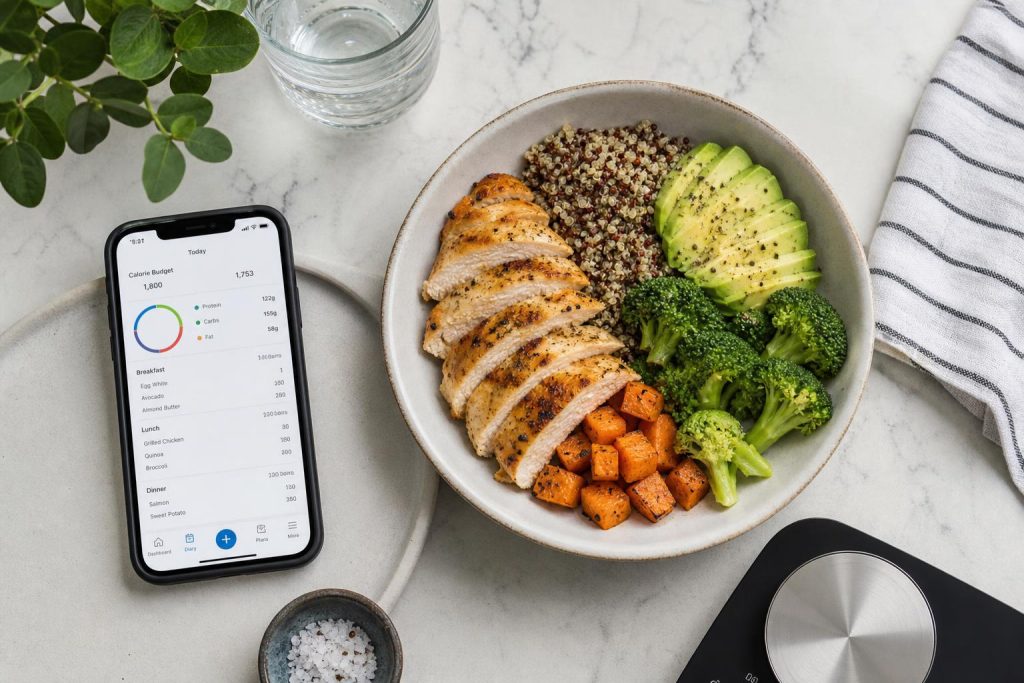
Macro tracking intimidates men who’ve never done it, and burns out men who take it too seriously. The goal is accuracy over precision — you need a realistic picture of your intake, not a laboratory-grade accounting of every calorie. Apps like Cronometer and MyFitnessPal make the logging process functional, though Cronometer’s database tends to be more nutritionally detailed for men focused on micronutrient adequacy alongside macros.
The most practical tracking system for a calorie deficit combines food scale use for calorie-dense items — oils, nuts, nut butters, cheese, meat — with reasonable estimations for low-density foods like vegetables, leafy greens, and most fruit. Weighing your chicken breast matters. Obsessing over the weight of your spinach does not. This distinction keeps tracking sustainable over weeks and months rather than something you white-knuckle for two weeks before abandoning.
Weekly averages are more meaningful than daily perfection. Research on dietary adherence has consistently found that flexible dietary control — allowing for day-to-day variance while meeting weekly targets — produces better long-term outcomes than rigid daily tracking, both in terms of fat loss and psychological relationship with food. If you hit 2,100 calories on Tuesday instead of 1,900, that doesn’t derail your week. If you consistently average 2,300 calories when your target is 1,900, the data tells you exactly where the drift is happening.
For GLP-1 users who are eating inconsistently due to medication-induced nausea or variable appetite across the week, weekly averaging is especially important. Some days you may barely manage 1,100 calories; others you’ll have more appetite. Tracking both prevents the silent accumulation of a deficit that’s too deep, and gives your clinician or coach actionable data during check-ins.
Protein distribution across meals also matters beyond just hitting a daily total. Studies examining muscle protein synthesis have found that distributing protein intake evenly across three to four meals — approximately 30 to 40 grams per meal — maximizes the anabolic stimulus compared to front- or back-loading protein in one or two large servings. In practical terms, this means your breakfast matters as much as your post-workout meal, and skipping it while in a GLP-1-suppressed appetite state is a compositional mistake, even if you aren’t hungry.
Resistance training during a calorie deficit is non-negotiable for muscle preservation — the macros and the training work together, not independently. A well-cited study found that resistance training combined with adequate protein intake during caloric restriction preserved significantly more lean mass than dietary intervention alone, regardless of the magnitude of the deficit. If you’re cutting calories and not lifting, you’re losing muscle. Period. Two to four sessions per week of progressive resistance training gives your body a reason to hold onto lean tissue when energy is scarce.
One practical macro strategy that many men find effective during cuts — particularly those on GLP-1 medications who struggle with total volume — is calorie cycling. This means setting a weekly calorie target and distributing it unevenly across days, with slightly higher calories and carbohydrates on training days and lower calories on rest days. Research on carbohydrate periodization suggests that matching carbohydrate intake to training demands can optimize training performance and body composition simultaneously during a deficit. For GLP-1 users, this also takes pressure off low-appetite days — if you genuinely can only eat 1,200 calories on a rest day, that’s more acceptable if your training days are hitting 1,800 to 2,000 calories with protein firmly intact.
Micronutrients deserve a brief but serious mention here. When total calorie intake drops, so does the volume of food — and with it, the density of vitamins and minerals your body depends on for hormonal function, immune health, and recovery. Studies have documented widespread micronutrient inadequacy in calorie-restricted diets, particularly for zinc, magnesium, vitamin D, and B vitamins — all of which are critically involved in testosterone synthesis, muscle protein synthesis, and energy metabolism. Prioritizing nutrient-dense whole foods over processed low-calorie alternatives is your first line of defense. A high-quality multivitamin, magnesium glycinate, and vitamin D3 with K2 serve as reasonable insurance, especially for men on significant calorie restriction.
What This Means For You
The men who come out of a fat loss phase — whether using Ozempic, running a traditional cut, or somewhere in between — looking leaner, stronger, and metabolically healthier than when they started all have one thing in common: they treated nutrition as a system, not an afterthought. They hit their protein. They kept their deficit measured. They trained with weights even when the scale was moving. And they tracked their intake with enough consistency to know when they were drifting off course.
Ozempic and its pharmaceutical cousins are genuinely powerful tools for appetite regulation and weight loss, and they have a legitimate place in the toolkit for men managing obesity or metabolic disease. But the medication doesn’t know the difference between fat and muscle. It doesn’t care whether you’re eating 80 grams of protein or 160. It won’t compensate for a deficit that’s become so deep it’s stripping your lean mass and cratering your metabolism. That’s your job — and macro tracking is the most practical instrument you have to do it well.
Start with your TDEE, set a moderate deficit, lock in your protein target first, and build everything else around it. Track consistently but not obsessively. Train hard enough to give your body a reason to protect its muscle. The math is patient. Follow it long enough, and the body composition you’re working toward becomes inevitable.