When researchers analyzed body composition data from the STEP trials — the landmark studies behind semaglutide’s approval — they found something that should give every man on Wegovy pause. A significant portion of the weight lost wasn’t fat. It was muscle. Studies show that lean mass can account for 25–40% of total weight lost during GLP-1 receptor agonist therapy, a ratio that mirrors what happens during aggressive caloric restriction without adequate protein or resistance training. That’s not a minor footnote — that’s the difference between looking and feeling transformed versus just being a smaller, weaker version of yourself.
Wegovy works by suppressing appetite through GLP-1 receptor activation, which meaningfully reduces how much you want to eat. For most men, that means consuming 500 to 1,000 fewer calories per day without much effort. But here’s the metabolic catch: your body doesn’t inherently know to spare muscle when it’s running on a calorie deficit. Without a deliberate strategy around protein, you’re essentially letting your body cannibalize tissue it took years to build. The drug creates the opportunity for fat loss — your nutrition and training determine whether you actually use that opportunity well.
Why Protein Becomes Even More Critical in a Caloric Deficit
Dietary protein does several things that become especially important when you’re eating less. It provides the amino acids your muscles need for repair and growth. It triggers muscle protein synthesis — the process by which muscle tissue is built and maintained. And it’s the most satiating macronutrient, meaning it keeps you full longer and makes the reduced appetite from Wegovy even more manageable. Research has consistently demonstrated that higher protein intakes during caloric restriction preserve lean mass better than moderate or low protein diets, regardless of whether someone is on a medication or not.
The general recommended dietary allowance for protein sits at 0.8 grams per kilogram of body weight — a number designed to prevent deficiency, not optimize performance or body composition. For men in a caloric deficit, especially those using Wegovy, that floor is dangerously low. A 2017 meta-analysis found that protein intakes of 1.6 grams per kilogram or higher were associated with significantly greater lean mass preservation during energy restriction. Some sports science literature pushes that number even higher — toward 2.2 grams per kilogram — when resistance training is part of the picture. A practical target for most men is somewhere between 1.6 and 2.4 grams per kilogram of body weight per day, erring toward the higher end if you’re lifting weights.
If you weigh 220 pounds (about 100 kg), that translates to roughly 160 to 240 grams of protein daily. That’s a meaningful commitment, especially when your appetite is blunted. Wegovy can make it easy to skip meals or subsist on small portions that feel satisfying in the moment but leave you chronically under-fueled. This is where intentionality matters more than instinct. You can’t rely on hunger cues alone to guide your eating when the medication has fundamentally altered those cues.
How to Actually Hit Your Protein Goals When You’re Not That Hungry
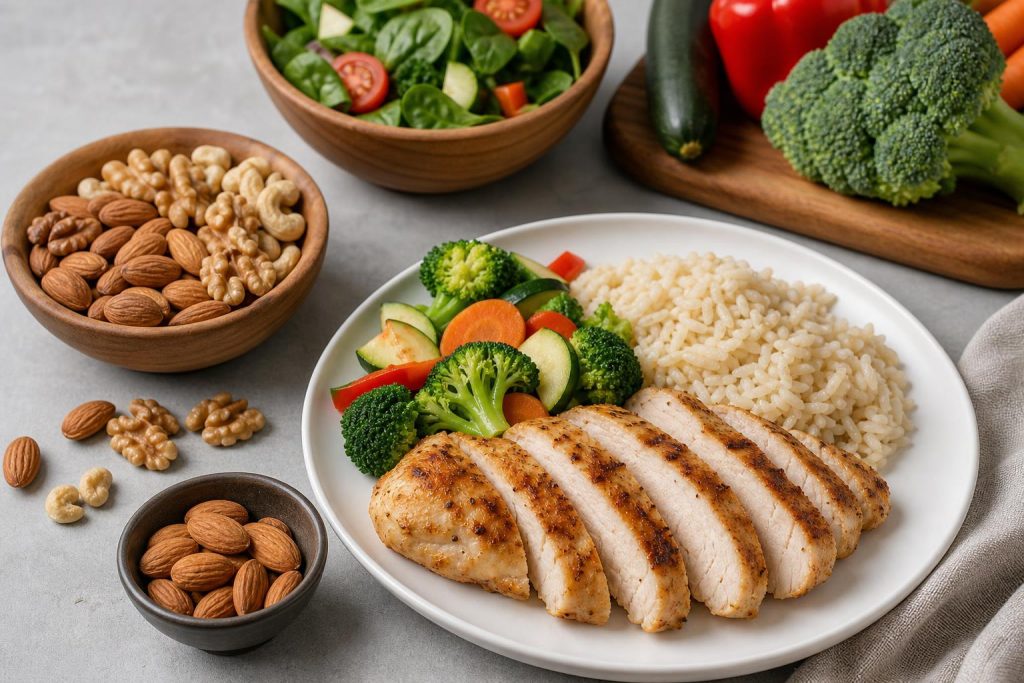
The strategy here is straightforward even if the execution takes some discipline. Prioritize protein at every meal — build the plate around it rather than treating it as a side consideration. Eggs, Greek yogurt, cottage cheese, chicken breast, ground turkey, canned salmon, and lean beef are all high-quality sources that provide substantial protein per calorie, which matters when your total intake is reduced. Animal-based proteins tend to have superior leucine content and bioavailability compared to most plant sources, and leucine in particular is the key amino acid that triggers muscle protein synthesis. That doesn’t mean plant proteins are useless — it means that if you’re relying heavily on plant sources, you need to eat more of them and potentially combine them strategically.
Protein shakes are a legitimate and practical tool here, not a shortcut. When you’re not particularly hungry but know you need 50 more grams of protein before the day ends, a well-formulated whey or casein shake gets the job done without requiring you to force down a full meal. Whey protein is rapidly absorbed and has excellent leucine content, making it particularly useful post-workout. Casein digests more slowly and works well before bed or between meals when you want sustained amino acid availability.
Meal timing matters less than total daily intake, but there is evidence supporting protein distribution across meals rather than loading it all in one sitting. Research suggests that muscle protein synthesis is maximized when protein is spread across three to four meals rather than consumed in one or two large doses. Aim for roughly 40 to 60 grams per meal if you’re eating three times a day, or 30 to 40 grams if you’re doing four smaller meals. Either approach works — the point is consistency across the day.
Resistance training is the non-negotiable complement to high protein intake. No amount of dietary protein will fully preserve muscle if you’re not giving your body a reason to keep it. Even two to three sessions per week of compound movements — squats, deadlifts, rows, presses — send a powerful anabolic signal that tells your body muscle is an asset worth maintaining. The combination of adequate protein and resistance exercise has been shown to preserve and even build lean mass during significant caloric restriction, which is the outcome every man on Wegovy should be working toward.
The Takeaway
Wegovy is a powerful tool for creating the caloric deficit that drives fat loss. But a drug doesn’t decide what you lose — your protein intake and training habits do. Men who treat protein as a priority and keep lifting throughout their weight loss phase come out the other side leaner, stronger, and metabolically healthier than those who simply ride the appetite suppression down the scale. The research is clear: aim for at least 1.6 grams of protein per kilogram of body weight daily, distribute it across your meals, and pair it with resistance training. That’s how you turn weight loss into body recomposition — and how you make the results actually last.