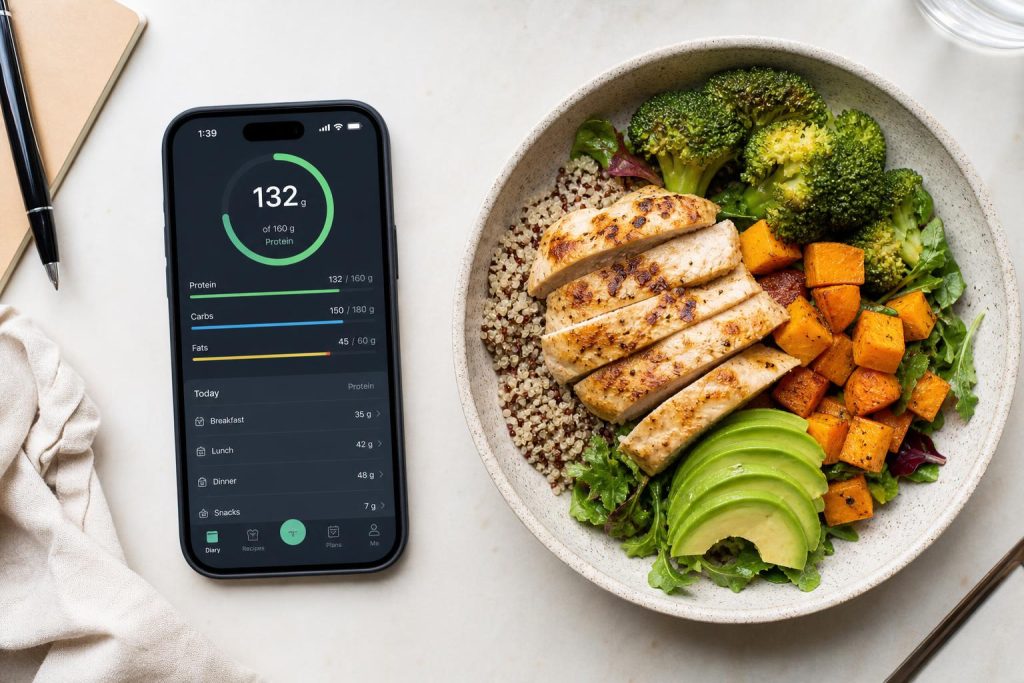
When semaglutide suppresses your appetite by 20–30% and clinical trials show weight losses approaching 15%, the math sounds simple — eat less, lose weight, done. But there’s a problem hiding inside that weight loss number. A significant portion of what you lose on GLP-1 medications isn’t fat. It’s muscle. And the single most important lever you have to change that outcome is protein intake.
Research published in Nature Metabolism confirms that semaglutide and tirzepatide represent a genuine breakthrough in obesity medicine — normalizing blood sugar and driving meaningful fat loss in ways that were previously out of reach. But breakthrough weight loss still follows the same physiological rules as any caloric deficit: your body will cannibalize lean tissue if you don’t give it a reason — and the raw material — to hold onto it. That’s where your protein goal becomes non-negotiable.
Why Protein Matters More When You’re on Semaglutide
Semaglutide works by mimicking glucagon-like peptide-1, a hormone that slows gastric emptying, reduces appetite signaling in the brain, and lowers overall caloric intake. A 2024 systematic review and meta-analysis found that GLP-1 receptor agonists produce an average weight loss of nearly 8.77 kg in people with obesity — alongside meaningful improvements in blood pressure and lipid profiles. That’s genuinely impressive. But reduced appetite is a double-edged sword. When you’re eating significantly less food overall, hitting an adequate protein target becomes harder, not easier.
The risk is muscle loss. In any caloric deficit, your body breaks down both fat and lean mass for fuel. The deeper the deficit — and semaglutide can create a steep one — the greater the threat to muscle. For men, this matters beyond aesthetics. Muscle mass is directly tied to metabolic rate, insulin sensitivity, functional strength, and long-term health. Losing it during weight loss sets you up for the classic rebound: a slower metabolism, less capacity to burn fat, and higher risk of regaining weight the moment the medication stops or the diet ends.
The solution isn’t complicated, but it requires intentionality. Most sports nutrition researchers and clinical dietitians now converge on a target of 1.6 to 2.2 grams of protein per kilogram of body weight per day for individuals in a caloric deficit who are engaging in resistance training. For a 200-pound (91 kg) man, that translates to roughly 145 to 200 grams of protein daily. If you’re sedentary, the lower end of that range — around 1.2 to 1.6 g/kg — still far exceeds the basic RDA of 0.8 g/kg, which was designed to prevent deficiency, not preserve muscle during aggressive fat loss.
How to Hit Your Protein Target When Appetite Is Suppressed
This is where semaglutide users face a practical challenge that traditional dieters don’t: you may not feel hungry enough to eat a chicken breast, let alone three meals with meaningful protein at each. The strategy, then, is to make every bite count. Protein-dense, lower-volume foods become your best allies — Greek yogurt, eggs, cottage cheese, lean meats, whey protein, and canned fish are all high in protein relative to their caloric and volume footprint. A single scoop of whey protein isolate delivers 25 grams of protein in a few sips. That’s not cheating — it’s smart nutrition engineering for a suppressed appetite.
A 2025 precision obesity medicine framework published in the Journal of Endocrinological Investigation specifically highlights that preserving lean mass in older and sarcopenic individuals requires both resistance training and adequate protein intake alongside anti-obesity medications. That principle doesn’t stop applying at age 40 or 30. If you’re losing weight — by any method — resistance training combined with high protein intake is the evidence-based strategy to ensure what you’re losing is fat, not the muscle you’ve worked to build.
Distribute your protein intake across three to four eating occasions rather than trying to front-load or back-load it. Muscle protein synthesis responds best to repeated leucine-rich protein doses throughout the day. Aim for at least 30 to 40 grams of protein per meal if your total daily target is in the 150–180 gram range. Track for at least the first few weeks — most men are genuinely surprised by how far short they fall when appetite is blunted and food volume drops.
One legitimate safety note: emerging research has flagged a potential concern around semaglutide use in individuals with certain neuroendocrine neoplasms expressing GLP-1 receptors. This is a niche but real consideration — if you have a history of neuroendocrine tumors, discuss semaglutide use explicitly with your physician before starting.
The Takeaway
Semaglutide can be a powerful tool for fat loss. But the medication doesn’t determine whether you lose fat or muscle — your protein intake and training do. Set a daily protein target of at least 1.6 g/kg of your body weight, prioritize high-density protein sources that won’t overwhelm a suppressed appetite, and pair your weight loss with resistance training. The goal isn’t just a lower number on the scale. It’s a leaner, stronger, more metabolically resilient version of yourself — and that requires protein, whether you’re on a GLP-1 or not.
Scientific References
-
France, Syed et al. (2024).
Tirzepatide: A Review in Type 2 Diabetes..
Drugs.
View on PubMed → -
Holst et al. (2024).
GLP-1 physiology in obesity and development of incretin-based drugs for chronic weight management..
Nature metabolism.
View on PubMed → -
Ansari, Qazi, Sajid et al. (2024).
Efficacy and Safety of Glucagon-Like Peptide-1 Receptor Agonists on Body Weight and Cardiometabolic Parameters in Individuals With Obesity and Without Diabetes: A Systematic Review and Meta-Analysis..
Endocrine practice : official journal of the American College of Endocrinology and the American Association of Clinical Endocrinologists.
View on PubMed → -
Tuccinardi, Masi, Watanabe et al. (2025).
Precision obesity medicine: A phenotype-guided framework for pharmacologic therapy across the lifespan..
Journal of endocrinological investigation.
View on PubMed → -
Shilyansky, Chan, Xiao et al. (2025).
GLP-1R agonist promotes proliferation of neuroendocrine neoplasm cells expressing GLP-1 receptors..
Surgery.
View on PubMed →