Here’s a number worth sitting with: after age 30, men lose roughly 3–8% of their muscle mass per decade — and that rate accelerates sharply after 60. But age isn’t the only thief. Aggressive calorie restriction, prolonged cardio, poor sleep, and inadequate protein can strip muscle from men at any age, in any decade. A 2017 review published in Nutrients found that muscle loss during weight loss interventions is not only common but substantially underestimated — and that most standard dieting protocols fail to adequately protect lean tissue. That failure has real consequences: lost muscle means a slower metabolism, reduced strength, higher injury risk, and a body composition that looks worse even at a lower scale weight.
The good news is that muscle loss is largely preventable. Not through supplements or shortcuts, but through a handful of well-researched strategies that work across different approaches — whether you’re cutting calories, using a GLP-1 medication, doing extended cardio training, or simply trying to age better. The science here is consistent and actionable. What follows is what the research actually says about keeping muscle while the fat comes off.
Protein Is the Non-Negotiable Foundation
If there is one variable that research consistently identifies as the most powerful lever for muscle preservation, it’s dietary protein. The mechanism is straightforward: muscle protein synthesis — the biological process by which your body builds and repairs muscle tissue — is directly stimulated by amino acid availability, particularly leucine. When protein intake falls short, especially during a caloric deficit, the body has no choice but to break down existing muscle to meet its amino acid demands.
A landmark study in the Journal of Nutrition demonstrated that a higher protein intake during caloric restriction — specifically around 2.4 grams per kilogram of body weight — led to significantly greater preservation of lean mass compared to lower protein intakes, even when total calories were matched. The implication is important: it’s not just about eating less, it’s about eating enough of the right macronutrient.
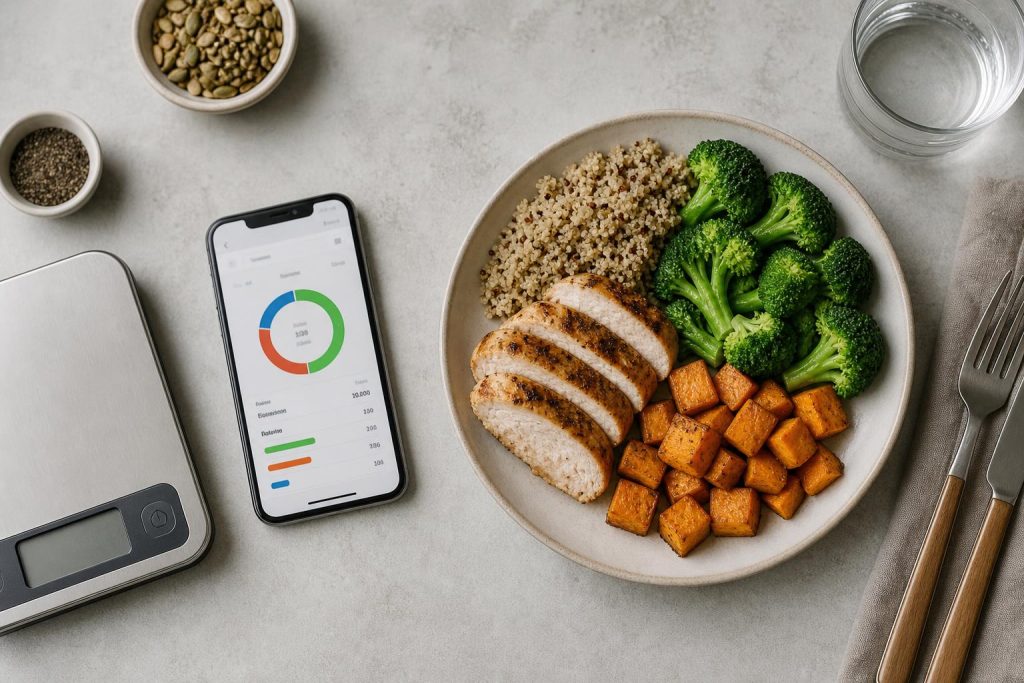
For most active men, a practical target sits between 1.6 and 2.2 grams of protein per kilogram of bodyweight per day — closer to the upper end during aggressive cuts or when training volume is high. The timing matters too. Research in the American Journal of Clinical Nutrition has shown that distributing protein evenly across three to four meals — rather than loading it into one or two — maximizes muscle protein synthesis throughout the day. Leucine-rich sources like eggs, chicken, beef, Greek yogurt, and whey protein are particularly effective at triggering this anabolic response.
Men using appetite-suppressing tools — including GLP-1 receptor agonists, which significantly reduce hunger — should be especially intentional about protein. Eating less doesn’t automatically mean eating less muscle-damaging food. It means every bite has to count, and protein should be the first priority on the plate, not an afterthought.
Resistance Training Is the Only True Muscle Preserving Signal
Diet creates the environment. Training sends the signal. No amount of protein consumption fully protects muscle if the mechanical stimulus to maintain it isn’t present. Resistance training — lifting weights, performing bodyweight exercises, or using machines — activates mTOR signaling pathways and satellite cells that are directly responsible for muscle maintenance and growth. Without that stimulus, the body treats muscle as metabolically expensive tissue it can afford to lose.
A study published in Medicine & Science in Sports & Exercise found that resistance training during a caloric deficit was significantly more effective at preserving lean mass than diet alone or diet combined with aerobic exercise. The takeaway isn’t that cardio is bad — it isn’t — but that resistance training is irreplaceable when muscle preservation is the goal.
The minimum effective dose appears to be two to three sessions per week, targeting major muscle groups with sufficient intensity — meaning sets taken close to muscular failure. Volume and frequency matter, but consistency matters more. A man who lifts three days a week for six months will preserve far more muscle than one who follows a perfect program for three weeks and then stops. Progressive overload — gradually increasing weight, reps, or difficulty over time — is what keeps the anabolic stimulus strong even as the body adapts.
For men who also do significant cardio, particularly endurance training or high-volume zone 2 work, prioritizing resistance sessions earlier in the week and separating them from long cardio bouts helps minimize the interference effect that has been documented in the scientific literature. The two modalities can absolutely coexist — but the programming has to be intentional.
Sleep, Stress, and the Hormonal Environment That Determines Whether Muscle Stays or Goes
Two variables that don’t get nearly enough attention in the muscle preservation conversation are sleep and cortisol. Both have a direct and measurable impact on the hormonal milieu that governs whether your body is in a muscle-building or muscle-breaking state.
Research published in Annals of Internal Medicine found that sleep restriction — even just reducing sleep from 8.5 to 5.5 hours per night — significantly reduced fat loss and increased the proportion of muscle loss during a caloric deficit. Subjects who slept less lost more muscle and less fat, even though they were eating the same amount. The mechanism involves cortisol, ghrelin, and suppressed anabolic hormone secretion — all of which shift the body toward catabolism when sleep is chronically short.
Chronic psychological stress compounds this effect. Elevated cortisol is directly catabolic to muscle tissue. It upregulates protein breakdown while simultaneously impairing testosterone and IGF-1 signaling — two of the primary anabolic hormones in men. This is why a man under extreme work stress, sleeping five hours a night and training hard, often loses more muscle than he should despite doing everything else right. Managing stress — whether through structured recovery, reduced training volume during high-stress periods, or lifestyle adjustments — is not soft advice. It’s physiology.
Creatine monohydrate deserves a mention here as one of the most thoroughly studied and effective supplements for supporting muscle preservation. A meta-analysis in the Journal of Strength and Conditioning Research confirmed that creatine supplementation combined with resistance training leads to significantly greater lean mass retention than training alone. It’s not a magic bullet, but at three to five grams per day, it’s one of the few supplements that consistently earns its place in the stack.
The Takeaway
Muscle loss is not inevitable — it’s largely a product of controllable inputs. Get enough protein, distributed across your day. Lift weights consistently and with enough intensity that your body has a reason to hold onto what it has. Sleep like it matters, because the research says it does. Keep cortisol from running the show. These aren’t complex interventions. They’re the fundamentals executed with intention. Whether you’re in a significant cut, using a medication that reduces your appetite, or simply trying to look and feel better as you age, the principles are the same. Muscle doesn’t disappear without cause — and when you understand the causes, you have the power to stop them.