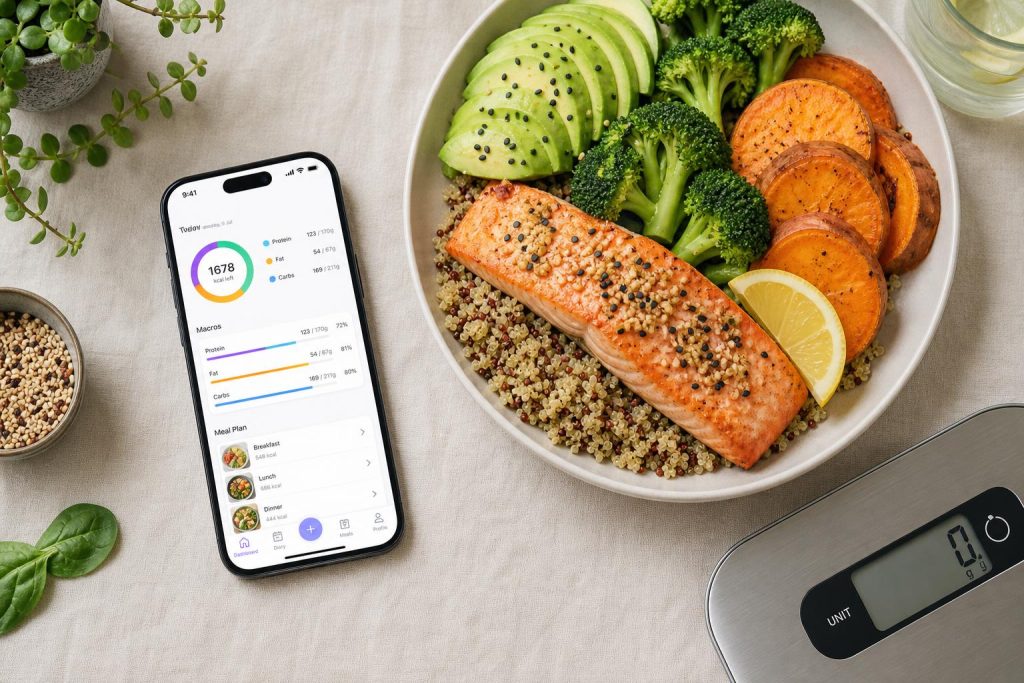
A landmark 2022 meta-analysis published in Obesity Reviews found that dietary fat quality — not simply quantity — was among the strongest predictors of metabolic outcomes in men undergoing caloric restriction. Yet most nutrition advice still treats fat as a dial to turn up or down based on whatever macronutrient trend is dominating the conversation. For men using GLP-1 receptor agonists like semaglutide or tirzepatide, this matters even more: appetite suppression changes the game, but it doesn’t write the rules. The rules are still written by your biology.
Whether you’re on a GLP-1 medication, grinding through a traditional cut, eating keto, or just trying to build a leaner body without overthinking it — fat intake is one of the most mismanaged macronutrients in men’s nutrition. Get it right and you support hormones, brain function, cardiovascular health, and body composition simultaneously. Get it wrong and you’re either starving your endocrine system or drowning your caloric budget in a macro that, gram for gram, packs more than twice the energy of protein or carbohydrates.
Why Fat Is Non-Negotiable — Regardless of Your Approach
Dietary fat serves functions that no other macronutrient can replicate. It is the structural backbone of every cell membrane in your body, the precursor to steroid hormones including testosterone, and the transport vehicle for fat-soluble vitamins A, D, E, and K. Research published in the Journal of Clinical Endocrinology & Metabolism demonstrated a significant positive correlation between dietary fat intake — particularly saturated and monounsaturated fat — and serum testosterone levels in healthy men. Drop fat too low and you’re not just losing calories; you’re suppressing the very hormone most responsible for muscle preservation and libido.
This is especially critical during any aggressive caloric deficit. Men pursuing fat loss often make the mistake of slashing dietary fat in the name of cutting calories, not realizing that fat provides roughly 9 calories per gram compared to 4 for protein and carbohydrates. A more surgical approach — keeping fat at a purposeful minimum floor, not an accidental floor — protects hormonal output while still creating the deficit needed for meaningful fat loss. Most evidence-based practitioners recommend keeping dietary fat at no lower than 20% of total caloric intake, with many endocrinologists suggesting 25–35% as the optimal range for maintaining testosterone and hormonal health in men during a cut.
The type of fat consumed matters just as much as the amount. A 2016 meta-analysis in PLOS ONE found that replacing saturated fats with polyunsaturated fats — specifically omega-3 and omega-6 fatty acids — was associated with reduced cardiovascular risk markers without adverse effects on testosterone in metabolically healthy men. Monounsaturated fats, found in olive oil, avocado, and nuts, showed particularly favorable effects on both lipid profiles and insulin sensitivity. For men focused on metabolic health, this means the Mediterranean-style fat framework — high in MUFAs and omega-3s, moderate in saturated fat, low in trans fats — remains one of the most evidence-supported dietary patterns available.
Optimal Fat Ratios for Fat Loss, Muscle Preservation, and Metabolic Health
There is no universal macro ratio that works identically for every man, but the research does converge on a workable framework. For a man in a moderate caloric deficit — say, 300 to 500 calories below maintenance — a target of approximately 25–30% of calories from fat, 30–35% from protein, and the remainder from carbohydrates offers a solid starting point. This isn’t dogma; it’s a starting position you adjust based on response.
Protein remains the non-negotiable anchor. Research in the Journal of the Academy of Nutrition and Dietetics and multiple subsequent trials have confirmed that higher protein intakes — in the range of 1.6 to 2.2 grams per kilogram of body weight — are necessary to preserve lean mass during caloric restriction. Once protein is set, fat and carbohydrates fill the remaining caloric space, and this is where individual context matters. Men who train with weights and respond well to carbohydrate-driven performance may keep fat closer to 20–25% to free up room for glycogen replenishment. Men following a ketogenic or low-carbohydrate approach may push fat to 60–70% of calories, relying on fat oxidation as the primary fuel source.
For men on GLP-1 medications, there’s a specific wrinkle worth addressing. Semaglutide and tirzepatide significantly reduce appetite and slow gastric emptying, which means total food volume drops — sometimes dramatically. When you’re eating 1,400 to 1,800 calories instead of your previous 2,800, every macronutrient choice becomes a high-stakes decision. A 2023 analysis in Diabetes, Obesity and Metabolism noted that GLP-1 receptor agonist users who did not prioritize protein and micronutrient-dense foods during treatment showed disproportionate losses of lean mass compared to non-medicated caloric restriction groups. The implication for fat intake is direct: fat cannot crowd out protein, and it cannot crowd out nutrient density. High-calorie, low-nutrition fat sources — fried foods, processed seed oils, pastries — become even more costly when your daily caloric window is narrow.
Practically speaking, a GLP-1 user eating 1,600 calories who targets 30% of calories from fat is working with approximately 53 grams of fat per day. That’s enough for two tablespoons of olive oil, a quarter of an avocado, a handful of almonds, and the fat naturally occurring in lean meats and eggs — a reasonable and nutritionally complete fat allocation that leaves ample room for 130–160 grams of protein. Men not on medication but in a similar deficit face the same math; the principles don’t change, only the appetite enforcement mechanism does.
One often-overlooked dimension is the role of omega-3 fatty acids in body composition beyond cardiovascular health. A randomized controlled trial published in the Journal of the International Society of Sports Nutrition found that supplementation with 4 grams per day of fish oil for six weeks was associated with significant increases in lean mass and reductions in fat mass in healthy young adults, effects attributed in part to omega-3’s role in stimulating muscle protein synthesis via mTOR signaling. Whether you’re eating salmon three times a week or supplementing with a quality fish oil, ensuring adequate omega-3 intake — targeting at least 2–3 grams of combined EPA and DHA daily — is one of the higher-leverage nutritional moves available for men serious about body composition.
The Fat Sources Worth Building Your Diet Around
Quality over quantity is the most accurate frame for dietary fat. The difference between a man who gets 30% of his calories from extra virgin olive oil, fatty fish, eggs, and avocado versus one who hits the same percentage with processed dressings, fast-food oils, and cheese-heavy convenience foods is enormous — not just cardiovascularly, but in terms of inflammation, insulin sensitivity, and long-term metabolic function.
Extra virgin olive oil deserves its status as the single most studied fat source in longevity and cardiovascular research. The PREDIMED trial, one of the largest dietary intervention studies ever conducted, demonstrated that a Mediterranean diet supplemented with extra virgin olive oil significantly reduced major cardiovascular events compared to a low-fat control diet — a finding so robust the trial was stopped early on ethical grounds. For men in midlife focused on both body composition and long-term health, making EVOO the default cooking and dressing fat is one of the simplest, most evidence-backed decisions available.
Whole food fat sources — eggs, fatty fish like salmon and sardines, nuts, seeds, and avocado — also carry protein, micronutrients, and fiber that isolated fats and oils do not. This is particularly relevant for men managing reduced appetite, whether from medication or a disciplined diet: whole food fats provide more nutritional return per calorie than extracted oils or processed fat sources. Saturated fat from whole food sources like eggs and minimally processed red meat has become less villainized in recent literature, with a major meta-analysis in the American Journal of Clinical Nutrition finding no significant association between saturated fat intake and cardiovascular disease risk when analyzed independently of refined carbohydrate displacement. Context matters: saturated fat replacing refined carbohydrates behaves very differently metabolically than saturated fat added on top of an already high-carbohydrate diet.
The fats most consistently linked to harm remain artificial trans fats — largely removed from the food supply but still present in some processed foods — and excessive omega-6 linoleic acid from refined vegetable oils like corn, soybean, and sunflower oil, particularly when consumed in a ratio heavily skewed against omega-3s. The ideal omega-6 to omega-3 ratio is estimated to be somewhere between 4:1 and 1:1; the average Western diet sits closer to 15:1 to 20:1. This imbalance promotes a chronic low-grade inflammatory state that undermines recovery, insulin sensitivity, and cardiovascular health over time. Correcting it through increased fatty fish consumption or high-quality EPA/DHA supplementation is one of the most impactful dietary adjustments a man can make regardless of what macro framework he follows.
The Takeaway
Fat intake doesn’t need to be feared or worshipped. It needs to be calibrated. For most men — whether cutting calories the old-fashioned way, following a structured ketogenic protocol, or navigating the appetite-suppressing effects of a GLP-1 medication — the optimal fat intake sits somewhere between 20–35% of total calories, prioritizing monounsaturated and omega-3-rich sources, keeping saturated fat moderate and from whole food origins, and ruthlessly eliminating refined vegetable oils and trans fats wherever possible. Protein sets the foundation. Carbohydrates flex with training demands. Fat holds everything together — hormonally, metabolically, structurally.
The men who get this right don’t just lose fat more effectively. They preserve muscle, protect long-term cardiovascular function, maintain the hormonal environment that makes training productive, and build a dietary pattern that’s sustainable beyond the next twelve weeks. That’s the actual goal — not perfecting a ratio on a spreadsheet, but building a body and a metabolism that works for decades.