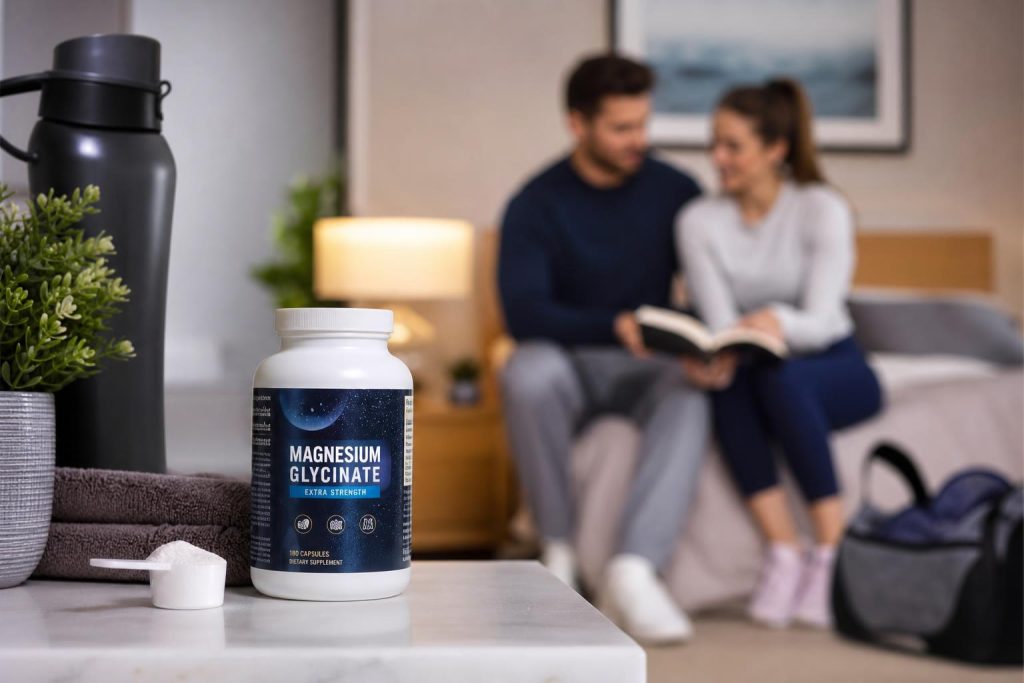
Most men are sleeping worse than they think. Not just fewer hours — worse quality, less deep sleep, more nighttime cortisol, and a nervous system that never fully downshifts. The consequences stack up fast: impaired testosterone production, elevated hunger hormones, slower muscle recovery, and a metabolism that fights you at every turn. What’s driving this quiet epidemic? For a significant portion of the population, the answer starts with a mineral deficiency that rarely shows up on a standard blood panel.
Magnesium deficiency is staggeringly common. Estimates suggest that nearly half of Americans fail to meet the recommended daily intake, and the problem is worse among men with metabolically demanding lifestyles — heavy training, caloric restriction, high stress, or any condition that accelerates urinary magnesium excretion. Among the various forms of supplemental magnesium available, magnesium glycinate has emerged as the clinical favorite for sleep and nervous system support. Here’s what the research actually shows, and how to use it intelligently as part of a serious recovery strategy.
What Magnesium Actually Does in the Body — And Why Most Men Don’t Have Enough
Magnesium is involved in over 300 enzymatic reactions, but its role in sleep and neurological function is where the research gets particularly compelling. The mineral acts as a natural antagonist to NMDA receptors — the same glutamate receptors responsible for excitatory neural activity. By blocking these receptors, magnesium effectively quiets the nervous system, making it physiologically easier to fall asleep and stay asleep. It also potentiates GABA, the brain’s primary inhibitory neurotransmitter. Think of magnesium as a biological brake pedal for a nervous system that, in most driven men, is pressed to the accelerator all day.
Beyond its neurological role, magnesium is essential for regulating cortisol. Research has demonstrated that magnesium deficiency increases stress reactivity and elevates cortisol secretion, which creates a vicious cycle: stress depletes magnesium, low magnesium raises stress hormones, elevated cortisol disrupts sleep, and poor sleep further impairs the body’s ability to regulate both. For men managing high workloads, intense training schedules, or periods of significant caloric deficit — including those on GLP-1 receptor agonists like semaglutide or tirzepatide who are eating substantially less — this cycle is especially easy to fall into.
The reason so many men are deficient comes down to diet and physiology. Magnesium is found primarily in leafy greens, legumes, nuts, seeds, and whole grains — foods that get deprioritized in typical Western eating patterns. Alcohol consumption accelerates renal magnesium loss. So does intense physical exercise. Studies on athletes have shown that strenuous training increases urinary and sweat-based magnesium losses, meaning the men who need it most — those training hard to build muscle and lose fat — are often the most depleted.
Standard serum magnesium tests are largely useless for detecting this. Only about 1% of the body’s magnesium is found in blood; the rest is in bone and soft tissue. You can be symptomatically deficient while your lab values appear normal. Symptoms of suboptimal magnesium are diffuse but telling: poor sleep quality, muscle cramps, heightened anxiety, constipation, fatigue that doesn’t resolve with rest, and difficulty recovering from training. If several of those sound familiar, that’s clinically relevant information.
Why Magnesium Glycinate Is the Form That Actually Works for Sleep
Not all magnesium supplements are equal — not by a long stretch. Magnesium oxide, the cheapest and most common form found in drugstore supplements, has notoriously poor bioavailability. Comparative absorption studies have shown that organic magnesium salts significantly outperform inorganic forms like magnesium oxide, which absorbs at rates as low as 4%. Much of what you swallow goes straight to your colon, which is why high-dose magnesium oxide is used clinically as a laxative.
Magnesium glycinate — also called magnesium bisglycinate — binds the mineral to glycine, an amino acid with its own independent sleep-promoting properties. Clinical research on glycine supplementation alone has shown it can improve sleep quality, reduce daytime sleepiness, and lower core body temperature at night, a key physiological trigger for sleep onset. In magnesium glycinate, you’re getting both compounds working in parallel through the same capsule.
The glycine chelate also significantly reduces the GI side effects that make other forms of magnesium unpleasant at therapeutic doses. Men who’ve experienced digestive distress or loose stools with magnesium citrate or oxide often find glycinate completely tolerable even at 400mg elemental magnesium per day. This matters because many men abandon supplementation before reaching a dose that’s actually therapeutic.
For men on GLP-1 medications specifically, there’s an additional consideration worth noting. Reduced food intake — sometimes dramatically reduced — means lower dietary magnesium intake at the same time that physiological demand may remain elevated. Nausea and altered gastric motility can further compromise absorption from food. In this context, a highly bioavailable, gentle form of supplemental magnesium isn’t optional — it’s functionally necessary if sleep and recovery are priorities.
A randomized controlled trial published in the Journal of Research in Medical Sciences found that magnesium supplementation in older adults with insomnia significantly improved sleep efficiency, sleep time, early morning awakening, and insomnia severity index scores compared to placebo. The study used 500mg of magnesium daily. While this trial focused on an older population, the underlying mechanisms — NMDA antagonism, GABA potentiation, cortisol regulation — are not age-specific. They apply to anyone with magnesium insufficiency and disrupted sleep architecture.
Sleep, Testosterone, and Body Composition: Why This Matters Beyond Just Feeling Rested
There’s a tendency to treat sleep optimization as a soft, lifestyle-adjacent topic — important but secondary to training and nutrition. That framing is a mistake. Sleep is one of the most powerful levers in men’s hormonal health, and the research makes this impossible to dismiss.
A landmark study published in JAMA found that restricting sleep to five hours per night for one week reduced testosterone levels in young healthy men by 10 to 15 percent — an effect comparable to aging 10 to 15 years. Deep sleep, particularly slow-wave sleep, is when the majority of pulsatile testosterone release occurs. If you’re not getting enough of it, you’re not getting the anabolic recovery signal your muscles need — regardless of how well you eat or how consistent you are in the gym.
Magnesium’s connection to testosterone is also direct. Research has found that magnesium supplementation in both sedentary individuals and athletes produced significant increases in free and total testosterone, with the effect being most pronounced in exercising men. Magnesium appears to reduce the binding of testosterone to sex hormone-binding globulin (SHBG), which increases the fraction of testosterone that’s actually bioavailable and active in tissue.
The downstream effects on body composition follow logically. Better sleep means better insulin sensitivity. Magnesium plays a central role in insulin receptor signaling, and supplementation has been shown to improve insulin sensitivity in individuals with low magnesium status. For men trying to lose fat, this matters — insulin sensitivity is the metabolic gatekeeper that determines whether calories are shuttled toward muscle glycogen or toward fat storage. Optimizing magnesium status isn’t glamorous, but it’s foundational.
From a practical standpoint, men who add magnesium glycinate to their evening routine often report that the effects aren’t dramatic — there’s no knockout punch like a sedative, no groggy hangover the next morning. What they typically notice over two to three weeks is a quieter mind at bedtime, fewer middle-of-the-night awakenings, and a measurably better sense of physical recovery. That’s what restoring a deficiency feels like: not a drug effect, but a normalization.
Dosing guidance from the research supports taking 300 to 400mg of elemental magnesium glycinate approximately 30 to 60 minutes before bed. This timing aligns with the compound’s relaxing effect on the nervous system and its influence on core body temperature. Taking it earlier in the day is fine for general repletion purposes, but evening timing optimizes the sleep-specific benefits. Men with very high training volumes or under significant caloric restriction may benefit from splitting the dose — 200mg with dinner and 200mg before bed.
It’s also worth layering magnesium glycinate intelligently with the rest of your stack. It pairs well with zinc, which shares similar roles in testosterone synthesis and sleep architecture. L-theanine, another non-sedating anxiolytic, complements magnesium’s GABA-potentiating effects without causing drowsiness. Avoid stacking it with large doses of calcium at the same meal, as the two minerals compete for absorption. And if you’re taking any medications that affect kidney function or involve magnesium excretion — diuretics, proton pump inhibitors, or metformin — a brief conversation with your physician before supplementing at therapeutic doses is prudent.
The Takeaway
Magnesium glycinate isn’t a headline supplement. It doesn’t promise rapid fat loss or overnight muscle gains, which is probably why it gets overlooked by men chasing more exciting interventions. But the research is consistent and clinically meaningful: magnesium deficiency quietly sabotages sleep quality, suppresses testosterone, impairs insulin sensitivity, and blunts recovery — all things that matter enormously whether you’re training for aesthetics, metabolic health, performance, or simply trying to feel better in your body as you get older.
Restoring magnesium status through a highly bioavailable form like glycinate doesn’t replace good sleep hygiene, intelligent training, or solid nutrition. But it removes a deficiency-driven ceiling that may be quietly limiting all three. For a supplement that costs less than a monthly gym protein delivery and carries virtually no side effects at standard doses, the risk-to-reward ratio is about as favorable as it gets in evidence-based supplementation.