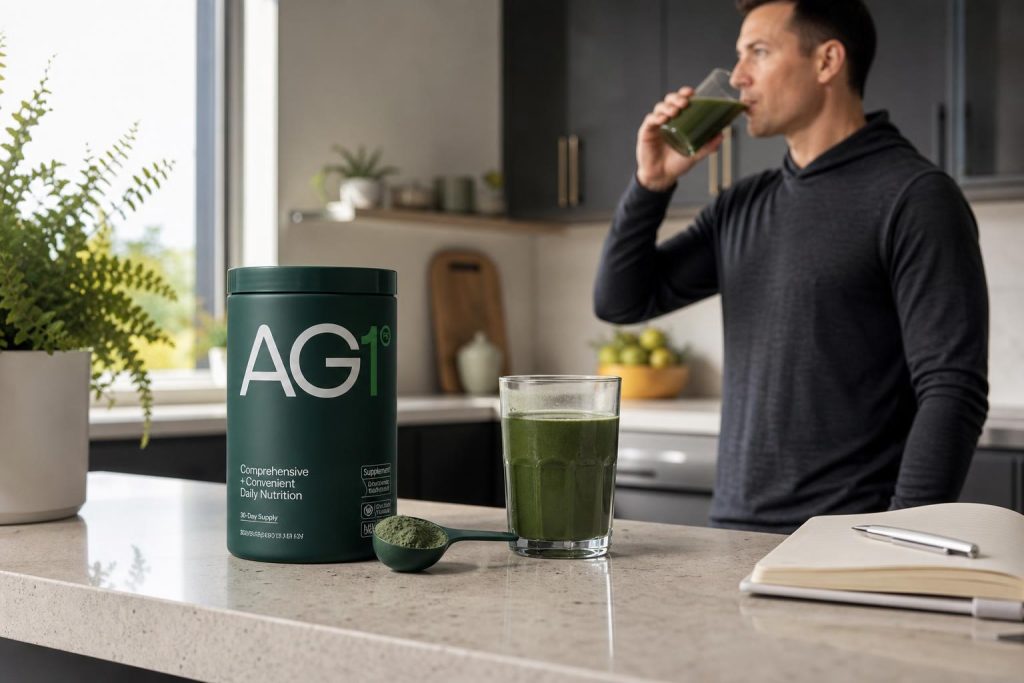
Most men eating a reasonably clean diet assume their micronutrient bases are covered. The research says otherwise. A landmark analysis published in the Journal of the International Society of Sports Nutrition found that even well-structured whole-food diets frequently fall short on key vitamins and minerals — particularly magnesium, vitamin D, zinc, and vitamin K2 — nutrients that govern everything from testosterone synthesis to insulin sensitivity to muscle recovery. That gap is exactly where a product like AG1 Athletic Greens positions itself. But the question worth asking is whether it actually delivers, or whether it’s an expensive placebo dressed up in convincing marketing.
AG1 has become one of the most recognizable supplements in the health optimization space, generating significant buzz among gym-goers, endurance athletes, and men managing metabolic health through diet, medication, or both. At roughly $79 to $99 per month for a single daily serving, the price point demands scrutiny. This review isn’t here to sell you on a morning ritual — it’s here to examine what the ingredients actually do, where the formula excels, where it falls short, and who genuinely benefits from adding it to their stack.
What AG1 Actually Contains — And What the Science Says
AG1’s formula is built around a 75-ingredient blend organized into several proprietary complexes: a greens and phytonutrient blend, a nutrient-dense extracts complex, a digestive enzyme and mushroom blend, and a dairy-free probiotics component. On the surface, this reads impressively. In practice, the proprietary blend structure — where individual ingredient doses aren’t disclosed — is the product’s most significant limitation from an evidence standpoint.
What is disclosed is encouraging in places. AG1 provides meaningful doses of vitamin C (420mg), zinc (15mg), and B12 (12mcg), along with a solid vitamin D3 contribution. Zinc alone earns its keep: research published in Nutrition demonstrated that zinc supplementation in deficient men significantly increased serum testosterone levels, underscoring its relevance for any man concerned with hormonal health. Magnesium, however, is conspicuously absent from the label — a notable miss given that studies estimate up to 50% of Americans are magnesium deficient, and magnesium plays a central role in over 300 enzymatic reactions including glucose metabolism and protein synthesis.
The probiotic component — 7.2 billion CFU of Lactobacillus acidophilus and Bifidobacterium bifidum — is where AG1 shows genuine promise backed by clinical evidence. A 2021 meta-analysis in Nutrients confirmed that multi-strain probiotic supplementation meaningfully improved gut barrier integrity and reduced systemic inflammation markers in healthy adults. For men dealing with digestive disruption — whether from high-protein diets, travel, stress, or reduced food variety during a caloric deficit — this element of the formula is legitimately useful. The digestive enzyme blend, including bromelain and papain, also has credible support for improving protein absorption efficiency, which matters for anyone prioritizing muscle preservation or growth.
The adaptogenic components — ashwagandha and rhodiola rosea — are dosed within the proprietary blend, making it impossible to verify whether they’re present at clinically effective levels. Ashwagandha, for example, has demonstrated meaningful cortisol-lowering and strength-supporting effects at doses of 300–600mg per day. Whether AG1 delivers anywhere near that is unknown. This is the core tension with proprietary blends: they protect the formula from competitors, but they also prevent consumers from making fully informed decisions.
Who Benefits Most — And Where AG1 Fits a Real-World Stack
AG1 is best understood not as a replacement for a quality diet but as nutritional insurance — a strategy to close micronutrient gaps that persist even in men who eat well and train consistently. For men in aggressive fat loss phases, that insurance becomes more valuable. Caloric restriction reliably reduces micronutrient intake, and research in the American Journal of Clinical Nutrition has shown that deficiencies in B vitamins, vitamin D, and zinc during weight loss can impair metabolic rate, immune function, and lean mass retention. AG1 addresses most of these — imperfectly, but meaningfully.
For men using GLP-1 receptor agonists like semaglutide or tirzepatide, the nutritional stakes are higher. Reduced appetite and significantly lower food volume increase the risk of falling short on micronutrients, and the gut motility changes associated with these medications make digestive support genuinely relevant. In this context, AG1’s probiotic and enzyme components aren’t just nice-to-haves — they address a real physiological need. That said, GLP-1 users with severe nausea or appetite suppression may find a simple, high-quality multivitamin more practical and cost-effective during the initial titration phase.
For athletes and men focused on performance, AG1’s vitamin C content supports collagen synthesis and reduces exercise-induced oxidative stress, while the B-vitamin profile supports mitochondrial energy production. Neither of these effects is dramatic, but combined they support training quality and recovery in ways that compound over time. The alkalizing greens blend — spirulina, chlorella, wheatgrass — carries some theoretical benefits around reducing exercise-induced acidosis, though direct human performance data in this area remains limited.
Where AG1 falls short for serious lifters and performance-focused men is in what it doesn’t include. Creatine, beta-alanine, leucine, and magnesium are absent or present in therapeutically irrelevant amounts. Men who train hard and want to cover all bases will still need to build a separate stack around AG1 rather than relying on it as a single solution. This doesn’t disqualify it — it just clarifies its role. Think of it as your nutritional foundation, not your entire house.
The taste and mixability deserve mention because they affect consistency, and consistency determines results. AG1 mixes cleanly in water with a mildly sweet, earthy flavor that most men find acceptable after a few days. The single-daily-serving format removes the decision fatigue that comes with managing a six-supplement protocol, and for busy men who already struggle to maintain habits, that simplicity has real practical value.
The Takeaway
AG1 Athletic Greens is a well-formulated, premium-priced greens supplement with genuine strengths in its micronutrient profile, probiotic content, and digestive enzyme support. It is not a miracle product, and the proprietary blend structure prevents a fully confident clinical endorsement. But for men who eat reasonably well and want to close nutritional gaps without managing a dozen individual supplements, it earns its place. The men who will benefit most are those in caloric deficits, those with variable or restricted diets, and those who prioritize gut health and immune resilience alongside body composition. If you’re already taking a comprehensive multivitamin, creatine, and vitamin D3/K2 separately, the case for AG1 becomes harder to justify at its price point. If you’re currently taking nothing and want a single, convenient nutritional foundation to build on, it’s one of the better options available — just go in with calibrated expectations and pair it with the fundamentals that no supplement can replace: consistent training, adequate protein, and quality sleep.