Most men on GLP-1 medications like semaglutide or liraglutide make the same mistake: they let the appetite suppression do all the work. The drug curbs hunger, they eat less, the scale drops — and they assume that’s the whole strategy. It isn’t. What you eat on a GLP-1 matters as much as how much you eat, and without a structured meal approach, you risk losing muscle instead of fat, stalling out after the initial drop, and feeling worse than you did before you started.
The good news is you don’t need to pay for a meal plan. You need the right framework — and the science to back it up. Whether you’re on a GLP-1 medication, eating in a calorie deficit the old-fashioned way, or just cleaning up your diet to support better metabolic health, the nutritional principles are more similar than you’d think. This is a guide for all of them.
What GLP-1 Medications Actually Do to Your Appetite — and Why Nutrition Still Matters
GLP-1 receptor agonists work by mimicking the body’s natural glucagon-like peptide-1 hormone, which slows gastric emptying, reduces appetite signals in the brain, and improves insulin sensitivity. The result is that food feels more satisfying in smaller quantities, and hunger between meals decreases substantially. For men who have struggled with caloric overconsumption for years, this is genuinely useful — but it’s a lever, not a solution.
The clinical problem is that when caloric intake drops dramatically without attention to food quality and protein distribution, the body doesn’t selectively burn fat. It burns whatever is available — and in a large deficit with inadequate protein, that includes lean muscle tissue. Research published in Sports Medicine (2026) by Jensen, Fiorenza, Juhl and colleagues found that liraglutide treatment alone did not improve physical fitness measures including cardiorespiratory fitness or functional performance. Only when structured exercise was combined with GLP-1 treatment did participants see meaningful improvements in peak oxygen consumption and stair climb performance — and relative muscle strength was best preserved in the group that combined both pharmacotherapy and exercise.
The implication is clear: the medication handles appetite regulation, but your nutrition and training have to handle the physical composition side of the equation. If you’re eating 1,200 calories of crackers, protein bars, and whatever you can stomach, you’re not optimizing — you’re just surviving the treatment.
The Free GLP-1 Meal Plan Framework: Built Around Protein First
The most important shift you can make, whether you’re on a GLP-1 or not, is to lead every meal with protein. For men on GLP-1 medications specifically, this matters because appetite suppression can make it easy to skip meals or fill up on low-protein foods that feel comfortable but don’t support muscle retention. The target is simple in concept: aim for at least 0.7 to 1 gram of protein per pound of bodyweight daily, distributed across two to three meals.
Practically, that looks like eggs and Greek yogurt in the morning, a substantial protein source at lunch — chicken breast, ground turkey, canned salmon, cottage cheese — and a dinner built around red meat, fish, or legumes. Men on GLP-1s often find they can’t finish large portions, which makes protein prioritization even more critical. Eat the protein on your plate first. Let the carbohydrates and fat fill in around it, not the other way around.
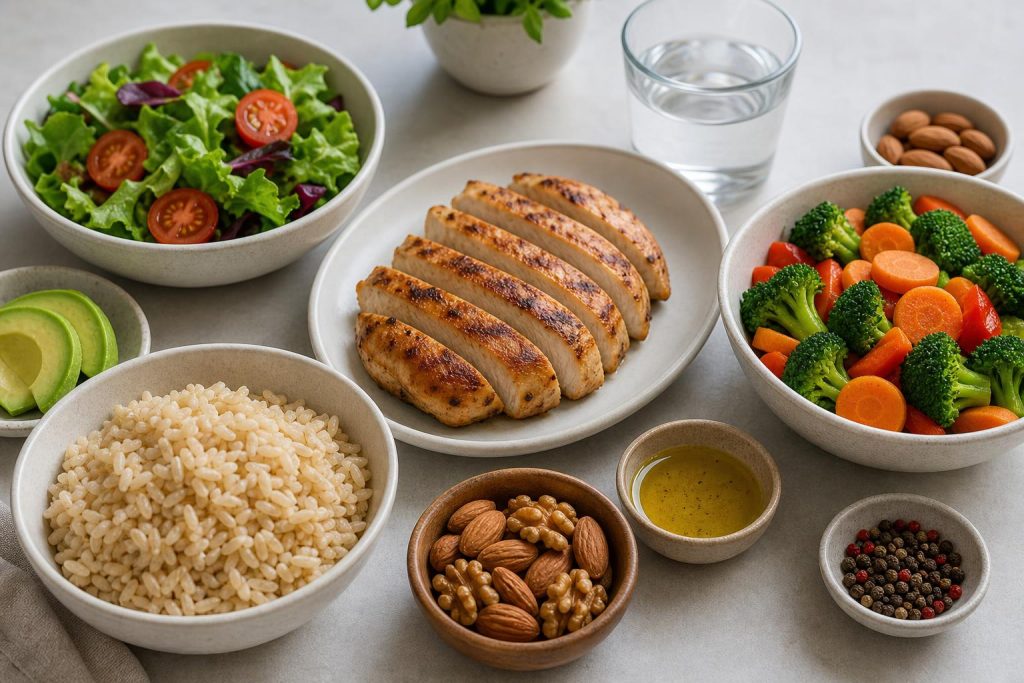
For a concrete free meal plan structure, think in terms of three anchors. Breakfast might be three scrambled eggs with one cup of Greek yogurt and a handful of berries — roughly 40 to 45 grams of protein, low glycemic load, easy to prepare. Lunch is where volume eating becomes your tool: a large salad base with six ounces of grilled chicken, olive oil and vinegar, and half an avocado gives you fiber, healthy fats, and another 40 grams of protein without overwhelming a reduced appetite. Dinner should be your most satisfying meal — five to six ounces of salmon or a lean beef preparation, roasted vegetables, and a small portion of complex carbohydrates like quinoa or sweet potato rounds out micronutrient coverage and supports overnight recovery.
This isn’t a rigid prescription. It’s a pattern. The pattern prioritizes protein, incorporates fiber-rich vegetables to support gut health and satiety, limits ultra-processed foods that spike blood glucose and undermine the metabolic benefits of GLP-1 treatment, and keeps calories high enough to protect muscle while remaining in a meaningful deficit. Men not on GLP-1s following the same pattern will see similar body composition improvements, because the underlying physiology is the same.
Hydration deserves a specific mention here because GLP-1 users frequently underdrink. Reduced appetite often extends to reduced thirst awareness, and dehydration compounds fatigue, slows digestion, and can worsen the nausea some men experience in early treatment phases. A practical rule is to drink 16 to 20 ounces of water with each meal and keep a water bottle visible throughout the day. Electrolytes — particularly sodium and potassium — become relevant if you’re sweating through exercise, which you should be.
Exercise Is Not Optional — The Research Is Blunt About This
There’s a tendency among men starting GLP-1 medications to treat the drug as a replacement for the hard parts of getting healthy. The data disagrees. The same 2026 randomized controlled trial by Jensen and colleagues showed that participants who completed exercise — at a median of 2.65 sessions per week, roughly 116 minutes weekly at 79% of maximum heart rate — achieved improvements in cardiorespiratory fitness and functional performance that liraglutide alone simply did not produce. The combined group also saw a 3.3% improvement in relative muscle strength compared to 1.0% for liraglutide alone and a 7.8% decline in the placebo-only group.
For men eating in a caloric deficit, whether medically induced or self-directed, resistance training is the primary mechanism for preserving lean mass. Three sessions per week covering the major movement patterns — squat, hinge, push, pull, carry — is enough to create the anabolic stimulus that tells your body to hold onto muscle while mobilizing fat stores. You don’t need to be in the gym five days a week. You need to be consistent at moderate intensity with progressive overload over time.
If you’re on a GLP-1 and finding energy levels lower than usual, particularly in the first weeks of treatment, scale the intensity down before you scale the frequency down. A 45-minute walk followed by 20 minutes of bodyweight or light resistance work is still a training session. The goal is to maintain the habit and the stimulus, not to hit personal records while your body is adapting to significant metabolic changes.
The Takeaway
A free GLP-1 meal plan isn’t complicated software or a paid subscription. It’s a framework: protein at every meal, vegetables as volume, whole food carbohydrates timed around activity, and enough calories to protect the muscle you’re working to keep. Pair that framework with consistent structured exercise — even at moderate frequency — and you transform what a GLP-1 can accomplish from passive weight loss into genuine body recomposition.
The men who get the best results from GLP-1 treatment — and from any serious fat loss effort — are the ones who use reduced appetite as an advantage for cleaner eating, not an excuse to eat less of everything indiscriminately. The science is clear on this. Now you have the roadmap.
Scientific References
-
Jensen, Fiorenza, Juhl et al. (2026).
Physical Fitness with Exercise and GLP-1 Receptor Agonist Treatment Alone or Combined After Diet-Induced Weight Loss: A Secondary Analysis of a Randomized Controlled Trial in Adults with Obesity..
Sports medicine (Auckland, N.Z.).
View on PubMed →