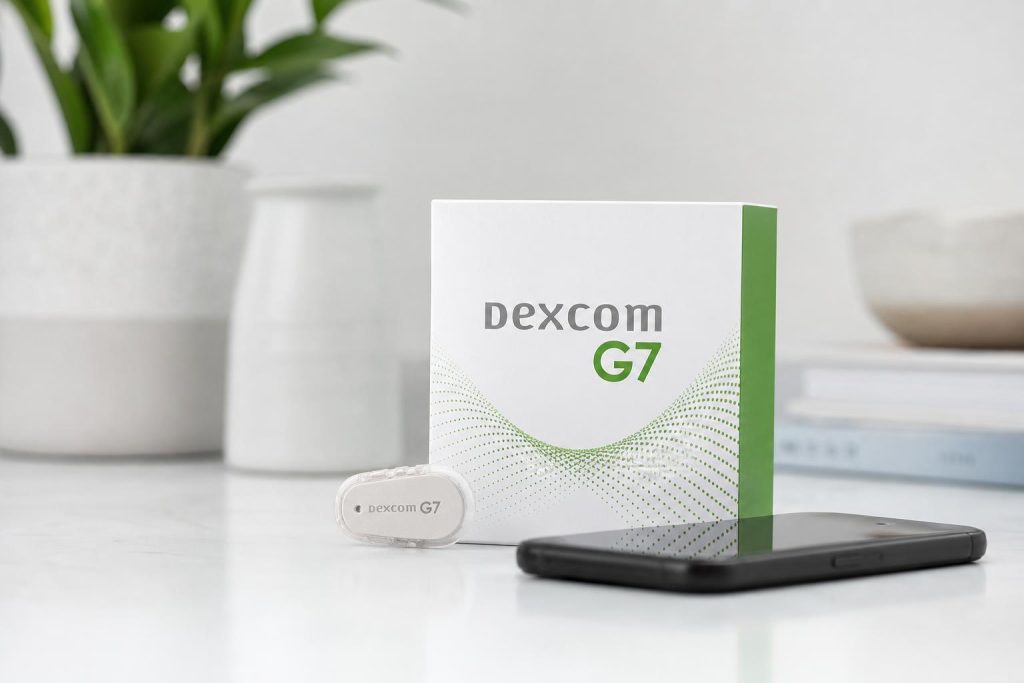
In 2023, a landmark study published in The New England Journal of Medicine demonstrated that continuous glucose monitoring reduced HbA1c levels significantly more than standard fingerstick monitoring in people managing metabolic conditions — and the margin wasn’t trivial. But that research only scratches the surface of why CGM technology is gaining serious traction well beyond the diabetic population. Research consistently shows that real-time glucose visibility changes behavior, improves dietary choices, and enhances metabolic outcomes across a wide range of individuals — including men who simply want to lose fat faster, train smarter, and understand how their body actually responds to food.
The Dexcom G7 is currently the most advanced consumer-grade continuous glucose monitor on the market. Smaller than its predecessor, faster to warm up, and integrated with more apps than ever before, it represents a meaningful leap in wearable metabolic technology. But is it actually worth using if you’re not diabetic? And if you’re on a GLP-1 medication like semaglutide or tirzepatide, does glucose tracking add any real value on top of what the medication is already doing? The answer to both questions is more nuanced — and more compelling — than most men expect.
What the Dexcom G7 Actually Does (And Why It Matters Beyond Blood Sugar)
The G7 is a small, coin-sized sensor that adheres directly to the back of your upper arm and measures interstitial glucose every five minutes, transmitting data wirelessly to your smartphone or compatible smartwatch. Unlike fingerstick meters that give you a single-point snapshot, the G7 provides a continuous curve — showing not just where your glucose is, but where it’s headed and how fast it’s moving. That directional data, called the glucose trend arrow, is arguably more useful than the number itself.
For healthy men without diabetes, the practical value of this becomes clear quickly. A seminal 2019 study from Stanford found enormous variability in postprandial glucose responses between individuals eating identical meals — meaning two men eating the same bowl of oatmeal might have wildly different glucose spikes. One might cruise along at 110 mg/dL while the other rockets to 165 mg/dL. Without a CGM, you’d never know. With a G7, you know within minutes, and you can actually do something about it.
The G7 improved significantly on the G6 with a slimmer, all-in-one sensor-transmitter design that eliminates the separate transmitter unit. Warmup time dropped from two hours to just 30 minutes — a meaningful quality-of-life improvement if you’re swapping sensors every 10 days. The app interface is clean, the alarm customization is robust, and the direct-to-Apple-Watch integration means you can glance at your glucose without pulling out your phone mid-workout. For men who train seriously, that’s not a small thing.
Accuracy-wise, the G7 earned an impressive MARD (Mean Absolute Relative Difference) of approximately 8.2%, which is among the best on the market for a consumer CGM. Clinical validation data published in 2023 confirmed its accuracy across a wide glucose range, including during periods of rapid glucose change — historically a weakness of CGM sensors. For practical purposes, the readings are reliable enough to make meaningful decisions around food, exercise, and recovery.
Using the G7 If You’re on a GLP-1 Medication
GLP-1 receptor agonists like semaglutide (Ozempic, Wegovy) and tirzepatide (Mounjaro, Zepbound) work by slowing gastric emptying, improving insulin sensitivity, and reducing postprandial glucose spikes — among other mechanisms. On paper, you might think that adds up to a good reason to skip the CGM. If the medication is already blunting your glucose response, what is there left to track?
Quite a bit, as it turns out. Research shows that even among GLP-1 users with good average glucose control, there can be significant glycemic variability — meaning the glucose curve is still moving around in ways that affect energy, hunger, and body composition, even if the peaks aren’t as dramatic. Understanding that variability in real time lets you optimize the details that the medication doesn’t automatically handle for you.
For men using GLP-1 medications who are specifically trying to preserve muscle mass — a genuine concern given the caloric deficits these drugs can create — glucose tracking offers a useful window into whether your protein intake and meal timing are supporting muscle protein synthesis or undermining it. Prolonged low glucose states during caloric restriction can accelerate muscle catabolism. Knowing when your glucose is trending downward gives you the opportunity to intervene with a protein-forward snack before that happens. The G7’s customizable alerts make this practical: set a low threshold alarm at, say, 80 mg/dL, and you’ll know before your body is already deep into a stress response.
There’s also the matter of exercise. Studies examining glucose dynamics during resistance training show that blood glucose can drop significantly during high-volume lifting sessions, particularly in a fasted or semi-fasted state — a scenario increasingly common among GLP-1 users who experience reduced appetite and may not be eating sufficiently before training. Watching your glucose in real time during a workout tells you whether you’re adequately fueled or running on fumes, and whether a carbohydrate source mid-session would improve performance and recovery. That’s actionable intelligence most men have never had access to before.
What the Data Reveals for Men Who Aren’t on Any Medication
If you’re not on a GLP-1, not diabetic, and just a motivated guy trying to get leaner and healthier, the Dexcom G7 can still be genuinely transformative — not as a permanent fixture, but as a short-term diagnostic tool. Using it for two to four sensor cycles (20–40 days) gives you a detailed metabolic profile that no blood panel or dietary log can replicate.
You’ll learn which foods spike you hard and which don’t — and the answers are often counterintuitive. White rice might barely move your needle while a seemingly innocent smoothie sends you to 160 mg/dL. Research from the Weizmann Institute established that individual glucose responses are highly personalized and tied to gut microbiome composition, genetics, and lifestyle factors — none of which a standard diet plan accounts for. The G7 makes you your own n-of-1 experiment, and the findings are usually eye-opening.
Sleep is another area where the G7 pays unexpected dividends. Poor sleep quality drives glucose dysregulation, and the data is striking: even a single night of sleep restriction has been shown to impair insulin sensitivity by a degree comparable to eating a high-fat diet for months. Men who wear the G7 overnight often discover that restless nights correlate directly with elevated fasting glucose the next morning — sometimes by 15–25 points. That kind of feedback loop accelerates lifestyle change faster than any generic sleep hygiene article ever could.
Stress and cortisol responses also become visible through glucose. A difficult morning meeting, an argument, a high-stakes event — cortisol triggers hepatic glucose release, and you’ll see it on the graph as an unexplained rise that has nothing to do with what you ate. Most men are shocked the first time they watch their glucose climb during a stressful phone call. That shock tends to motivate change in a way that abstract advice about stress management never does.
From a practical standpoint, men doing intermittent fasting can use the G7 to validate that their fasting window is actually keeping glucose stable and not triggering excessive stress responses. Men on ketogenic diets can confirm they’re genuinely in a low-glucose metabolic state rather than guessing. Endurance athletes can optimize carbohydrate intake around long sessions without trial and error. The device doesn’t prescribe a specific dietary approach — it gives you the data to optimize whatever approach you’re already committed to.
The cost is the honest downside. Without insurance coverage, the G7 runs approximately $89–$99 for a single 10-day sensor, making a full month of monitoring a $300 investment. For most non-diabetic men, insurance won’t cover it. Prescription options exist for those who qualify medically, and some employers with robust wellness benefits are beginning to cover CGM use for metabolic health optimization, but coverage remains inconsistent. Stelo, a newer FDA-cleared OTC CGM from Dexcom, offers a lower-cost alternative for non-diabetic users, though with somewhat less precision and fewer integration features than the G7.
The Takeaway
The Dexcom G7 isn’t magic, and it won’t replace disciplined training, smart nutrition, and sufficient sleep. But it offers something those fundamentals can’t provide on their own: real-time biological feedback that makes the invisible visible. Whether you’re using a GLP-1 medication and trying to extract every advantage from a powerful pharmaceutical tool, or you’re a lifter, a fat-loss-focused guy, or a biohacker who wants to understand your metabolism at a granular level — the G7 delivers data that changes how you eat, train, recover, and think about your health. For men serious about results, that’s worth a great deal. Use it for a month, learn what your body is actually doing, and then use that knowledge for the years that follow.