Muscle doesn’t disappear overnight — but it does disappear quietly. Whether you’re cutting calories, aging past 40, dealing with a sedentary stretch, or navigating a health challenge, the biology of muscle loss is working against you in ways most men never fully appreciate. Research published in Antioxidants identifies four core drivers of muscle wasting: low-grade systemic inflammation, disrupted protein homeostasis, mitochondrial dysfunction, and declining satellite cell activity — the stem cells responsible for muscle repair and growth. Understanding these mechanisms isn’t just academic. It’s the foundation of every effective strategy to preserve and rebuild lean mass.
The consequences compound fast. A 2023 review on spaceflight physiology — which functions as an accelerated model of muscle atrophy — found that muscle loss and sarcopenia triggered by prolonged inactivity mirror the same molecular pathways seen in accelerated aging, including oxidative stress, mitochondrial damage, and elevated inflammatory signaling. You don’t need to be an astronaut to experience this cascade. Extended bed rest, aggressive caloric restriction, or simply neglecting resistance training for a few months can set the same biology in motion.
Protein Is Non-Negotiable — But Timing Matters As Much As Amount
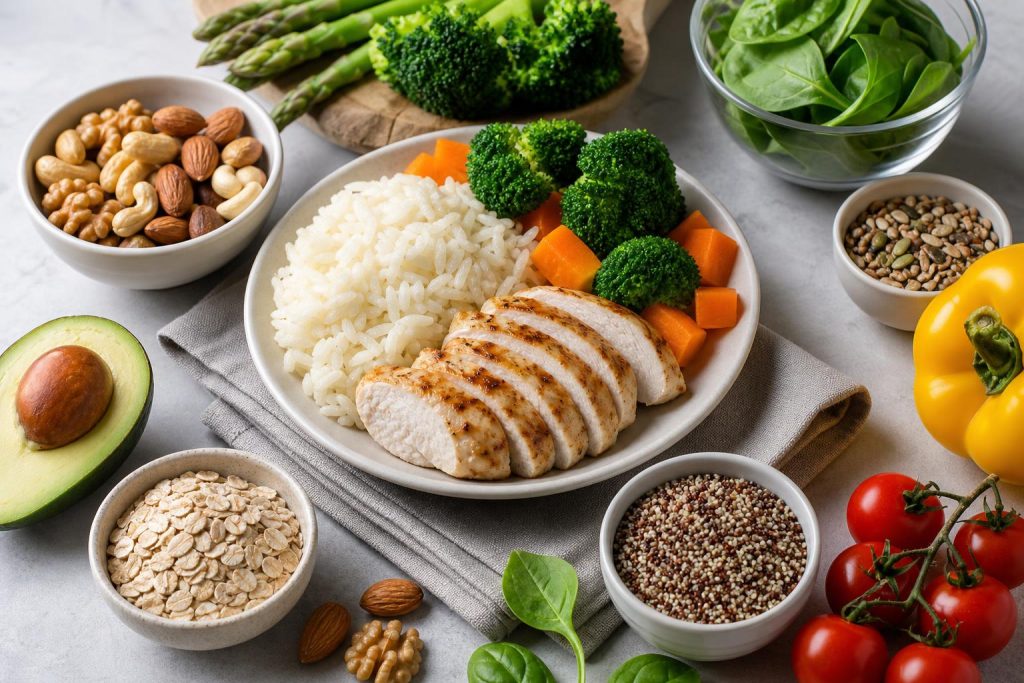
Most men know protein matters. Fewer understand that when you eat it changes the outcome almost as much as how much you eat. Position data from the International Society of Sports Nutrition recommends consuming a high-quality protein source as close to the beginning or end of exercise as possible, specifically to blunt exercise-induced amino acid oxidation and initiate muscle protein remodeling. For practical application, that means a protein-rich meal or shake within an hour on either side of your training window — not just hitting a daily number spread across random meals.
Quality matters too. Leucine-rich complete proteins — whey, eggs, beef, Greek yogurt — trigger muscle protein synthesis more effectively than plant sources at equivalent gram-for-gram doses. If you’re in a caloric deficit for fat loss, this becomes even more critical. Deficit eating accelerates muscle catabolism, and protein intake is your primary buffer against it. A practical target for men actively trying to preserve or build muscle sits between 0.7 and 1.0 grams per pound of bodyweight daily, with emphasis on distributing it across meals rather than loading it all at dinner.
Resistance Training Is the Signal Your Muscle Tissue Needs to Survive
Nutrition provides the raw material, but resistance training provides the biological signal that tells your body muscle is worth keeping. Without that mechanical stress, even adequate protein intake won’t fully prevent atrophy during caloric restriction or aging. The mechanism runs through satellite cell activation — the same cells identified in the sarcopenia research as essential for muscle repair and maintenance. Heavy, progressive loading activates these cells. Steady-state cardio alone does not.
Three to four resistance training sessions per week, prioritizing compound movements — squats, deadlifts, rows, presses — delivered with sufficient intensity (working within a few reps of failure) is enough to preserve muscle during a cut and build it during a surplus. Progressive overload, meaning consistently increasing the challenge over time, is what separates men who maintain muscle from those who slowly lose it despite showing up to the gym regularly.
Inflammation management rounds out the picture. Dietary interventions targeting antioxidant intake alongside protein have shown measurable effects on muscle protein homeostasis and cellular lifespan — meaning a diet rich in vegetables, omega-3 fatty acids, and minimally processed foods isn’t just good for cardiovascular health. It directly supports the cellular environment your muscle tissue needs to regenerate and survive. Sleep, stress management, and avoiding prolonged sedentary periods complete the equation. None of this is complicated in isolation. The challenge is executing all of it consistently, in the same window of time, while the rest of life competes for attention.
The Takeaway
Fighting muscle loss comes down to three non-negotiables: eat enough protein with strategic timing around training, apply consistent progressive resistance training, and manage the inflammatory and lifestyle factors that quietly accelerate muscle breakdown. Whether you’re 35 and cutting body fat, 50 and concerned about age-related loss, or dealing with a health condition that affects your physiology — the fundamentals don’t change. The science is clear. The execution is yours.
Scientific References
-
Sims, Kerksick, Smith-Ryan et al. (2023).
International society of sports nutrition position stand: nutritional concerns of the female athlete..
Journal of the International Society of Sports Nutrition.
View on PubMed → -
Little, Llorián-Salvador, Tang et al. (2020).
Macrophage to myofibroblast transition contributes to subretinal fibrosis secondary to neovascular age-related macular degeneration..
Journal of neuroinflammation.
View on PubMed → -
Capri, Conte, Ciurca et al. (2023).
Long-term human spaceflight and inflammaging: Does it promote aging?.
Ageing research reviews.
View on PubMed → -
Barbiera, Pelosi, Sica et al. (2020).
Nutrition and microRNAs: Novel Insights to Fight Sarcopenia..
Antioxidants (Basel, Switzerland).
View on PubMed → -
Bowers et al. (1995).
[Anabolic steroids]..
SIDAhora : un proyecto del Departamento de Publicaciones del PWA Coalition, NY.
View on PubMed →