Here’s a number that should change how you think about weight loss drugs: in the landmark STEP 1 trial, participants taking semaglutide lost an average of 14.9% of their body weight — but a significant portion of that loss was lean muscle mass. Research published in the New England Journal of Medicine confirmed the scale moved, but what moved with it matters enormously. For any man trying to come out the other side of a calorie deficit looking better — not just lighter — understanding how to track and manage macronutrients isn’t optional. It’s the difference between losing fat and losing the physique you’re working toward.
Whether you’re using a GLP-1 medication like Ozempic or semaglutide, cutting calories through traditional means, or training hard and eating clean, the fundamental biochemistry is the same: a sustained calorie deficit triggers fat loss but also creates conditions where muscle protein breakdown accelerates. Your job is to use smart macro tracking to protect muscle, fuel performance, and make the deficit work for you — not against you.
Why Macros Matter More Than Calories Alone
The calorie-in, calorie-out model isn’t wrong — it’s just incomplete. Total calorie intake determines whether you lose or gain weight, but the macronutrient composition of those calories determines what you actually lose or gain. This distinction becomes critical when appetite suppression — whether from a GLP-1 medication, aggressive dieting, or high training volume — drives intake down significantly.
Protein is the most important macro to track during any fat-loss phase. A meta-analysis in the British Journal of Nutrition found that higher protein intake during caloric restriction preserves significantly more lean mass compared to standard protein intakes, even when total calories are identical. The mechanism is straightforward: dietary protein provides the amino acids needed to maintain muscle protein synthesis when your body is otherwise signaling catabolism through low energy availability and elevated cortisol. For men in a deficit, a target of 0.7 to 1.0 grams of protein per pound of body weight — or closer to 1.0 to 1.2 grams per pound of lean body mass if you’re tracking that — is a well-supported starting point backed by decades of research.
Carbohydrates are often the first macro men slash when cutting, and while reducing carbs can be effective for creating a deficit, aggressive restriction carries a real cost in active men. Muscle glycogen fuels resistance training intensity, and research in the Journal of the International Society of Sports Nutrition has consistently linked low glycogen availability to reduced training volume and blunted anabolic signaling post-workout. If you’re lifting weights — which you should be during any fat-loss phase — keeping carbohydrate intake sufficient to support your sessions isn’t just performance insurance, it’s muscle-preservation strategy.
Dietary fat rounds out the picture, and it deserves more respect than diet culture gives it. Fat is essential for testosterone production, absorption of fat-soluble vitamins, joint health, and cellular membrane integrity. Studies have shown that very low fat intakes correlate with measurable drops in serum testosterone in men — a hormonal environment that makes preserving muscle during a deficit even harder. A practical floor is 0.35 to 0.5 grams per pound of bodyweight, prioritizing unsaturated fats from whole food sources like olive oil, avocado, nuts, and fatty fish.
Building Your Deficit: How Deep Is Too Deep?
The size of your calorie deficit is the dial that controls the speed of your fat loss — and the degree of metabolic and hormonal disruption you trigger in the process. A moderate deficit of 400 to 600 calories below your total daily energy expenditure is consistently supported in the literature as the sweet spot for body recomposition in resistance-trained men. Research published in the International Journal of Sport Nutrition and Exercise Metabolism found that larger deficits in athletes and active individuals led to disproportionately greater lean mass loss without a meaningful increase in the rate of fat loss — meaning the aggressive cut wasn’t buying anything except muscle.
For men using Ozempic or other GLP-1 receptor agonists, this calculation gets complicated fast. These medications can suppress appetite so effectively that total intake drops far below any intentional target. A man who was eating 2,800 calories might find himself struggling to reach 1,400 on semaglutide — a deficit that triggers accelerated lean mass loss, micronutrient deficiencies, and fatigue that makes maintaining training intensity nearly impossible. This is not a theoretical concern. A 2023 analysis highlighted in Obesity Reviews noted that without deliberate protein targeting and resistance training, GLP-1-induced weight loss carries a substantially elevated risk of clinically meaningful muscle loss.
The fix isn’t complicated, but it requires intentionality. Tracking macros — not just loosely watching what you eat — creates the feedback loop you need to make sure protein targets are being hit even when appetite is suppressed. Apps like Cronometer or MyFitnessPal make this practical. Log everything, set your protein floor as non-negotiable, then use the remaining calories to distribute carbohydrates and fats based on your training schedule and personal preference. On training days, shift slightly more toward carbohydrates. On rest days, fat intake can naturally rise as carb needs decrease.
There is also a compelling case for cycling your deficit rather than maintaining a constant restriction. Strategic diet breaks — periods of one to two weeks where you return to maintenance calories — have been shown to partially restore leptin levels and reduce adaptive thermogenesis, the metabolic slowdown that makes extended cuts progressively less effective. This isn’t a cheat week — it’s a structured recalibration that makes your next cutting phase more productive. For men on GLP-1 medications who are managing dose schedules, coordinating a brief maintenance phase around dose adjustments can also help manage side effects while keeping muscle intact.
Practical Macro Tracking for Real-World Fat Loss
Knowing the theory and executing it consistently are two different problems. Most men who track macros well share a few common habits: they use a food scale for at least the first few weeks until portion estimation becomes reliable, they pre-log meals rather than logging after eating (which consistently produces more accurate data), and they treat their protein target as the anchor around which everything else is built.
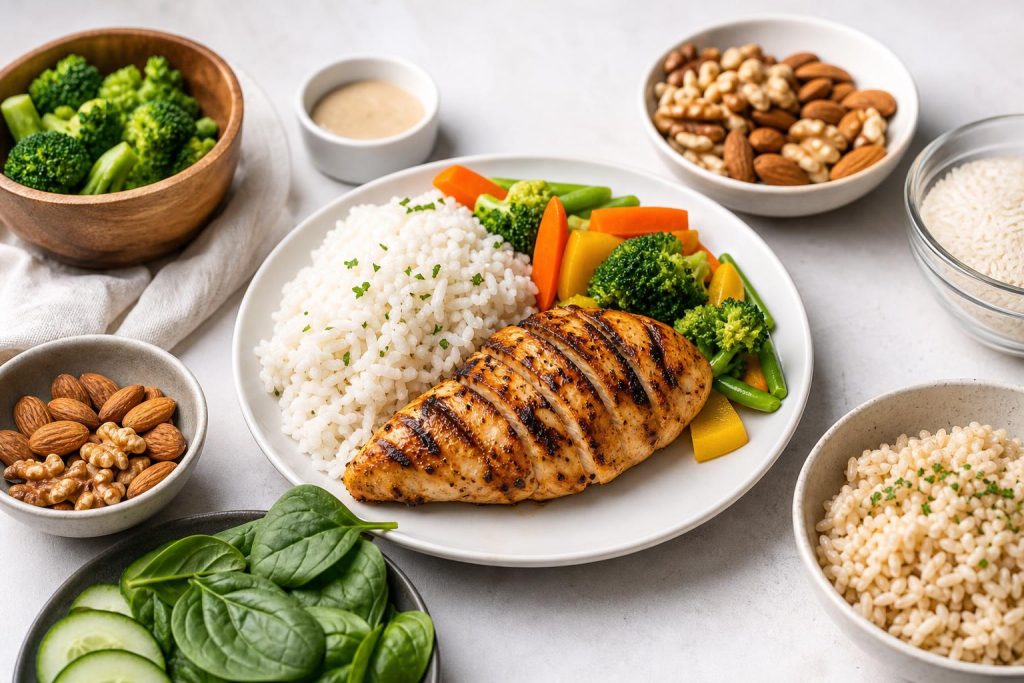
A practical starting framework for a 200-pound man in a moderate deficit targeting around 2,200 calories might look like 180 to 200 grams of protein, 200 to 230 grams of carbohydrates, and 55 to 70 grams of fat. These numbers aren’t arbitrary — they reflect protein at roughly 0.9 to 1.0 grams per pound, carbohydrates sufficient to fuel 4 to 5 weekly resistance training sessions, and fat above the threshold associated with normal hormonal function. From there, individual adjustments based on food preferences, satiety, and training response make the approach sustainable.
Meal timing within this framework is secondary to hitting totals, but distributing protein across three to four meals of 40 to 50 grams each optimizes muscle protein synthesis. Research from the American Journal of Clinical Nutrition demonstrated that muscle protein synthesis is maximized when leucine threshold is reached at each meal — approximately 2.5 to 3 grams of leucine, which corresponds to roughly 30 to 40 grams of high-quality protein from animal sources. Spacing these doses across the day rather than front- or back-loading protein provides a continuous anabolic stimulus that supports muscle retention during a deficit.
For men with significantly suppressed appetite — whether from medication, aggressive training, or simply eating in a deficit for an extended period — liquid protein sources can be a practical bridge. A whey protein shake, Greek yogurt smoothie, or high-protein milk-based drink delivers 30 to 40 grams of protein in a format that’s far easier to consume than a chicken breast when hunger signals are muted. This isn’t about replacing whole food meals — it’s about hitting your protein floor on days when solid food volume feels impossible.
Resistance training needs to be stated explicitly because no amount of protein or macro precision compensates for the absence of the primary anabolic signal: mechanical tension on muscle tissue. Studies consistently show that progressive resistance training combined with adequate protein intake is the most effective intervention for preserving lean mass during caloric restriction — more effective than protein alone, more effective than aerobic exercise alone. Three to four sessions of compound-movement focused lifting per week — squats, deadlifts, rows, presses — provides the stimulus your muscles need to justify staying around when calories are scarce.
The Takeaway
Fat loss done right is a precision operation, not a blunt force event. Whether you’re navigating appetite suppression from a GLP-1 medication, grinding through a traditional cut, or somewhere in between, the variables that determine your outcome are the same: a moderate, well-constructed calorie deficit, protein intake high enough to defend your muscle mass, carbohydrates calibrated to your training demands, and fat intake sufficient to support hormonal health. Track your macros with enough consistency to know what you’re actually eating — not what you think you’re eating — and lift heavy enough to give your body a reason to hold onto the muscle you’ve built. The scale will move. What matters is that what moves with it is fat, not the physique you’re building.