Here is a number worth sitting with: in a landmark 68-week trial published in the New England Journal of Medicine, participants on semaglutide lost an average of 14.9% of their body weight — but those who combined the medication with a structured behavioral intervention, including dietary counseling, lost significantly more than those who simply took the drug. The research makes clear that semaglutide is a powerful appetite suppressant, not a metabolic free pass. What you eat — and how much — still determines whether you lose fat, preserve muscle, or end up skinnier-fat and metabolically worse off than when you started.
This matters whether you are on a GLP-1 medication like Ozempic or Wegovy, running a traditional calorie deficit through food logging and training, or somewhere in between. The physiology of fat loss does not change based on the tool you use to get there. A calorie deficit drives weight loss. Protein intake preserves muscle. Micronutrient density protects metabolic function. These principles are not suggestions — they are the operating system. What Ozempic does is make it dramatically easier to stay inside that operating system by blunting hunger signals and slowing gastric emptying. But blunted hunger can also mean blunted awareness of how little you are actually eating, and that is where things go wrong.
If you are using semaglutide and not tracking macros, there is a real possibility you are eating so little that your body is cannibalizing muscle tissue to meet its energy needs. If you are not on any medication and simply grinding through a calorie deficit with willpower, tracking macros is arguably even more important — because without appetite suppression, precision is the only thing standing between you and a stalled cut. Either way, the strategy is the same. The execution is what this article is about.
Why Macro Tracking Changes the Game in a Calorie Deficit
Counting calories alone is better than nothing, but it misses roughly half the picture. Two men can eat exactly 1,800 calories per day and end up with completely different body composition outcomes depending on how those calories are distributed across protein, carbohydrates, and fat. A 2012 study in JAMA demonstrated that the macronutrient composition of a diet significantly affects resting energy expenditure — meaning a low-fat, calorie-matched diet produced lower metabolic rates compared to low-glycemic and very-low-carbohydrate diets. Macros are not just about body composition aesthetics. They are metabolic levers.
Protein is the most critical lever for any man in a calorie deficit. When you eat less than your body burns, you create conditions that favor catabolism — the breakdown of stored tissue for fuel. Fat tissue is the target, but muscle is always on the table. The degree to which you spare muscle depends heavily on how much protein you are consuming. A meta-analysis in the British Journal of Sports Medicine found that protein intakes of around 1.6 grams per kilogram of body weight per day maximized muscle protein synthesis, and in a deficit, requirements trend even higher — with some evidence supporting up to 2.2 to 2.4 grams per kilogram for lean individuals trying to preserve muscle while cutting aggressively.
For a 200-pound (90 kg) man, that translates to roughly 145 to 200 grams of protein per day. That is a significant amount, and it does not happen by accident. It requires intentional food choices — and tracking. The challenge with Ozempic specifically is that the medication reduces overall caloric intake so dramatically that hitting protein targets while staying in a reasonable calorie range demands almost surgical precision. Nausea, early satiety, and food aversions are common side effects, and they tend to disproportionately kill protein intake because high-protein foods like meat and eggs are often less palatable when appetite is suppressed. Without tracking, most men on GLP-1 medications end up hitting their calorie targets but failing their protein targets — and the scale drops, but so does muscle mass.
Carbohydrates and fats deserve attention too, though they offer more flexibility than protein. Dietary fat is essential for hormone production — testosterone synthesis depends on adequate fat intake, and research published in the Journal of Applied Physiology showed that very-low-fat diets reduce testosterone concentrations in men. A floor of roughly 0.5 to 0.7 grams of fat per kilogram of body weight is a reasonable minimum in any deficit. Carbohydrates, meanwhile, are your training performance fuel. They are not required for survival, but they are strongly associated with muscle glycogen replenishment and workout output. The exact split between carbs and fat is largely a matter of personal preference, dietary adherence, and metabolic response — but protein is non-negotiable.
How to Set Your Calorie Deficit When Appetite Is Suppressed
The conventional wisdom on calorie deficits is built around a 500-calorie-per-day reduction from maintenance, producing roughly one pound of fat loss per week. That model works reasonably well in a standard diet context. On semaglutide, it can fall apart quickly — not because the deficit is too small, but because it can become catastrophically large without the person realizing it.
GLP-1 receptor agonists reduce caloric intake by an average of 16 to 24 percent, according to clinical data, primarily through reduced hunger and increased satiety signaling. For a man who was eating 2,800 calories per day before starting the medication, that could mean dropping to 2,100 to 2,350 calories with no conscious effort. Add in the 500-calorie intentional deficit many clinicians recommend, and you are suddenly at 1,600 to 1,850 calories — an aggressive cut for a larger man that, without adequate protein, will chew through muscle tissue.
The goal in a well-designed deficit is to lose primarily fat while retaining lean mass. Research from the American Journal of Clinical Nutrition has established that losing more than one percent of body weight per week dramatically increases the proportion of weight loss that comes from lean mass rather than fat. Slower, more controlled deficits with high protein intake produce superior body composition outcomes over time, even if the scale moves less quickly. For most men, this means targeting a deficit of 300 to 500 calories below true maintenance — not below the already-reduced appetite intake. That distinction is critical for GLP-1 users.
Calculating your true maintenance calories requires honesty. Use a validated equation like the Mifflin-St Jeor formula, multiply by your activity factor, and treat the result as your starting point — not your reduced appetite as a baseline. If your calculated maintenance is 2,600 calories and you are currently eating 1,400 because your hunger has evaporated, you are running a 1,200-calorie daily deficit. Over weeks, this will result in accelerated muscle loss, metabolic adaptation, fatigue, micronutrient deficiencies, and potentially a rebound when the medication is discontinued or when appetite returns during a dose stabilization period.
A practical floor for most men, regardless of medication status, is 1,500 to 1,800 calories — and even at that lower end, you need to be lifting weights and hitting protein targets consistently. If satiety makes eating feel difficult, prioritize calorie-dense, protein-forward foods: Greek yogurt, cottage cheese, whole eggs, protein shakes, nut butters, salmon, and ground beef. These foods allow you to hit macro targets in smaller volumes, which is especially useful when gastric capacity feels limited.
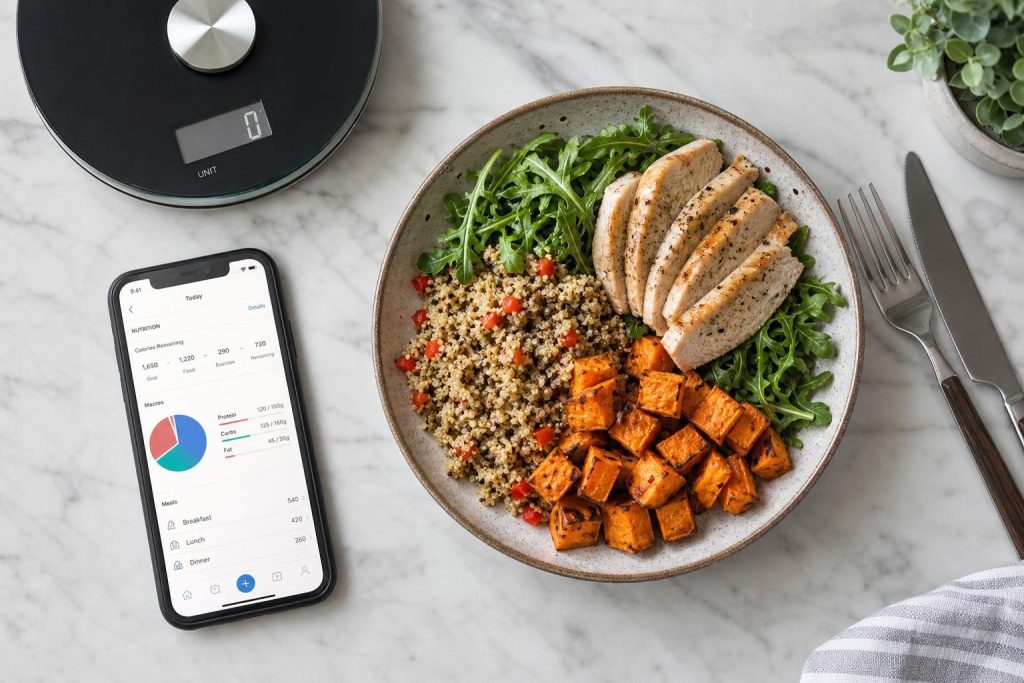
Tracking tools matter here. Apps like Cronometer or MacroFactor use dietary analysis that goes beyond simple calorie counts — they track micronutrients, adjust your targets based on weight trend data, and in MacroFactor’s case, use an adaptive algorithm to calculate your actual expenditure from real-world weight and intake data over time. This adaptive approach is particularly valuable on GLP-1 medications because it removes the guesswork from a rapidly changing metabolic environment. You log what you eat, the app watches how your weight responds, and it recalculates your true maintenance continuously. The result is a deficit that is always calibrated to where your body actually is — not where a formula predicted it would be six weeks ago.
Resistance Training: The Non-Negotiable Variable in Any Cutting Strategy
No macro tracking strategy, no matter how precise, can fully offset the muscle-sparing role of resistance training in a calorie deficit. The mechanical stimulus of lifting weights sends a powerful anabolic signal that essentially tells your body to protect muscle tissue even in an energy-deficient state. A 2017 study in Obesity found that GLP-1 users who incorporated resistance training during their weight loss phase retained significantly more lean mass compared to those who relied on cardio or did not exercise. The same principle applies to anyone in a prolonged cut: the men who lift consistently come out leaner, stronger, and with a higher resting metabolic rate than those who diet without training.
The training does not need to be elaborate. Three to four sessions per week of compound-movement-focused resistance training — squats, deadlifts, rows, presses — is sufficient to provide the anabolic signal needed to defend muscle during a deficit. Volume can be reduced from a typical muscle-building phase, but intensity should remain high. Lifting heavy, even with fewer total sets, is more effective at preserving muscle than high-rep, low-load work. This is a common mistake men make when cutting: they shift to light weights and high reps thinking they are burning more fat, when in reality they have removed the primary stimulus that was protecting their lean mass.
Progressive overload still applies in a deficit. Aim to maintain or modestly increase your strength numbers across the cut. If your bench press, squat, and deadlift stay roughly stable during a fat loss phase, you can be reasonably confident that muscle is being preserved. If your lifts drop significantly over several weeks, it is a signal to investigate protein intake, total caloric intake, sleep quality, and training volume — in that order.
Creatine monohydrate is worth mentioning here not as a shortcut but as a well-supported ergogenic that becomes especially relevant in a deficit. Decades of research confirm its ability to support strength output and lean mass preservation during calorie restriction. At three to five grams per day, it is low-cost, safe, and effective — and for men on GLP-1 medications who are eating less overall, it represents one of the few supplemental interventions with genuine evidence behind it.
Sleep is the other underappreciated variable in this equation. Research from the Annals of Internal Medicine demonstrated that sleep restriction during a calorie deficit reduced the proportion of weight lost from fat by 55 percent — meaning nearly half the weight loss came from lean mass when participants slept 5.5 hours compared to 8.5 hours per night. Macro tracking and calorie precision cannot override the hormonal chaos of chronic sleep deprivation. Cortisol rises, testosterone falls, ghrelin spikes, and the entire anabolic-catabolic balance tips toward muscle breakdown. Seven to nine hours is not a luxury recommendation. It is a physiological requirement for effective fat loss.
The Takeaway
Whether you are using Ozempic to control appetite, running a disciplined calorie deficit through food logging and gym discipline, or somewhere on the spectrum between, the fundamentals do not change. A controlled deficit of 300 to 500 calories below true maintenance, protein intake anchored between 1.6 and 2.4 grams per kilogram of body weight, adequate dietary fat to support testosterone production, consistent resistance training three to four days per week, and seven to nine hours of sleep per night — this is the architecture of effective, sustainable fat loss that protects muscle and supports metabolic health.
What macro tracking adds is accountability and precision. It converts intention into data. It catches the gaps — the days when protein falls short, when calories dip too low, when fat intake threatens hormonal function. Apps like MacroFactor or Cronometer make this process faster and more accurate than guesswork ever could, especially in the dynamic environment of a GLP-1-assisted cut where appetite signals are unreliable.
The men who get this right — who combine the right tools with the right strategy — end up not just lighter but genuinely leaner, stronger, and metabolically healthier. That is the goal. The medication, the food log, the barbell — they are all just means to that end. Use them with intention, and the results follow.