Here’s a number worth taking seriously: depending on age and health status, sarcopenia affects anywhere from 5% to 50% of older adults — and most of them never saw it coming. Muscle loss doesn’t announce itself. It happens gradually, quietly, through years of suboptimal eating, insufficient training, and ignored hormonal shifts. By the time most men notice it, the problem has been building for a decade. The good news is that the science on preventing muscle loss is clearer than ever, and the strategies are well within reach for any man willing to act on them.
Muscle is not a passive tissue. It’s metabolically expensive, hormonally sensitive, and profoundly responsive to the signals you give it — through food, movement, and recovery. Understanding what drives muscle loss in the first place is the foundation for building a strategy that actually works.
Why Muscle Loss Happens — And Why It’s Not Just About Age
The conventional framing is that muscle loss is an aging problem. That’s partially true, but it’s also dangerously incomplete. Research on muscle tissue changes with aging identifies several interconnected drivers: insulin resistance, hormonal decline, nutritional deficits, and physical inactivity. None of these are exclusive to older men. A 35-year-old who’s sedentary, protein-deficient, and metabolically dysregulated is already running a muscle-loss deficit — even if his DEXA scan doesn’t show it yet.
The mechanism is straightforward: muscle mass is governed by the balance between protein synthesis and protein degradation. When degradation outpaces synthesis — due to inadequate protein intake, low anabolic hormone levels, chronic inflammation, or disuse — you lose muscle. This negative protein balance can be driven by lifestyle factors entirely within your control. Studies examining muscle loss in clinical populations confirm that metabolic acidosis, vitamin D deficiency, insulin resistance, and poor dietary intake all tip the balance toward catabolism. These aren’t abstract clinical concepts — they’re real physiological states that many men are living in right now without realizing it.
Weight loss itself adds another wrinkle. Whether a man is cutting calories through discipline alone or using pharmacological assistance, losing weight without a preservation strategy means losing muscle alongside fat. Recent clinical review data show that up to 40% of total weight lost during pharmacological treatment for obesity can come from fat-free mass — which includes muscle. That’s not a minor footnote. That’s a fundamental risk that applies to any aggressive caloric deficit, regardless of how it’s achieved.
Protein, Resistance Training, and the Non-Negotiables
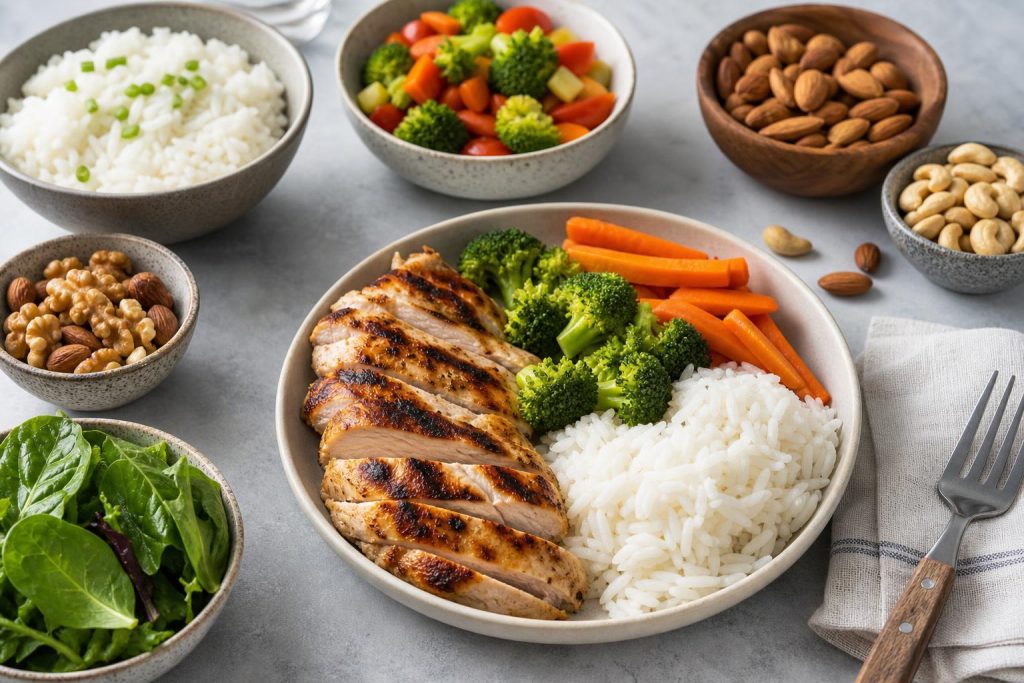
If there are two interventions with the strongest and most consistent evidence behind them, they are resistance training and adequate protein intake. Randomized controlled trials consistently point to dietary protein as a critical factor in preventing muscle loss, with researchers noting that while the optimal dose and protein source remain debated, the protective effect of higher protein intake is well-established. For most men, the practical target is somewhere in the range of 1.6 to 2.2 grams of protein per kilogram of bodyweight daily — prioritizing whole food sources like eggs, beef, poultry, fish, and dairy, with supplementation used to fill gaps when needed.
Protein timing also matters more than it’s often given credit for. Spreading protein intake across meals — rather than loading it all at dinner — supports more consistent muscle protein synthesis throughout the day. Aim for at least 30 to 40 grams of high-quality protein per meal, with particular attention to the post-training window when muscle tissue is most receptive to amino acid uptake.
Resistance training is the other half of the equation, and it’s irreplaceable. Both resistance and aerobic training have demonstrated utility in improving muscle growth and function, but resistance work — lifting weights, performing compound movements, applying progressive overload — is the primary stimulus for muscle protein synthesis. Three to four sessions per week, built around compound lifts like squats, deadlifts, presses, and rows, provide the mechanical stress that tells the body to maintain and build muscle tissue. This holds true whether you’re 30 or 65, whether you’re in a caloric surplus or deficit.
For men on GLP-1 receptor agonist therapy or any other form of structured caloric restriction, resistance training isn’t optional — it’s the primary defense against losing muscle alongside fat. Clinical guidance is increasingly clear that pharmacological weight loss should be accompanied by resistance training and optimal protein intake to mitigate the risk of fat-free mass loss.
The Supporting Cast: Micronutrients, Omega-3s, and Lifestyle Factors
Beyond protein and training, several nutrients play meaningful supporting roles. Vitamin D stands out as one of the most commonly deficient and most consequential. Research shows promising data linking vitamin D status to muscle function and sarcopenia risk, with deficiency creating an environment where muscle maintenance becomes harder. Getting bloodwork done to check 25(OH)D levels is a simple, actionable step — most men benefit from supplementing 2,000 to 5,000 IU daily, particularly in northern latitudes or with limited sun exposure.
Omega-3 fatty acids, magnesium, and selenium have also shown associations with better muscle performance and physical function in clinical studies. Leucine — one of the branched-chain amino acids — deserves specific mention because it acts as a direct trigger for muscle protein synthesis. Branched-chain amino acids, leucine, and creatine have been identified as potentially beneficial nutrients for preserving muscle mass during weight loss, with creatine monohydrate in particular having one of the strongest safety and efficacy records of any supplement in existence. Three to five grams daily is the standard dose.
Dietary pattern matters too. Higher consumption of fruits, vegetables, and Mediterranean-style eating patterns has been associated with improved physical performance and protection against muscle wasting. This isn’t about rigid dietary dogma — it’s about recognizing that anti-inflammatory eating, rich in micronutrients, creates a hormonal and cellular environment where muscle is easier to preserve. Sleep, stress management, and avoiding chronic alcohol use round out the lifestyle factors that quietly influence muscle protein balance every single day.
The Takeaway
Preventing muscle loss is not complicated, but it does require consistency across multiple fronts simultaneously. Eat enough protein — distributed across meals, anchored by whole food sources. Lift weights with progressive intent, at least three times per week. Address vitamin D deficiency, consider creatine, and build an overall diet that supports rather than undermines your hormonal health. Whether you’re 28 or 58, cutting aggressively or eating at maintenance, these fundamentals apply. Muscle is the most valuable metabolic asset a man carries — the research is clear on what it takes to keep it.
Scientific References
-
Massini, Caldiroli, Molinari et al. (2023).
Nutritional Strategies to Prevent Muscle Loss and Sarcopenia in Chronic Kidney Disease: What Do We Currently Know?.
Nutrients.
View on PubMed → -
Papadopoulou et al. (2020).
Sarcopenia: A Contemporary Health Problem among Older Adult Populations..
Nutrients.
View on PubMed → -
Ganapathy, Nieves et al. (2020).
Nutrition and Sarcopenia-What Do We Know?.
Nutrients.
View on PubMed → -
Chavez, Carrasco Barria, León-Sanz et al. (2025).
Nutrition support whilst on glucagon-like peptide-1 based therapy. Is it necessary?.
Current opinion in clinical nutrition and metabolic care.
View on PubMed → -
Volpi, Nazemi, Fujita et al. (2004).
Muscle tissue changes with aging..
Current opinion in clinical nutrition and metabolic care.
View on PubMed →