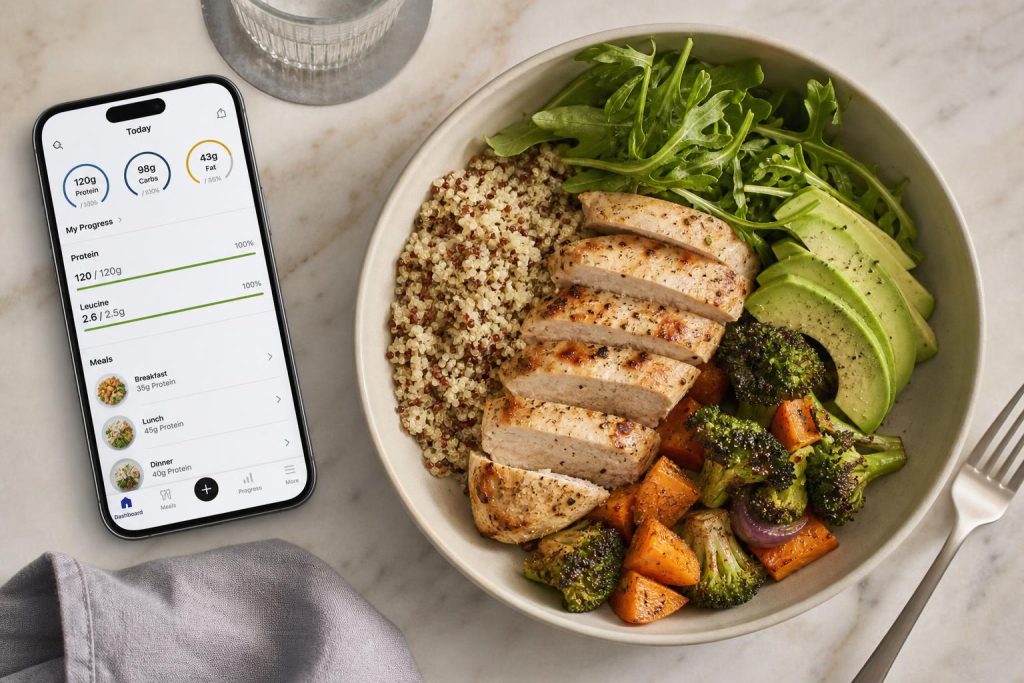
In 2009, researchers at the University of Illinois published findings that quietly rewrote the rules of muscle building. They demonstrated that muscle protein synthesis isn’t simply proportional to total protein intake — it’s gated by a specific threshold of leucine, a branched-chain amino acid, that must be reached in a single sitting before anabolic signaling meaningfully activates. That research introduced a concept that remains one of the most actionable findings in sports nutrition: the leucine threshold. If you’re not clearing it, you’re leaving muscle on the table — regardless of how much protein you think you’re eating.
This matters for every man pursuing a better physique, whether you’re hitting the gym five days a week, managing calories on a structured diet, or using GLP-1 medications like semaglutide or tirzepatide to drive fat loss. The underlying biology doesn’t change based on your method. What changes is how easy or hard it becomes to hit the leucine threshold consistently — and that’s where strategy separates the men who lose fat and stay strong from those who shrink in all the wrong ways.
What the Leucine Threshold Actually Is — and Why It Matters More Than Total Protein
Leucine is one of the nine essential amino acids, and among them it holds a uniquely privileged role. It functions not just as a building block for muscle tissue but as a molecular trigger — specifically, it activates the mTORC1 signaling pathway, the master regulator of muscle protein synthesis. Think of mTORC1 as a light switch. Leucine is the hand that flips it. Without sufficient leucine in a given meal, the switch stays off, no matter how many grams of total protein you consumed.
Research published in the Journal of Physiology helped clarify that this threshold sits somewhere between 1.7 and 3.5 grams of leucine per meal for most adults, with the range shifting upward as men age due to a phenomenon called anabolic resistance — a blunted sensitivity of aging muscle to the same leucine signal. For a younger man in his twenties, a meal with roughly 25–30 grams of high-quality protein from animal sources will typically clear the threshold. For a man in his fifties or sixties, that number may need to climb toward 40 grams or higher to produce the same anabolic response.
This is why protein quantity alone is a misleading metric. Two men can both eat 160 grams of protein per day and have dramatically different muscle-building outcomes depending on how that protein is distributed across meals and what sources they’re eating. A meal of 20 grams of protein from a leucine-poor source like collagen or plant-based blends may not trigger a meaningful muscle protein synthesis response at all. Meanwhile, a single well-constructed meal with 35 grams of whey protein — which contains approximately 3 grams of leucine per serving — clears the threshold decisively. Studies comparing whey to casein and soy consistently show whey’s superiority largely because of its leucine density and rapid absorption kinetics, not because of some mysterious whey-specific magic.
Practical leucine content to know: eggs contain roughly 0.54 grams of leucine each, meaning six eggs gets you close to the lower threshold. Chicken breast delivers about 2.4 grams per 100 grams of cooked meat, so a 150-gram serving clears the floor. Greek yogurt, cottage cheese, and salmon all sit in a favorable range when portions are adequate. Where men most commonly fall short is in low-protein snacks, small meals, or overly diluted plant-protein shakes that spread amino acids too thin to flip the switch.
The GLP-1 Problem — and the Strategy That Fixes It
For men using GLP-1 receptor agonists — semaglutide, tirzepatide, or similar agents — the leucine threshold problem becomes acutely relevant. These medications work in part by significantly suppressing appetite and slowing gastric emptying, which means most users eat substantially less food overall. Clinical trial data from the SURMOUNT-1 study on tirzepatide showed impressive fat loss outcomes, but analyses of body composition data raised a flag that practitioners have since taken seriously: a meaningful percentage of weight lost on GLP-1 medications is lean mass, not just fat. When caloric intake collapses and protein hits are too small to clear the leucine threshold meal after meal, muscle loss accelerates.
This isn’t a reason to avoid GLP-1 medications — for men with obesity or metabolic dysfunction, the benefits are well-documented and significant. But it is a reason to be deliberate about protein strategy while using them. The practical approach is protein-first eating: treating each reduced-appetite meal as an opportunity to front-load leucine-rich protein before anything else. If nausea limits you to 300 calories at lunch, those 300 calories should skew heavily toward a high-quality protein source rather than carbohydrates or fats that do nothing for muscle protein synthesis. Leucine supplementation — typically 2.5 to 3 grams of free-form leucine added to a meal that would otherwise fall short — has also shown promise in older and calorically restricted individuals as a way to rescue an anabolic response from a meal that might otherwise miss the threshold.
Resistance training amplifies this entire picture. Exercise increases muscle sensitivity to leucine and extends the post-workout window during which protein synthesis is elevated. Research from McMaster University demonstrated that resistance exercise potentiates the muscle protein synthesis response to leucine-containing protein, meaning the same dose of leucine hits harder in a post-training context than it does at rest. This is one of the strongest arguments for combining structured lifting with any fat loss protocol, GLP-1-assisted or otherwise — you’re not just burning calories, you’re upregulating the machinery that converts dietary leucine into preserved or built muscle tissue.
For men who aren’t on medications and are simply managing a caloric deficit through traditional diet and exercise, the leucine threshold is equally relevant. Sub-threshold protein hits are one of the primary reasons men in a cut feel flat, lose strength, and find themselves lighter on the scale but softer in the mirror. Distributing protein across three to four meals — each with at least 30 to 40 grams of high-leucine protein — maintains a repeated anabolic stimulus throughout the day rather than one large hit that saturates capacity and several smaller hits that fall short of doing anything meaningful.
What This Means For You
The leucine threshold reframes how any man should think about protein. It’s not about hitting a daily number and calling it done. It’s about structuring meals so that each eating opportunity clears the threshold required to switch on muscle protein synthesis — every time. Choose leucine-dense sources: whey protein, eggs, chicken, beef, salmon, cottage cheese. Ensure each meal reaches an adequate dose rather than spreading protein too thinly across five or six small hits. If you’re in a significant caloric deficit — whether from GLP-1 suppression, aggressive dieting, or competition prep — consider free-form leucine supplementation as a practical insurance policy to rescue the anabolic response from smaller meals. And lift weights consistently, because resistance training is the multiplier that makes every gram of leucine you eat work harder. The men who understand this aren’t just losing weight — they’re losing fat and keeping the muscle that makes that transformation worth it.