Here is a number that should get your attention: in clinical studies examining men and women who lost significant weight through diet, exercise, or pharmacological intervention, a consistent pattern emerges — the scale moves in the right direction, but the skin does not always follow. A 2026 systematic review published in Aesthetic Plastic Surgery analyzing 40 studies found that weight-loss-induced fat reduction frequently results in dermal thinning, loss of collagen and elastin fibers, and decreased skin elasticity. This is not a vanity issue — it is a structural one, rooted in how your body manages the extracellular matrix when fat stores shrink faster than the skin can adapt.
Collagen peptides have emerged as one of the most discussed nutritional strategies for addressing exactly this problem. Walk into any supplement store or scroll through any fitness forum and you will find them everywhere. But the real question is whether the science behind them is as solid as the marketing suggests — and whether they are actually relevant to men pursuing fat loss, muscle preservation, and long-term metabolic health. The answer, based on the current body of clinical evidence, is more nuanced and more promising than most people realize.
What Happens to Your Skin When You Lose Weight
To understand why collagen peptides matter, you first need to understand what rapid or significant weight loss actually does to the body’s largest organ. Subcutaneous fat is not just dead weight. It provides structural scaffolding beneath the skin, keeping it taut and supported. When that fat disappears — whether through caloric restriction, resistance training, bariatric surgery, or GLP-1 receptor agonist medications — the overlying skin must contract and remodel to match the new body composition beneath it.
A 2026 narrative review in the Journal of Drugs in Dermatology documented exactly what this process looks like at a tissue level: rapid weight loss impacts collagen content, elastic fiber integrity, adipose compartment volume, muscle mass, and even bone density. The skin’s ability to rebound depends heavily on its collagen and elastin density — two proteins that naturally decline with age and are further stressed by the physiological demands of major fat loss. Men over 35 face a compounded challenge here because baseline collagen synthesis is already declining at roughly one percent per year after the mid-twenties.
The same review emphasized that a multidisciplinary, evidence-informed approach is critical for managing these structural concerns — and nutritional optimization sits at the top of that strategy. This is where protein intake broadly, and collagen peptides specifically, enter the conversation. The skin’s extracellular matrix is a living, dynamic structure. It can be supported and partially rebuilt through targeted nutrition if the right substrates are available at the right time.
A 2026 review in Dermatologic Surgery added further mechanistic detail, noting that weight loss — particularly rapid weight loss — can reduce fibroblast function, decrease collagen production, increase collagen degradation, and deplete glycosaminoglycans. These glycosaminoglycans, including hyaluronic acid, are what keep skin hydrated and plump. When they drop alongside collagen and elastin, the structural consequence is visible: laxity, sagging, and accelerated signs of aging. The same paper noted that growth factors, peptides, and targeted topical formulations show clinical evidence of helping address post-weight-loss skin quality — but oral nutrition remains the foundation that any other intervention builds on.
What the Research Actually Says About Collagen Peptides
Collagen peptides — also called hydrolyzed collagen or collagen hydrolysate — are collagen proteins that have been broken down into smaller amino acid chains through enzymatic hydrolysis. This process makes them more bioavailable than intact collagen, allowing them to be absorbed through the gut and enter systemic circulation as peptide fragments that the body can use directly.
A 2026 narrative review in Nutrients representing one of the most comprehensive summaries of current clinical evidence found that collagen-derived peptide supplementation has been associated with measurable improvements in skin hydration, elasticity, wrinkle appearance, and dermal extracellular matrix organization. The review also reported benefits extending to hair thickness and strength, modest improvements in nail growth, and support for wound healing — all outcomes that matter to men going through body recomposition. Critically, the authors identified that benefits are most consistent with low-molecular-weight hydroxyproline-rich peptides, and that peptide characteristics appear more important than collagen source — meaning whether it comes from bovine hide, marine sources, or chicken sternal cartilage matters less than the molecular weight and amino acid profile of the final product.
This is a clinically meaningful finding because it gives you a practical filter when evaluating products. Low-molecular-weight peptides — generally under 5,000 daltons — have demonstrated the most consistent absorption and downstream effects on fibroblast activity. Hydroxyproline, an amino acid almost unique to collagen, appears to be the key driver. When it reaches dermal fibroblasts in peptide form, it signals the cell to upregulate collagen synthesis — essentially telling your skin that there is raw material available and that production should increase. This is a plausible and increasingly well-documented mechanism, not just supplement company marketing language.
A 2020 review in Antioxidants added important mechanistic depth, confirming that oral ingestion of hydrolyzed collagen increases circulating levels of collagen-derived peptides in the bloodstream and improves skin properties including elasticity, moisture retention, and transepidermal water loss. The same research highlighted that hydrolyzed collagen also stimulates fibroblast proliferation and extracellular matrix production, and offers antioxidant properties linked to the presence of hydrophobic amino acids and histidine in the peptide structure. The antioxidant dimension is worth noting because oxidative stress is one of the accelerators of collagen degradation — so a supplement that provides both the building blocks for new collagen and protection against the enzymes that break existing collagen down represents meaningful dual-action support.
The honest caveat in the literature is that many studies are short in duration — often eight to twelve weeks — use heterogeneous formulations, and are funded by industry. The Nutrients review explicitly flagged these limitations and called for longer, independently funded trials with standardized outcomes. That is a fair scientific objection. At the same time, the consistent directional trend across dozens of human clinical trials — improvements in elasticity and hydration being the most replicated findings — is not something to dismiss. The effect sizes may be modest and the ideal dosing protocol not yet locked down, but the mechanistic plausibility combined with the clinical signal makes collagen peptides one of the more defensible supplements a man can take during a fat loss phase.
How to Use Collagen Peptides Intelligently During a Fat Loss Phase
If you are in a caloric deficit — whether through a structured diet, intermittent fasting, a GLP-1 medication, or simply clean eating and consistent training — your collagen infrastructure is under pressure. Your skin is losing structural support as fat depletes, your overall protein turnover is elevated, and your fibroblasts are working in a nutritionally compromised environment. This is the context in which supplemental collagen peptides are most likely to provide meaningful benefit.
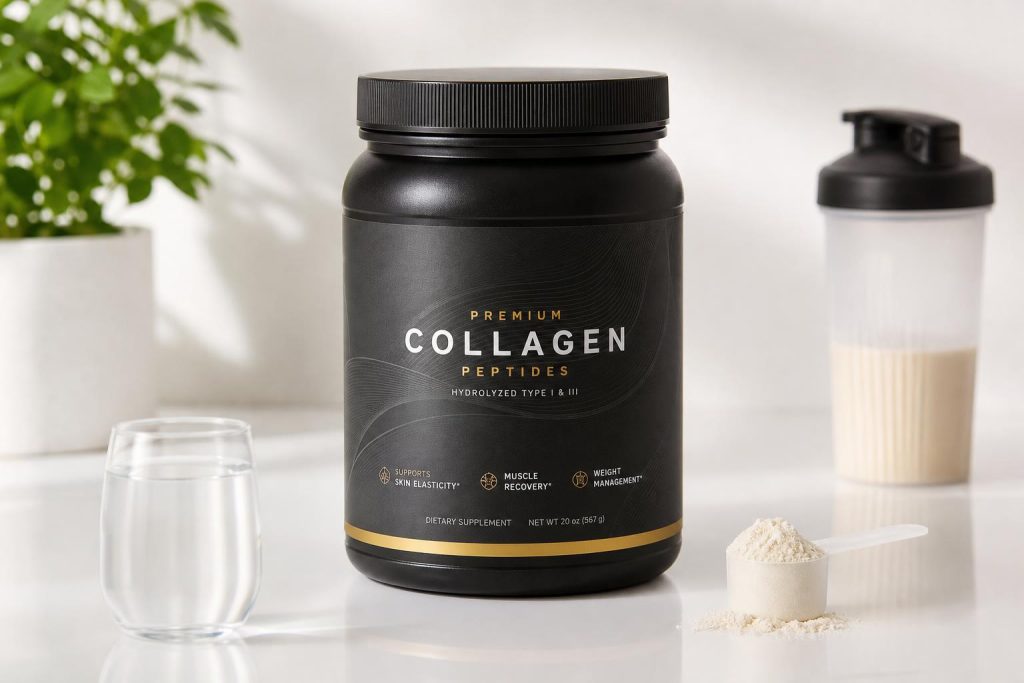
The practical protocol that the current research supports looks like this: ten to fifteen grams of hydrolyzed collagen peptides per day, ideally in a formulation specifying low molecular weight (under 5,000 daltons) and hydroxyproline content. Timing matters less than consistency, but some evidence suggests taking it alongside a vitamin C source may enhance collagen synthesis, since ascorbic acid is a required cofactor in the hydroxylation of proline and lysine — the steps that make collagen structurally stable. A glass of citrus juice or a dedicated vitamin C supplement taken alongside your collagen powder covers this base without overcomplicating your routine.
Collagen peptides are not a replacement for a high total protein intake. They lack tryptophan and are not a complete protein source for muscle protein synthesis. A man in active body recomposition still needs one point six to two point two grams of protein per kilogram of bodyweight from high-quality complete sources — whey, eggs, meat, fish, and legumes. Collagen peptides work best understood as a targeted supplement layered on top of that foundation, specifically aimed at skin, tendon, ligament, and joint connective tissue — structures that are often underserved by conventional high-protein diets that prioritize muscle.
Hydration deserves equal emphasis. The dermatological research across multiple reviews consistently identifies poor hydration as a compounding risk factor for accelerated skin quality decline during weight loss. Glycosaminoglycans in the skin matrix are water-binding molecules — they need systemic hydration to function. Targeting three or more liters of water per day during an active fat loss phase is not excessive; it is structural maintenance. Combine this with resistance training, which preserves the muscular scaffolding beneath the skin and mechanically stimulates fibroblast activity through loading forces on connective tissue, and you have a comprehensive approach that no single supplement can replicate on its own.
The Takeaway
Collagen peptides are not magic, and anyone selling them as a dramatic fat-burning solution is overstating what the science supports. But framed correctly — as a targeted connective tissue support strategy during fat loss, backed by a reasonable and growing body of clinical evidence — they represent one of the more sensible additions a man can make to his supplement stack when the goal is to lose fat without losing the structural integrity of his skin in the process. The research on skin elasticity improvements is the most consistent signal in the literature, and the mechanistic explanation is credible. If you are losing meaningful weight, getting older, or both, the cost-benefit calculus here is straightforward. Take the peptides, dial in your protein, stay hydrated, keep lifting, and give your skin the same attention you give the rest of your physiology.
Scientific References
-
Barone, Brunetti, D’Emilio et al. (2026).
Effects of GLP-1 Receptor Agonists on Skin Quality: A Comprehensive Literature Review..
Aesthetic plastic surgery.
View on PubMed → -
Fathizadeh, Palm, Hooper et al. (2026).
Weight Loss and Its Impact on Soft Tissue..
Journal of drugs in dermatology : JDD.
View on PubMed → -
Biełach-Bazyluk, Jurga, Flisiak et al. (2026).
Dietary Collagen Supplementation as a Strategy for Skin Health: A Narrative Review of Clinical Effects on Skin, Hair, Nails, and Wound Healing..
Nutrients.
View on PubMed → -
Aguirre-Cruz, León-López, Cruz-Gómez et al. (2020).
Collagen Hydrolysates for Skin Protection: Oral Administration and Topical Formulation..
Antioxidants (Basel, Switzerland).
View on PubMed → -
Shridharani, Kourosh, Saltzman et al. (2026).
The Potential Role of Topical Skincare Approaches After Glucagon-like Peptide-1 Receptor Agonist Use and Rapid Weight Loss..
Dermatologic surgery : official publication for American Society for Dermatologic Surgery [et al.].
View on PubMed →