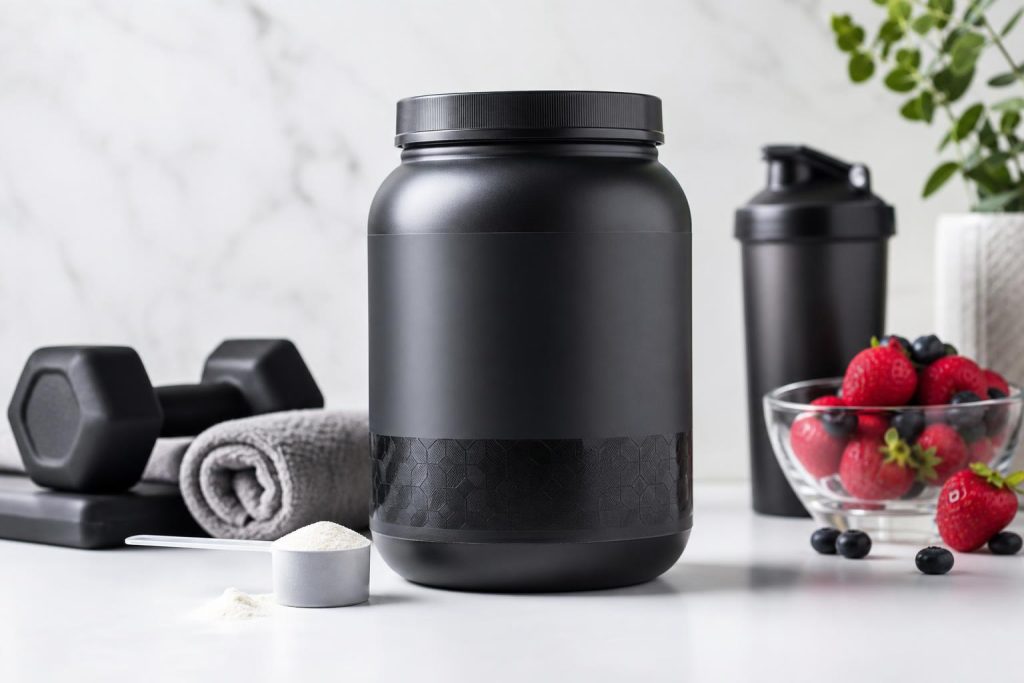
Here’s a statistic that should get your attention: a 2026 systematic review published in Aesthetic Plastic Surgery found that rapid weight loss — whether through GLP-1 medications, bariatric surgery, or aggressive dieting — consistently leads to measurable loss of collagen and elastin fibers, decreased skin elasticity, and visible changes in skin morphology. The researchers analyzed 40 studies and concluded that dermal thinning and redundant skin folds are not rare edge cases — they’re a predictable consequence of significant fat loss, particularly when it happens quickly and without nutritional support.
That finding has quietly reshuffled the conversation around collagen peptides — a supplement category that many serious men once dismissed as a product for women’s anti-aging routines. The reality is more nuanced and more relevant to anyone who is actively losing fat, building muscle, or trying to look as good as they feel. Whether you’ve dropped 40 pounds through a dedicated training program, you’re using a GLP-1 medication like semaglutide, or you’ve overhauled your diet and watched the scale move dramatically, your skin is responding to every pound you lose. The question is whether collagen supplementation can meaningfully support that process — and what the science actually says about dosing, form, and realistic expectations.
What Happens to Your Skin When You Lose Weight
Skin isn’t just a passive wrapper around your body. It’s a living organ with a complex extracellular matrix built largely from collagen and elastin — proteins that give skin its tensile strength, bounce-back ability, and structural integrity. When you carry excess body fat for years, your skin gradually stretches and adapts. When that fat disappears — especially rapidly — the dermis doesn’t always snap back the way you’d hope.
A 2026 narrative review in the Journal of Drugs in Dermatology laid out the full scope of this problem with clinical precision. Rapid weight loss impacts collagen, elastic fibers, adipose tissue, muscle mass, and even skeletal integrity, the authors concluded — noting that patients experience decreased skin firmness and structural changes that go well beyond aesthetics. The dermatologic and physical consequences are real, and they’re increasingly being seen in clinics as more men pursue aggressive fat loss goals.
The mechanisms driving this aren’t hard to understand. Subcutaneous fat provides a scaffolding effect beneath the skin. As that volume depletes, the overlying skin loses support. Simultaneously, caloric restriction — necessary for any meaningful fat loss — can impair the body’s ability to synthesize new collagen if protein and specific micronutrient intake are insufficient. Add in the oxidative stress and inflammation that often accompany obesity and rapid dieting, and you have a perfect environment for accelerated dermal aging. A separate 2026 review in Dermatologic Surgery confirmed that rapid fat loss specifically disrupts the dermal extracellular matrix, reducing fibroblast function and increasing the degradation of collagen, elastic fibers, and glycosaminoglycans — the key molecules that keep skin plump and resilient.
For men who are older, have a longer history of obesity, or are losing weight particularly fast, the risk is more pronounced. But no man pursuing serious fat loss is entirely immune. This is precisely where targeted nutrition — including collagen peptide supplementation — enters the conversation as a legitimate clinical and practical consideration, not just a cosmetic afterthought.
What the Research Actually Says About Collagen Peptides
Collagen peptides are hydrolyzed fragments of collagen protein — broken down into short chains of amino acids, primarily glycine, proline, and hydroxyproline, that are small enough to be absorbed intact through the gut and circulate in the bloodstream. The working theory is that these peptides act as bioactive signaling molecules that stimulate fibroblasts — the cells responsible for producing new collagen and elastin — to ramp up production. Think of them less like raw building blocks and more like biological text messages telling your skin cells to get to work.
The most comprehensive recent evaluation of this field comes from a 2026 narrative review in Nutrients, which performed a targeted literature search across PubMed and Web of Science to assess the clinical evidence on oral collagen supplementation. The authors found that collagen-derived peptide supplementation has been consistently associated with improvements in skin hydration, elasticity, wrinkle appearance, and dermal extracellular matrix organization — with benefits also extending to hair thickness, nail quality, and wound healing outcomes.
Importantly, the review identified a critical nuance that most supplement marketing ignores: peptide characteristics appear to matter more than the source of the collagen. Low-molecular-weight hydroxyproline-rich peptides showed the most consistent benefits across studies. This means that not all collagen supplements are created equal, and the molecular weight and amino acid profile of the product you choose have a meaningful bearing on whether it actually works. Marine collagen, bovine collagen, and chicken sternum collagen can all produce effective peptides — but the hydrolysis process and resulting peptide size are the variables that drive efficacy.
An earlier but foundational review published in Antioxidants adds another layer to this picture. Oral ingestion of hydrolyzed collagen increases the levels of collagen-derived peptides in circulation and demonstrably improves skin elasticity, moisture, and transepidermal water loss, while also enhancing fibroblast production and extracellular matrix density. The review also highlights an underappreciated benefit: hydrolyzed collagen has meaningful antioxidant properties, largely due to hydrophobic amino acids that neutralize free radicals — which is directly relevant to men in caloric restriction, where oxidative stress tends to increase.
The honest caveat in this literature is that many studies are short in duration, use multi-ingredient formulations that make it difficult to isolate collagen’s contribution, and are partially funded by industry. The Nutrients review authors are explicit about this limitation. Taken together, however, the mechanistic plausibility is strong, the safety profile is excellent, and the balance of human trial data is directionally positive — particularly for skin elasticity and hydration endpoints that are directly relevant to men losing significant amounts of body fat.
It’s also worth addressing the weight loss angle directly. Collagen peptides are not a fat loss supplement in any meaningful sense — the evidence for a direct metabolic effect is thin. However, they are a high-quality protein source with a modest satiety effect, and adequate protein intake during fat loss is one of the most consistently supported strategies for preserving lean muscle mass. The indirect contribution collagen makes to body composition goals — through protein adequacy and muscle preservation — is real even if it’s not the primary reason to take it. Men who are lean bulking or maintaining while cutting will get more mileage from whey or casein for muscle protein synthesis, but collagen fills a complementary nutritional role that supports the connective tissue, joint, and skin demands of an active body.
How to Use Collagen Peptides Effectively
The dosing range used in the majority of positive clinical trials falls between 2.5 and 10 grams per day, with most studies showing meaningful skin outcomes at 5 to 10 grams taken consistently over a minimum of 8 to 12 weeks. Results are not immediate — collagen remodeling is a slow biological process, and anyone expecting visible skin improvement in two weeks is going to be disappointed. Think in terms of three to six month commitments, especially if you’re in the middle of an active fat loss phase where your skin is actively challenged.
Bioavailability can be enhanced by taking collagen peptides alongside vitamin C, which is an essential cofactor in collagen synthesis. Zinc, copper, and adequate overall protein intake also support the fibroblast activity that makes supplementation clinically meaningful. If you’re eating enough protein from whole food sources — which men focused on physique and performance generally are — collagen supplements add specific amino acids and bioactive peptides that aren’t abundant in muscle meat or dairy. This is a genuine nutritional gap that supplementation addresses rather than a redundancy.
For men who have lost substantial weight — particularly those who notice skin laxity on the face, neck, arms, or abdomen — collagen peptide supplementation is best understood as one component of a multimodal strategy. The Journal of Drugs in Dermatology review recommends resistance training, nutritional optimization, and in more advanced cases, energy-based dermatologic devices or biostimulatory injectables as a comprehensive approach. Collagen supplements alone won’t reverse significant loose skin — that’s an unrealistic expectation — but as part of a stack that includes adequate total protein, strength training, hydration, and sun protection, they contribute to a more favorable skin remodeling environment during and after fat loss.
Men currently using GLP-1 medications deserve a specific note here. The 2026 Aesthetic Plastic Surgery systematic review found that insufficient protein intake was among the primary risk factors for more severe dermatological outcomes in GLP-1 users — a population that often experiences significant appetite suppression that can compromise protein targets. Prioritizing protein, including from collagen peptides, becomes even more clinically important in this context. But this principle applies broadly: any man in a meaningful caloric deficit should be proactively protecting the structural proteins his skin and connective tissue depend on.
What This Means For You
The research makes a compelling case that collagen peptides — specifically low-molecular-weight hydroxyproline-rich formulations — are among the more evidence-backed supplements available for men who want to protect skin quality during and after significant fat loss. They’re not magic, and they won’t compensate for a poor diet, inadequate training, or chronic dehydration. But the mechanistic and clinical evidence is solid enough that dismissing them as a purely cosmetic product misses the point.
If you’re dropping weight, you are losing fat from under your skin. Your dermis is remodeling whether you support it or not. Taking 5 to 10 grams of hydrolyzed collagen daily alongside a protein-sufficient diet and consistent resistance training is one of the more evidence-informed moves you can make to ensure that when you arrive at your goal weight, the skin you’re in reflects the effort you’ve put in.
Scientific References
-
Barone, Brunetti, D’Emilio et al. (2026).
Effects of GLP-1 Receptor Agonists on Skin Quality: A Comprehensive Literature Review..
Aesthetic plastic surgery.
View on PubMed → -
Fathizadeh, Palm, Hooper et al. (2026).
Weight Loss and Its Impact on Soft Tissue..
Journal of drugs in dermatology : JDD.
View on PubMed → -
Biełach-Bazyluk, Jurga, Flisiak et al. (2026).
Dietary Collagen Supplementation as a Strategy for Skin Health: A Narrative Review of Clinical Effects on Skin, Hair, Nails, and Wound Healing..
Nutrients.
View on PubMed → -
Aguirre-Cruz, León-López, Cruz-Gómez et al. (2020).
Collagen Hydrolysates for Skin Protection: Oral Administration and Topical Formulation..
Antioxidants (Basel, Switzerland).
View on PubMed → -
Shridharani, Kourosh, Saltzman et al. (2026).
The Potential Role of Topical Skincare Approaches After Glucagon-like Peptide-1 Receptor Agonist Use and Rapid Weight Loss..
Dermatologic surgery : official publication for American Society for Dermatologic Surgery [et al.].
View on PubMed →