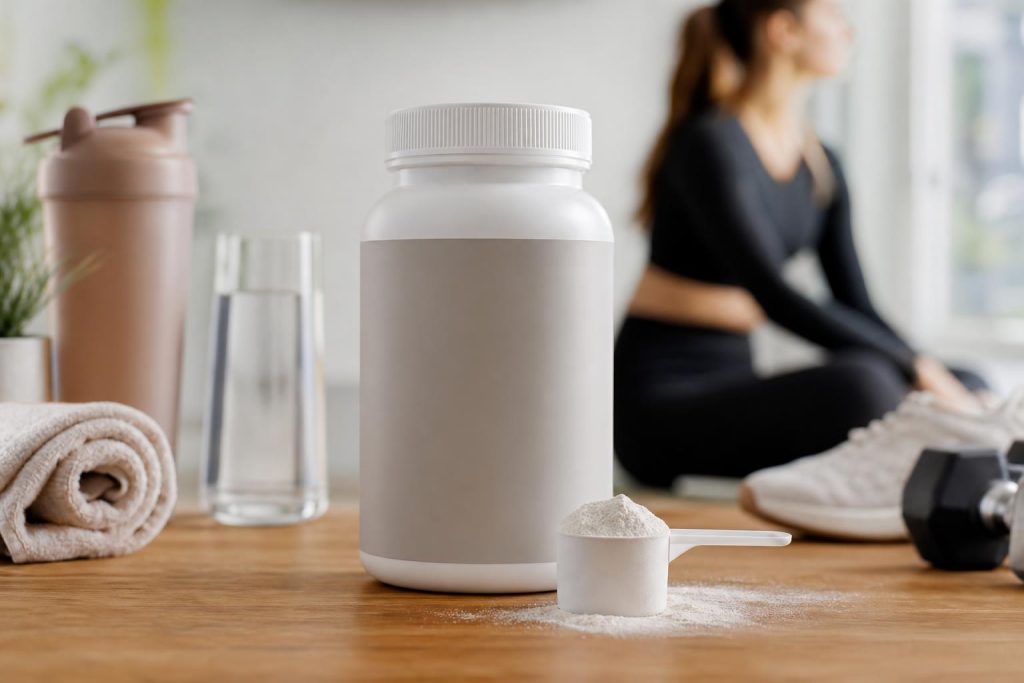
If you’ve been losing weight — whether through disciplined dieting, hard training, or pharmacological support — there’s a good chance your skin has started telling a different story than your scale. Loose skin, reduced firmness, and that vaguely deflated look aren’t just cosmetic annoyances. They’re signs of real structural changes happening beneath the surface, and collagen peptides may be one of the most practical tools available to address them.
A 2026 narrative review published in Nutrients by Biełach-Bazyluk and colleagues offers one of the most thorough evaluations of oral collagen supplementation to date, concluding that collagen-derived peptides are associated with meaningful improvements in skin hydration, elasticity, wrinkle appearance, and extracellular matrix organization. The caveat? Benefits appear most consistent with low-molecular-weight, hydroxyproline-rich peptides — and the peptide characteristics matter more than the collagen source. In other words, not all collagen products are created equal.
What Rapid Weight Loss Actually Does to Your Skin
Here’s the part most fitness content glosses over. When you shed fat quickly — regardless of how you got there — the structural scaffolding of your skin doesn’t automatically snap back into shape. A 2026 review in the Journal of Drugs in Dermatology found that rapid weight loss impacts collagen, elastic fibers, adipose tissue, muscle mass, and even skeletal integrity, with consequences that go well beyond aesthetics. Patients experience decreased skin firmness, muscle loss, and reduced tissue density — changes that require a proactive, multi-pronged management strategy.
This is especially relevant for men who lose significant amounts of weight in a compressed timeframe. The dermis relies on an organized network of collagen and elastin fibers to maintain its architecture. When subcutaneous fat diminishes faster than the skin can adapt, you’re left with structural redundancy — essentially skin that has lost its internal support system. A separate 2026 systematic review in Aesthetic Plastic Surgery zeroed in on this mechanism specifically, finding that rapid weight-loss-induced changes include dermal thinning, loss of collagen and elastin fibers, and decreased skin elasticity, with risk factors including advanced age, prolonged obesity history, poor hydration, and insufficient protein intake. That last one is particularly actionable.
The good news is that the skin’s extracellular matrix isn’t static. It’s a dynamic tissue that responds to nutritional signals — which is exactly where collagen peptide supplementation enters the picture.
How Collagen Peptides Work and What They Actually Do
The mechanism behind oral collagen supplementation is more sophisticated than it might appear on a supplement label. When you ingest hydrolyzed collagen — collagen that’s been broken down into smaller peptide fragments — those peptides are absorbed through the gut and circulate in the bloodstream, where they appear to stimulate fibroblast activity and upregulate the body’s own collagen synthesis. A 2020 review in Antioxidants confirmed that oral ingestion of hydrolyzed collagen increases collagen-derived peptides in the bloodstream and improves skin elasticity, moisture, and transepidermal water loss, while also supporting fibroblast production and extracellular matrix integrity.
Beyond structural support, hydrolyzed collagen carries meaningful antioxidant properties. The same review noted that the antioxidant capacity of collagen peptides correlates with lower molecular weight — smaller peptides donate electrons more effectively to neutralize free radicals, which are a significant driver of skin aging and tissue degradation during periods of metabolic stress. This is one reason why the molecular weight of your collagen supplement isn’t just marketing language — it’s a functionally relevant characteristic.
The 2026 Nutrients review adds important texture to the dosing and formulation question. Across the clinical trials evaluated, improvements in skin elasticity and hydration were most consistently seen with low-molecular-weight hydroxyproline-rich peptides taken daily, typically in the range of 2.5 to 10 grams per day. The review also flagged that multi-ingredient formulations — products that combine collagen with vitamin C, hyaluronic acid, or biotin — complicate the ability to isolate collagen’s specific contribution, though vitamin C in particular is well-established as a necessary cofactor for collagen synthesis and is a reasonable co-ingredient to look for.
It’s worth being clear-eyed about the limitations the research itself acknowledges. Most studies are short in duration, many are industry-funded, and outcome measures vary between trials. The Nutrients review explicitly notes that high-quality, long-term, independently funded trials are still needed to confirm the magnitude of these effects. That doesn’t mean the evidence is weak — it means you should be skeptical of any collagen product claiming dramatic, guaranteed results, while still recognizing that the directional signal from the science is meaningfully positive.
For men dealing with post-weight-loss skin changes, the picture from a 2026 review in Dermatologic Surgery is also encouraging in a complementary way. The authors found that topical skincare formulations — particularly those featuring growth factors, peptides, and botanical extracts — can serve as important adjuncts by addressing reduced fibroblast function, decreased collagen production, and degradation of elastic fibers and glycosaminoglycans at the skin surface. In other words, combining oral collagen peptides with a targeted topical skincare routine appears to be a more comprehensive strategy than either approach alone.
Resistance training deserves mention here as well — not as an afterthought, but as a core pillar. The Journal of Drugs in Dermatology review specifically lists resistance-based physical activity as a primary management strategy for soft tissue changes associated with weight loss. Mechanical loading signals the body to preserve and rebuild lean tissue, which indirectly supports the structural integrity of skin by maintaining the muscle and connective tissue framework beneath it. Collagen peptides and training are synergistic, not competing strategies.
The Takeaway
Collagen peptides aren’t a magic fix, but the science increasingly supports them as a legitimate, low-risk nutritional strategy for men who want to protect skin quality during fat loss. If you’re actively losing weight — whether through a caloric deficit, a structured training program, or any other means — prioritizing adequate protein intake, staying well hydrated, training with resistance, and supplementing with a low-molecular-weight hydrolyzed collagen product (ideally alongside vitamin C) gives your skin the best available nutritional foundation. The research won’t guarantee a specific outcome, but the mechanistic rationale and the clinical evidence both point in the same direction. For a tissue that takes years of neglect to degrade and responds slowly to intervention, starting early and being consistent is the strategy that matters most.
Scientific References
-
Biełach-Bazyluk, Jurga, Flisiak et al. (2026).
Dietary Collagen Supplementation as a Strategy for Skin Health: A Narrative Review of Clinical Effects on Skin, Hair, Nails, and Wound Healing..
Nutrients.
View on PubMed → -
Barone, Brunetti, D’Emilio et al. (2026).
Effects of GLP-1 Receptor Agonists on Skin Quality: A Comprehensive Literature Review..
Aesthetic plastic surgery.
View on PubMed → -
Fathizadeh, Palm, Hooper et al. (2026).
Weight Loss and Its Impact on Soft Tissue..
Journal of drugs in dermatology : JDD.
View on PubMed → -
Aguirre-Cruz, León-López, Cruz-Gómez et al. (2020).
Collagen Hydrolysates for Skin Protection: Oral Administration and Topical Formulation..
Antioxidants (Basel, Switzerland).
View on PubMed → -
Shridharani, Kourosh, Saltzman et al. (2026).
The Potential Role of Topical Skincare Approaches After Glucagon-like Peptide-1 Receptor Agonist Use and Rapid Weight Loss..
Dermatologic surgery : official publication for American Society for Dermatologic Surgery [et al.].
View on PubMed →