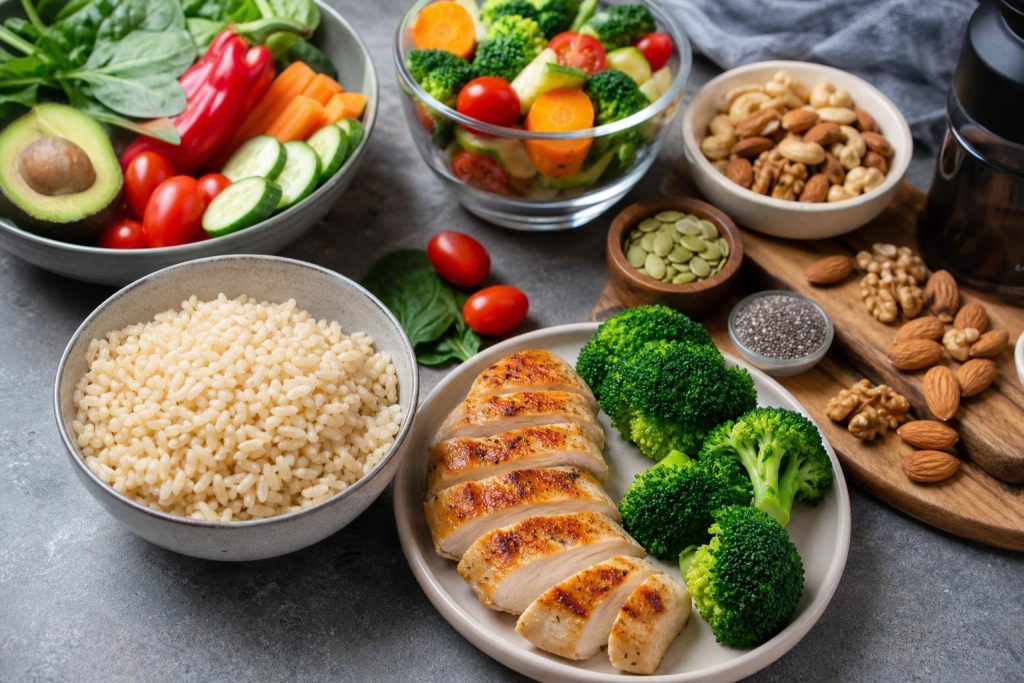
Here’s a number that should change how you think about weight loss drugs: in the landmark STEP 1 trial, participants taking semaglutide lost an average of 14.9% of their body weight over 68 weeks — but a significant portion of that weight came from lean muscle mass, not just fat. Research published in the New England Journal of Medicine confirmed the impressive scale movement, but what it didn’t headline was the composition problem underneath. When appetite drops this dramatically and calories fall off a cliff, the body doesn’t just shed fat. It cannabilizes muscle too — unless you’re deliberate about what you’re eating and how much protein you’re protecting.
This is the central challenge for any man using a GLP-1 receptor agonist like semaglutide (Ozempic, Wegovy) or tirzepatide (Mounjaro): the medication does the hard work of suppressing hunger, but it doesn’t know the difference between a disciplined calorie deficit and a starvation spiral. Without a macro tracking strategy, you can end up lighter on the scale but metabolically worse off — less muscle, slower metabolism, and a body that’s more likely to regain every pound once the prescription ends.
But here’s what makes this conversation bigger than GLP-1 medications alone. Every man pursuing fat loss — whether through keto, intermittent fasting, traditional caloric restriction, or structured training — faces the same fundamental tension: create enough of a deficit to lose fat, but not so aggressive a deficit that you sacrifice the muscle driving your metabolism. Ozempic just makes this problem more acute, more visible, and more urgent. The strategies that solve it apply universally.
Why Macros Matter More Than Calories Alone
The calorie-in, calorie-out framework is real — thermodynamics isn’t negotiable — but treating all calories as equal is where most fat loss strategies quietly fail. A 1,800-calorie day built around 180 grams of protein, adequate fats, and controlled carbohydrates produces a dramatically different physiological outcome than 1,800 calories of whatever you happened to eat. A study in the American Journal of Clinical Nutrition found that higher protein intake during caloric restriction preserved significantly more lean mass compared to standard protein intake — even when total calories were matched. This isn’t a minor rounding error. It’s the difference between losing fat and losing yourself.
For men on semaglutide or any GLP-1 agonist, appetite suppression can drive intake down to 1,000–1,200 calories per day without much conscious effort. That sounds like a dream until you realize your body interprets that signal as a famine event. Muscle protein synthesis drops. Cortisol rises. The adaptive thermogenesis literature — particularly research from Leibel and colleagues — has documented how aggressively the body downregulates metabolic rate in response to severe restriction, often far beyond what simple math would predict. Tracking macros isn’t about obsession. It’s about ensuring that even when hunger signals go quiet, your body is still getting the raw materials it needs to hold onto muscle and keep metabolism from tanking.
The practical starting point for any man in a fat loss phase — GLP-1 or not — is setting protein as the non-negotiable anchor of every meal. A target of 0.7 to 1.0 grams of protein per pound of body weight (or per pound of target body weight if you’re significantly overweight) is well-supported in the literature. Research from Helms and colleagues suggests that natural trainees in a caloric deficit benefit from protein intakes toward the higher end of this range — roughly 1.0g per pound — to offset the accelerated muscle breakdown that comes with energy restriction. For a 220-pound man targeting 190 pounds, that means roughly 190 grams of protein daily, tracked deliberately, regardless of how full or unfull he feels.
Once protein is anchored, fat and carbohydrate targets can flex based on preference and training demands. Men who train with weights — which they absolutely should be doing in any fat loss phase — benefit from keeping carbohydrate intake sufficient to fuel those sessions and support glycogen replenishment. A reasonable starting structure for an active man running a moderate deficit might look like 40% of calories from protein, 30% from carbohydrates, and 30% from fat, with adjustments made based on training volume and individual response. The specific ratio matters less than the consistency of tracking it.
Building a Calorie Deficit That Doesn’t Backfire
The ideal fat loss deficit sits somewhere between aggressive enough to produce meaningful results and conservative enough to preserve metabolic health. Most sports science and nutrition researchers converge around a deficit of 300 to 500 calories per day for sustainable fat loss with minimal muscle sacrifice — roughly 0.5 to 1.0 pounds of fat lost per week. A meta-analysis in the British Journal of Sports Medicine found that slower rates of weight loss were associated with significantly better retention of lean mass, even when total weight lost was similar to faster approaches.
For GLP-1 users, this is where active macro tracking becomes genuinely protective. The medication may suppress hunger so effectively that eating 1,000 calories feels comfortable — maybe even generous. But 1,000 calories into a training program is a fast path to muscle loss, fatigue, nutrient deficiency, and eventual metabolic adaptation that makes continued fat loss harder. The goal isn’t to eat as little as possible. The goal is to eat the right amount, structured correctly, to lose fat while keeping the muscle that makes the body worth living in.
A practical way to set your calorie target is to calculate your Total Daily Energy Expenditure (TDEE) using a validated formula like the Mifflin-St Jeor equation, then apply your activity multiplier, and subtract 300–500 calories from that number. Free apps like Cronometer or MyFitnessPal make the daily logging manageable. The critical discipline for GLP-1 users specifically is to track food even when — especially when — appetite is minimal. Eating 900 calories because you weren’t hungry is not a win. It’s a problem that requires course correction by deliberately adding protein-dense, calorie-efficient foods: Greek yogurt, cottage cheese, eggs, lean meats, protein shakes made with milk rather than water.
Protein shakes deserve a specific mention here because they solve a real problem: how do you hit 180–200 grams of protein when your appetite is blunted and the thought of a full meal feels overwhelming? A well-formulated whey or casein protein shake delivers 25–30 grams of protein in a few hundred calories, requires minimal digestive effort, and can be consumed even when solid food feels unappealing. Research in the Journal of the International Society of Sports Nutrition confirms that protein supplementation during resistance training programs significantly improves lean mass retention compared to no supplementation — a finding that holds whether you’re on a medication or not. If you’re looking for a clean, third-party tested option, a high-quality whey protein isolate with minimal fillers is worth the investment and should be a staple in any serious fat loss protocol.
Beyond the numbers, meal timing and food quality deserve attention even if they’re secondary to total intake. Spreading protein across three to four meals throughout the day — rather than concentrating it at dinner — maximizes muscle protein synthesis at each eating occasion. Studies from the laboratory of Stuart Phillips at McMaster University have consistently demonstrated that muscle protein synthesis responds to protein dose in a per-meal fashion, with roughly 0.4g/kg of body weight per meal representing a threshold below which the anabolic response begins to plateau. For a 200-pound man, that’s roughly 36 grams of protein per meal, spread across four eating occasions, to fully saturate the muscle-building signal throughout the day.
Resistance Training Is Non-Negotiable — Here’s Why
No macro strategy, no matter how well designed, fully compensates for the absence of a training stimulus. Protein preserves muscle in a deficit only when there’s a reason for the body to keep it — and that reason is mechanical loading. Resistance training sends a signal that muscle tissue is necessary and should be retained even as the body mobilizes fat for energy. Without that signal, even adequate protein intake may not fully prevent the lean mass losses that accompany significant caloric restriction.
The evidence here is unambiguous. A 2021 study in Obesity specifically examined GLP-1 receptor agonist users and found that those who combined medication with structured resistance training lost significantly more fat and preserved significantly more muscle compared to those who relied on the drug alone. This is not a subtle finding. It is arguably the most important practical takeaway for any man using a GLP-1 medication: the drug handles appetite, but your job in the gym is to protect the body composition outcomes the drug cannot control.
A minimum effective dose of resistance training during a fat loss phase is three full-body sessions per week, prioritizing compound lifts — squat patterns, hip hinges, horizontal and vertical pressing, rowing movements — performed with progressive overload at moderate to high intensity. You don’t need to train like a competitive bodybuilder. You need to train hard enough that the body perceives muscle as a survival asset worth protecting. That threshold is lower than most men think, but it requires showing up consistently and pushing with intention, not just going through the motions because the scale is moving anyway.
For men who aren’t on GLP-1 medications but are in a traditional diet-and-training fat loss phase, the same logic applies. The combination of adequate protein, a moderate calorie deficit, and regular resistance training is the single most well-validated approach to achieving meaningful fat loss while maintaining or even improving body composition. Everything else — meal timing, carb cycling, supplement stacks — operates at the margins of this foundation.
One additional consideration worth raising is the role of dietary fiber and food volume in appetite management, particularly for men who aren’t using pharmacological appetite suppression. High-fiber, high-volume foods — vegetables, legumes, whole fruits — provide satiety at a low caloric cost, making it easier to sustain a deficit without constant hunger. Research in the journal Nutrients found that dietary fiber intake was independently associated with improved weight loss outcomes and better adherence to calorie-restricted diets. Building meals around a protein anchor and a large volume of vegetables before adding calorie-dense foods is a simple structural approach that works whether you’re eating 1,600 or 2,400 calories per day.
Tracking apps, food scales, and macro logging tools are the infrastructure, not the strategy. The strategy is knowing what you’re trying to achieve — preserve muscle, lose fat, sustain the deficit without metabolic catastrophe — and using the data those tools provide to make real-time adjustments. If your protein is consistently falling short, you reorganize your meals to front-load protein earlier in the day. If your total calories are drifting below your floor, you add a protein shake or a structured snack. If fat loss stalls, you audit your tracking for the common errors: underestimating oils, overlooking caloric beverages, eyeballing portions that are larger than assumed. The number doesn’t lie. But only if you’re actually recording it honestly.
What This Means For You
Whether you’re using semaglutide, following a structured meal plan, or just grinding through a calorie deficit the old-fashioned way, the fundamentals don’t change. Protein is the priority — anchor it, hit it daily, distribute it across meals. Set a deficit that’s aggressive enough to produce fat loss but conservative enough to protect muscle and metabolic rate. Train with weights consistently, because no amount of pharmaceutical appetite suppression replaces the anabolic stimulus of mechanical loading. And track your intake with enough honesty and precision to know whether you’re actually executing the plan or just assuming you are.
GLP-1 medications are a powerful tool, and for the right men in the right circumstances, they represent a genuine clinical advancement in metabolic health. But they are a lever, not a solution. They move one variable — appetite — while leaving body composition, metabolic adaptation, and long-term muscle health entirely in your hands. Macro tracking closes that gap. It turns a passive weight loss process into an active body recomposition strategy. And that distinction, over months and years, is the difference between a man who loses weight and a man who transforms his physiology.
Start with your protein target. Build your deficit around it. Train like the muscle matters — because it does. The rest is details.