Here is a number worth sitting with: in a landmark 12-week trial, once-weekly semaglutide reduced total daily energy intake by 24% compared to placebo — a reduction of roughly 3,036 kilojoules per day. Research published in Diabetes, Obesity & Metabolism showed that this dramatic caloric suppression came largely from reduced hunger, fewer food cravings, and a measurably lower preference for high-fat, energy-dense foods. For men trying to lose body fat, that sounds like exactly what the doctor ordered. And technically, it is. But buried inside that impressive caloric deficit is a serious problem that most men on Ozempic never see coming: when you eat significantly less, you are also at serious risk of eating far too little protein — and that is where muscle loss begins.
Ozempic (semaglutide) works by mimicking the glucagon-like peptide-1 hormone, which acts on receptors throughout the brain and gut to suppress appetite, slow gastric emptying, and reduce overall food intake. According to Drucker’s 2022 review in Molecular Metabolism, GLP-1 receptor agonists exert their weight-loss effects primarily by reducing calorie consumption rather than dramatically increasing energy expenditure. The drug does not selectively eliminate fat. It eliminates appetite. What happens to your body composition during that weight loss — whether you lose fat, muscle, or both — depends almost entirely on how deliberately you manage your nutrition, and specifically your protein intake.
Why Muscle Loss Is the Hidden Risk Nobody Talks About
When the body is in a significant caloric deficit — the kind that semaglutide reliably produces — it does not automatically reach into fat stores for all of its energy needs. Without adequate dietary protein, the body increasingly turns to lean tissue for fuel. This process, known as muscle protein catabolism, is accelerated when protein intake falls below the threshold needed to stimulate muscle protein synthesis. For a man in his 40s or 50s already battling age-related muscle loss, spending months in a low-protein caloric deficit can quietly erode the muscle mass that drives metabolism, supports joint health, and determines long-term physical capability.
The risk is compounded by how Ozempic changes eating behavior. The same study that documented semaglutide’s dramatic appetite suppression also found a reduced preference for high-fat foods. While that sounds positive on the surface, it often means men unconsciously shift away from calorie-dense, protein-rich foods like red meat, eggs, and full-fat dairy — and toward lighter, lower-protein options that feel easier to stomach. The result is a diet that is lower in both calories and protein simultaneously, which is the worst-case scenario for preserving lean mass during weight loss.
Body composition data from GLP-1 research reinforces this concern. A 2023 study in Diabetes Care comparing tirzepatide and semaglutide found that both drugs produced significant fat mass reductions, but the weight lost was a combination of fat and lean tissue — not fat alone. Without deliberate protein prioritization and resistance training, the lean mass component of that weight loss can be substantial, potentially setting men up for a lower resting metabolic rate, reduced strength, and greater difficulty maintaining their results long-term.
How Much Protein You Actually Need on Ozempic
The standard dietary reference intake for protein — 0.8 grams per kilogram of body weight — is a floor designed to prevent deficiency, not a target designed to preserve muscle during aggressive caloric restriction. For men on semaglutide who are actively losing weight, the evidence consistently points toward a significantly higher target. Most sports nutrition and clinical weight-loss research supports a range of 1.6 to 2.2 grams of protein per kilogram of body weight per day for men trying to maintain lean mass in a deficit. For a 200-pound man, that translates to roughly 145 to 200 grams of protein daily — a target that becomes genuinely challenging when Ozempic has cut your appetite nearly in half.
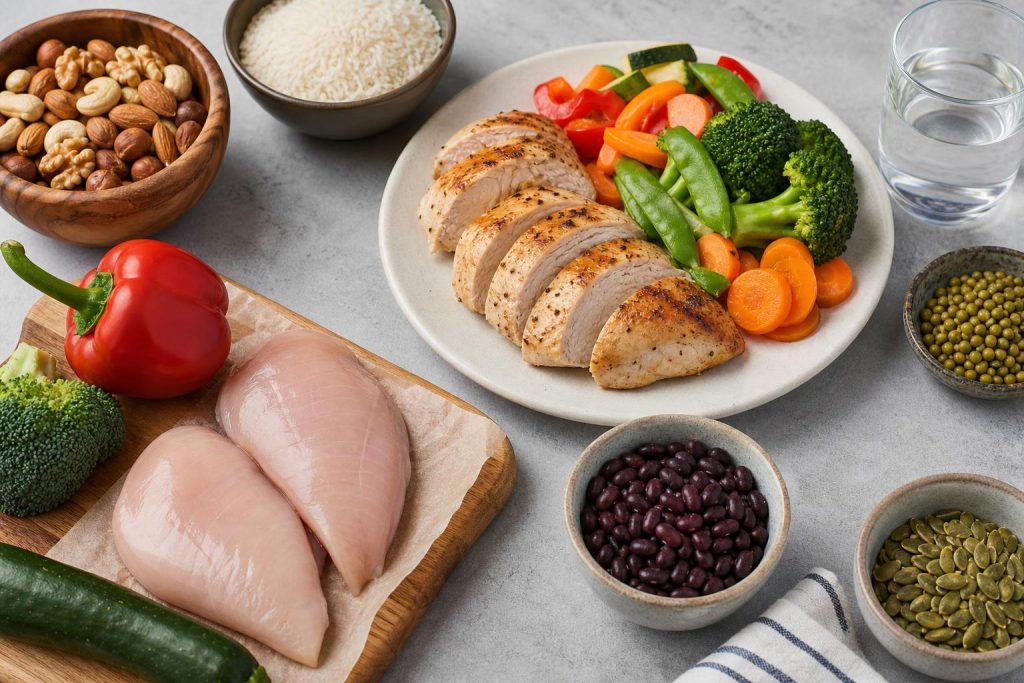
The practical strategy is to restructure meals so that protein comes first, not as an afterthought. Because semaglutide slows gastric emptying — a mechanism well-documented across GLP-1 receptor agonist pharmacology research — meals become smaller and you reach satiety faster than you normally would. That means every bite counts more. Starting a meal with your protein source — chicken, fish, eggs, lean beef, Greek yogurt — before filling in with vegetables or carbohydrates ensures that the most critical macronutrient gets consumed before appetite cuts the meal short. Waiting until the end of the plate to get to your protein is a common mistake that compounds muscle-loss risk over weeks and months.
Liquid and semi-solid protein sources often become particularly useful for men on Ozempic, especially on days when nausea or fullness makes solid meals difficult. A high-quality whey protein isolate shake, cottage cheese, or Greek yogurt can deliver 25 to 40 grams of protein in a format that clears the stomach more comfortably than a dense solid meal. This is not about replacing real food — it is about using every available format to hit a protein target that the medication makes genuinely difficult to reach through food alone.
Resistance training amplifies the protein utilization signal. Preclinical research on semaglutide’s neural mechanisms confirms that the drug’s weight loss effect operates primarily through food intake reduction rather than metabolic rate increases. That means the training you do is one of the few levers you control for preserving or building lean mass while the drug drives the caloric deficit. Lifting weights two to four times per week, combined with consistent protein intake, creates the anabolic stimulus that tells the body to hold onto muscle even as fat is being lost.
The Takeaway
Ozempic is a powerful tool for reducing body weight, and the science behind its appetite-suppressing mechanisms is robust and well-replicated. But the drug does not know the difference between fat and muscle. It simply reduces how much you eat. What you choose to eat within that reduced intake — and how deliberately you protect your protein — determines whether you come out of this process leaner and stronger or lighter but metabolically weaker. Set a daily protein target, lead every meal with your protein source, consider a quality supplement on low-appetite days, and keep lifting. The medication handles the deficit. You handle the muscle.
Scientific References
-
Drucker et al. (2022).
GLP-1 physiology informs the pharmacotherapy of obesity..
Molecular metabolism.
View on PubMed → -
Nauck, Quast, Wefers et al. (2021).
GLP-1 receptor agonists in the treatment of type 2 diabetes – state-of-the-art..
Molecular metabolism.
View on PubMed → -
Gabery, Salinas, Paulsen et al. (2020).
Semaglutide lowers body weight in rodents via distributed neural pathways..
JCI insight.
View on PubMed → -
Heise, DeVries, Urva et al. (2023).
Tirzepatide Reduces Appetite, Energy Intake, and Fat Mass in People With Type 2 Diabetes..
Diabetes care.
View on PubMed → -
Blundell, Finlayson, Axelsen et al. (2017).
Effects of once-weekly semaglutide on appetite, energy intake, control of eating, food preference and body weight in subjects with obesity..
Diabetes, obesity & metabolism.
View on PubMed →