In 2009, researchers at the University of Texas Medical Branch made a discovery that quietly reshaped how sports scientists think about protein and muscle growth. They found that muscle protein synthesis doesn’t scale linearly with protein intake — it behaves more like a light switch. Below a certain concentration of leucine in the bloodstream, the anabolic machinery inside muscle cells stays largely dormant. Above it, the switch flips, ribosomes start assembling new proteins, and muscle grows. That threshold, now well-established in the literature, sits at roughly 2 to 3 grams of leucine per meal for most healthy adults — and it has profound implications for anyone trying to build or preserve lean mass, whether you’re deep into a cut, training for performance, or navigating appetite suppression from a GLP-1 medication.
Understanding the leucine threshold isn’t just academic. It’s one of the most actionable pieces of nutrition science available to men who want to make every gram of protein they eat actually count. And given that most men still distribute protein poorly throughout the day — heavy at dinner, nearly absent at breakfast — applying this knowledge is often the difference between a body recomposition that actually works and one that spins its wheels.
How the Leucine Threshold Works at the Cellular Level
Leucine is one of the three branched-chain amino acids, but it occupies a category of its own when it comes to muscle biology. Unlike the other BCAAs — isoleucine and valine — leucine acts as a direct signaling molecule, not just a building block. Specifically, it activates mTORC1 (mechanistic target of rapamycin complex 1), the master regulator of muscle protein synthesis. When leucine rises above a threshold concentration in plasma, mTORC1 phosphorylates downstream targets including S6K1 and 4E-BP1, initiating translation of new muscle proteins. Research by Norton and Layman demonstrated that this signal is transient — it peaks within 90 to 120 minutes and returns to baseline regardless of continued amino acid availability, which is why meal frequency and distribution matter as much as total daily intake.
The critical insight here is that a sub-threshold leucine dose doesn’t just produce a smaller anabolic response — it may produce almost no measurable response at all. A meal containing 10 grams of protein from a leucine-poor source might fail to meaningfully stimulate synthesis even if the other essential amino acids are present. This is partly why plant-based proteins have historically shown inferior anabolic responses compared to whey or meat on a gram-for-gram basis — not because plant proteins are inherently inferior, but because their leucine content per gram of total protein is lower, often requiring larger servings to clear the threshold.
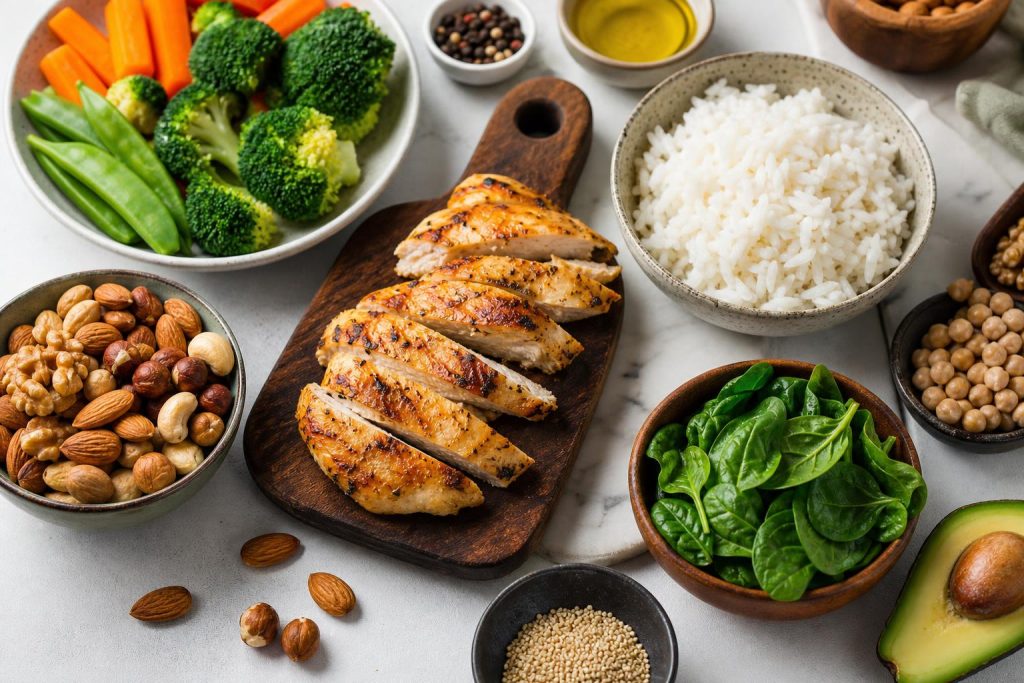
For practical purposes, hitting the leucine threshold at a given meal generally requires somewhere between 20 and 40 grams of high-quality protein, depending on the source. Whey protein concentrate typically delivers around 2.5 to 3 grams of leucine per 25-gram serving. Chicken breast provides roughly 2.7 grams per 100 grams of cooked weight. Eggs deliver about 0.54 grams per egg, meaning you’d need four to five whole eggs to reliably clear the threshold from eggs alone. These numbers aren’t ceiling targets — they’re floor targets. You need to hit them at each protein-containing meal to make that feeding anabolically effective.
Why This Matters More When You’re Eating Less
The leucine threshold becomes especially consequential during caloric restriction. When you’re in a deficit — whether from deliberate dieting, a very active lifestyle, or the appetite suppression that comes with GLP-1 receptor agonists like semaglutide or tirzepatide — total food intake drops. And when total food intake drops without a strategic approach to protein distribution, the risk of falling below the leucine threshold at multiple meals in a day increases substantially.
A 2021 analysis in Nutrients examining protein requirements during energy restriction found that muscle protein synthesis is particularly vulnerable to leucine insufficiency during a caloric deficit, because the anabolic resistance created by low energy availability means the threshold may actually shift upward — requiring slightly more leucine to produce the same mTORC1 activation. This concept of anabolic resistance is well-documented in older adults but also appears in young men under significant caloric stress. In practical terms, it means that eating less is not the time to eat casually or allow protein quality to slide.
For men using GLP-1 medications, this is a clinically meaningful issue. Studies on semaglutide and tirzepatide consistently show meaningful reductions in lean mass alongside fat loss — typically 25 to 40 percent of total weight lost comes from lean tissue in trials without structured resistance training or high protein protocols. The mechanism isn’t mysterious: appetite suppression leads to lower food intake, and if protein distribution isn’t deliberately managed, multiple meals in the day fail to clear the leucine threshold, net protein balance turns negative, and muscle is catabolized to meet systemic amino acid demands. This isn’t a problem unique to GLP-1 users — it’s the exact same problem faced by anyone doing aggressive calorie restriction without attention to protein quality and timing.
The solution, across all of these contexts, is the same: prioritize leucine-sufficient meals over total daily protein spread uniformly. Research by Areta and colleagues demonstrated that distributing 80 grams of whey protein as four 20-gram doses over 12 hours produced superior muscle protein synthesis compared to two 40-gram doses or eight 10-gram doses. The 10-gram doses failed to consistently clear the threshold. The 40-gram doses exceeded it without adding proportional benefit at the top end. Four threshold-clearing doses hit the sweet spot — enough leucine signal at each feeding to maximally stimulate synthesis, with enough time between feedings for the mTORC1 signal to reset and respond again.
Building a Leucine-Optimized Protein Strategy
Translating threshold science into real eating habits requires thinking less about total daily protein as a single number and more about per-meal leucine delivery. A man eating 160 grams of protein per day spread across three meals needs each of those meals to contain a leucine-sufficient source. That means breakfast — historically the weakest link for most men — can no longer be two eggs and a slice of toast. It needs to be four eggs with cottage cheese, or Greek yogurt with a scoop of whey stirred in, or a protein shake built around whey isolate or concentrate, which delivers one of the highest leucine concentrations of any protein source at roughly 10 to 11 percent leucine by weight.
Whey protein’s leucine content is one reason it remains the most-studied and most-recommended protein supplement for muscle protein synthesis, and the evidence supporting it is substantial. A landmark study by Tang and colleagues found that whey hydrolysate produced greater muscle protein synthesis than soy or casein consumed at equivalent doses, largely driven by its superior leucine content and rapid absorption kinetics. For men who prefer plant-based eating, the practical workaround is either to increase serving sizes of leucine-lower proteins or to supplement with leucine powder directly — research suggests that fortifying a plant-based protein to match whey’s leucine content can close most of the anabolic gap.
Timing around resistance training also interacts with the threshold in a meaningful way. The post-exercise period is characterized by elevated muscle protein synthetic machinery — mTORC1 is already sensitized by mechanical load — which means a leucine-sufficient protein dose consumed within the two-hour window after training produces a synergistically larger anabolic response than the same dose consumed at rest. Rasmussen and Phillips’ work on post-exercise protein timing consistently shows this window matters, particularly for men who train in a fasted or semi-fasted state. On days when appetite suppression or busy schedules make eating difficult post-workout, a leucine-rich protein shake is one of the few supplements where the evidence clearly supports its use — not as a replacement for food, but as a practical threshold-hitter when whole food isn’t accessible.
Beyond whey, the whole food sources with the most favorable leucine profiles are animal proteins: beef, chicken, turkey, fish, eggs, and dairy. Among dairy sources, cottage cheese and Greek yogurt are particularly practical for men trying to front-load protein earlier in the day. Cottage cheese, in particular, is experiencing something of a nutritional renaissance — a cup delivers roughly 25 grams of protein with a leucine content high enough to clear the threshold on its own, and its slow-digesting casein fraction makes it effective as a nighttime protein source as well, supporting overnight muscle protein synthesis. Research from Maastricht University confirmed that 40 grams of casein protein consumed before sleep significantly increased overnight muscle protein synthesis and improved net protein balance compared to placebo.
The Takeaway
The leucine threshold is one of those research findings that sounds like a detail but turns out to be a cornerstone. It explains why some men eat plenty of protein on paper and still struggle to hold muscle during a cut. It explains why meal timing matters. It explains why protein source quality isn’t pedantic — it’s mechanistically significant. And it provides a clear, evidence-backed framework for making every meal work harder: hit 2 to 3 grams of leucine per feeding, choose high-quality protein sources, distribute those feedings across the day rather than concentrating them, and anchor at least one dose around your training session.
Whether you’re cutting aggressively, training for strength, managing appetite on a medication, or simply trying to get more out of your nutrition without overcomplicating it, the leucine threshold is the kind of concept that pays dividends immediately. You don’t need to count leucine grams obsessively — you just need to understand that not all protein meals are created equal, and a strategic 25 to 40 grams of a leucine-rich source, three to four times a day, is the difference between eating protein and actually using it.