Here’s a problem most men on semaglutide don’t see coming: the drug works so well at suppressing appetite that you stop eating enough protein — and then you start losing muscle along with the fat. That’s not a theoretical risk. It’s a documented pattern with GLP-1 receptor agonists, and it can quietly undermine every fitness goal you have, even as the scale moves in the right direction.
Semaglutide (Ozempic, Wegovy) has earned its reputation. Real-world data from over 41,000 adults shows meaningful weight loss at 3, 6, and 12 months — with head-to-head comparisons against tirzepatide confirming semaglutide produces significant fat reduction across diverse populations. And the 2025 SOUL trial in the New England Journal of Medicine demonstrated a 14% reduction in major cardiovascular events with oral semaglutide versus placebo — cementing these drugs as serious metabolic medicine, not just a weight-loss shortcut. But none of that cardiovascular or metabolic benefit matters much if you’re losing muscle mass in the process. And without deliberate protein intake, that’s exactly what happens.
Why Semaglutide Makes Protein Intake Harder — and More Critical
GLP-1 receptor agonists work by slowing gastric emptying, amplifying satiety signals, and blunting the reward response to food. The result is that many men on semaglutide find themselves genuinely not hungry — sometimes for most of the day. Real-world evidence confirms that gastrointestinal side effects like nausea are among the most common reasons patients reduce dosing or discontinue treatment altogether, and even men who tolerate the drug well often eat dramatically less than they realize.
The trouble is that a dramatic caloric deficit without adequate protein is a recipe for muscle loss — what researchers call lean mass catabolism. During rapid weight loss, the body does not selectively burn fat. It breaks down muscle tissue for fuel too, particularly when protein intake is low and resistance training is absent. Estimates from clinical weight-loss research suggest that anywhere from 25% to 40% of weight lost during aggressive caloric restriction can come from lean mass rather than fat. On semaglutide, where appetite suppression is potent and sustained, this risk is real and largely underappreciated.
The standard protein recommendation for the general population — 0.8 grams per kilogram of body weight — is almost certainly not enough here. For men in a caloric deficit, the research consistently supports higher targets. Most sports nutrition and clinical obesity experts converge on a range of 1.6 to 2.2 grams of protein per kilogram of body weight per day to preserve lean mass during weight loss. For a 200-pound man (roughly 91 kg), that translates to approximately 145 to 200 grams of protein daily. That’s a significant amount of food — and when your appetite is suppressed, hitting that number requires a conscious, structured approach.
How to Actually Hit Your Protein Target on Semaglutide
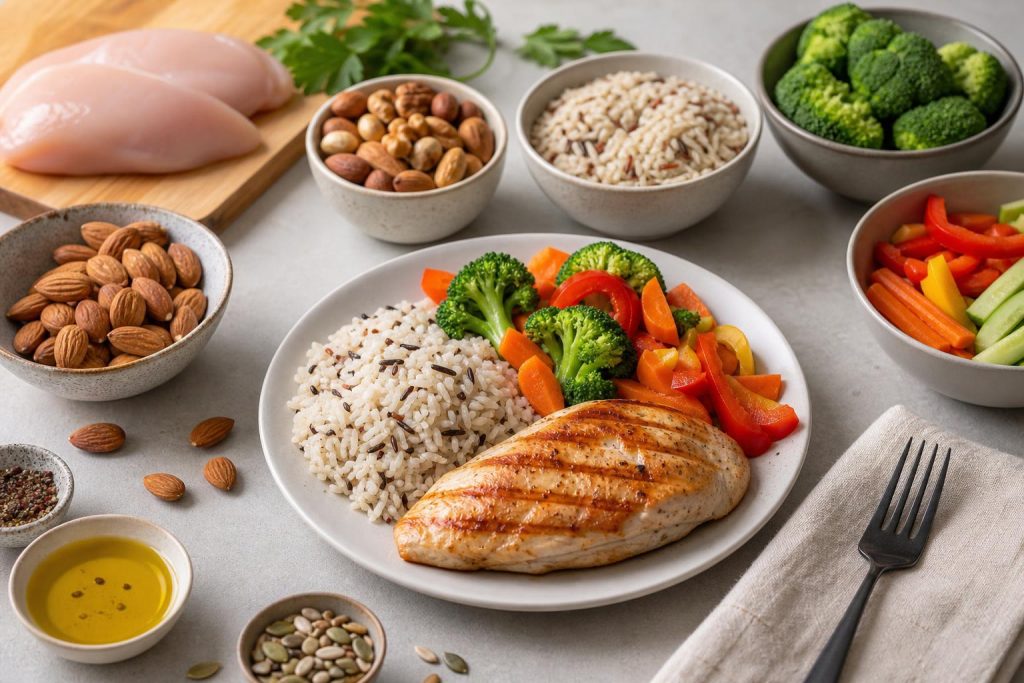
The most practical shift men can make is front-loading protein at every eating opportunity. Since semaglutide reduces total food volume, every bite needs to count. Prioritizing protein-dense foods — eggs, Greek yogurt, cottage cheese, chicken breast, lean beef, canned fish, protein shakes — before anything else at a meal ensures you’re covering your nutritional bases even when fullness hits early. This isn’t about force-feeding. It’s about strategic sequencing.
Protein shakes and powders serve a genuine purpose here, not as replacements for whole food, but as a practical insurance policy when appetite is low and solid meals feel like too much. A quality whey or casein shake with 25 to 30 grams of protein and minimal fillers can close the gap on days when nausea or satiety makes eating challenging. Spreading intake across two to four eating occasions — rather than trying to load it all into one sitting — also helps with absorption and appetite management.
Resistance training remains non-negotiable. Protein alone preserves muscle, but progressive resistance training is the anabolic signal that tells your body to hold onto that muscle in the first place. Even two to three sessions per week of compound lifts — squats, presses, rows, deadlifts — paired with adequate protein makes a measurable difference in the quality of weight lost on semaglutide. Emerging combination therapies like cagrilintide-semaglutide are producing even greater weight loss in trials — which makes the muscle preservation argument even more urgent as these drugs become more powerful.
The Takeaway
Semaglutide is a legitimate, evidence-backed tool for fat loss and metabolic health. But the drug does not differentiate between fat and muscle — your nutrition does. Men on Ozempic or Wegovy should be targeting at minimum 1.6 grams of protein per kilogram of bodyweight daily, prioritizing protein at every meal, and pairing their treatment with consistent resistance training. The medication can do its job. Make sure you’re doing yours.
Scientific References
-
McGuire, Marx, Mulvagh et al. (2025).
Oral Semaglutide and Cardiovascular Outcomes in High-Risk Type 2 Diabetes..
The New England journal of medicine.
View on PubMed → -
Rodriguez, Goodwin Cartwright, Gratzl et al. (2024).
Semaglutide vs Tirzepatide for Weight Loss in Adults With Overweight or Obesity..
JAMA internal medicine.
View on PubMed → -
Thomsen, Mailhac, Løhde et al. (2025).
Real-world evidence on the utilization, clinical and comparative effectiveness, and adverse effects of newer GLP-1RA-based weight-loss therapies..
Diabetes, obesity & metabolism.
View on PubMed → -
Husain, Birkenfeld, Donsmark et al. (2019).
Oral Semaglutide and Cardiovascular Outcomes in Patients with Type 2 Diabetes..
The New England journal of medicine.
View on PubMed → -
Davies, Bajaj, Broholm et al. (2025).
Cagrilintide-Semaglutide in Adults with Overweight or Obesity and Type 2 Diabetes..
The New England journal of medicine.
View on PubMed →