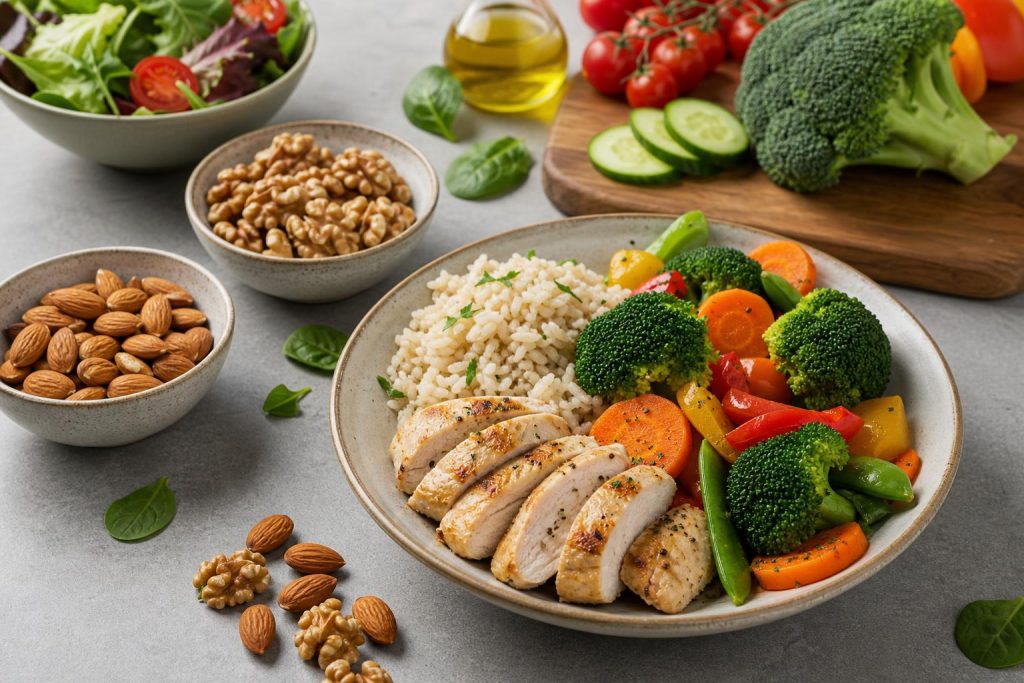
Most men have heard of GLP-1 by now — the hormone behind blockbuster medications like semaglutide and tirzepatide that have reshaped how the world thinks about weight loss and metabolic health. But here’s what often gets buried under the pharmaceutical headlines: your body already makes GLP-1, and how much it produces is largely within your control. Long before injectable medications existed, researchers were studying how food, exercise, sleep, and gut health influence this hormone naturally. The answers are more actionable than most people realize.
GLP-1, or glucagon-like peptide-1, is secreted by L-cells in your small intestine and colon in response to eating. It slows gastric emptying, signals fullness to your brain, stimulates insulin secretion, and suppresses glucagon — the hormone that raises blood sugar. Beyond blood sugar regulation, emerging research suggests GLP-1 receptor activation is associated with reduced cognitive decline in adults with type 2 diabetes, hinting that this hormone plays a far broader role in long-term health than appetite control alone. Optimizing your natural GLP-1 output isn’t just a hack for weight loss — it’s a legitimate metabolic health strategy.
The Food Inputs That Drive GLP-1 Release
Not all meals trigger the same GLP-1 response, and the differences matter. Protein is consistently the most potent macronutrient for stimulating GLP-1 secretion. Studies using high-protein meals — particularly those rich in leucine, whey, and casein — show meaningful increases in postprandial GLP-1 compared to carbohydrate- or fat-matched controls. For practical purposes, this means front-loading your meals with 30 to 50 grams of quality protein isn’t just good for muscle — it’s directly working your GLP-1 signaling pathway. Think eggs with breakfast, Greek yogurt as a snack, or a substantial serving of chicken, beef, or fish at lunch before you reach for the carbohydrates.
Dietary fat also stimulates GLP-1 release, particularly long-chain fatty acids that reach the small intestine. Olive oil, avocado, nuts, and fatty fish all contribute to this effect. The combination of protein and fat — essentially what a well-structured whole-food meal looks like — produces a more sustained GLP-1 response than any single macronutrient in isolation. This is part of why ultra-processed, rapidly absorbed foods are so problematic: they bypass the intestinal triggers that generate a healthy satiety signal before you’ve overeaten.
Fiber deserves its own conversation here. Fermentable fibers — found in oats, legumes, Jerusalem artichokes, green bananas, and cooked-then-cooled potatoes — are fermented by gut bacteria into short-chain fatty acids (SCFAs), particularly butyrate and propionate. These SCFAs directly stimulate GLP-1 secretion from L-cells in the colon. Research consistently shows that higher dietary fiber intake correlates with improved GLP-1 responses and better postmeal satiety. Practically speaking, men who eat 30 or more grams of fiber daily from whole food sources are quietly running a natural GLP-1 optimization protocol without ever thinking of it that way. Polyphenol-rich foods — berries, dark chocolate, green tea, and coffee — also show promise in preclinical and early human studies for enhancing gut hormone secretion, likely through their effects on gut microbiome diversity and L-cell activity.
Exercise, Sleep, and the Lifestyle Levers
Exercise influences GLP-1, though the relationship is nuanced. Acute aerobic exercise — a 30- to 60-minute moderate-intensity run or cycling session — has been shown in multiple studies to acutely elevate GLP-1 levels, and the effect appears more pronounced in men with insulin resistance or obesity. Resistance training contributes differently: it improves insulin sensitivity and muscle glucose uptake, reducing the metabolic burden that GLP-1 has to compensate for in the first place. The practical takeaway is that combining cardiovascular work with strength training creates the most favorable hormonal environment for GLP-1 function — not just its secretion, but its downstream effectiveness.
Sleep deprivation is a direct suppressor of GLP-1 activity. Research shows that even one or two nights of poor sleep blunts the postmeal GLP-1 response while simultaneously elevating ghrelin — the hunger hormone — creating a double hormonal hit that drives overeating. Men who pull late nights regularly are fighting their own metabolic biology. Prioritizing seven to nine hours of quality sleep isn’t a soft lifestyle recommendation; it’s a hard metabolic intervention that preserves your body’s natural satiety signaling system.
Intermittent fasting and time-restricted eating also appear to enhance GLP-1 sensitivity over time. While fasting itself doesn’t spike GLP-1, the improved insulin sensitivity and gut microbiome changes that come with consistent eating windows seem to amplify the GLP-1 response when you do eat. This is another reason why men who adopt structured eating patterns — not necessarily extreme fasting, but consistent meal timing — often report improved appetite control even without caloric restriction.
Chronic stress is worth flagging as well. Elevated cortisol over time impairs gut hormone function, disrupts the gut microbiome, and promotes the kind of visceral fat accumulation that itself reduces GLP-1 receptor sensitivity. Stress management isn’t ancillary to metabolic health — it’s central to it. Whether that’s structured breathwork, zone-2 cardio as active recovery, or simply protecting time away from work, the hormonal payoff is real and measurable.
It’s also worth noting that for men who are already on GLP-1 medications like semaglutide or tirzepatide — a dual GIP and GLP-1 receptor agonist that has shown benefits beyond weight loss, including reducing airway inflammation in obese asthmatic models — these natural strategies are additive, not redundant. The lifestyle inputs that support natural GLP-1 function make pharmacological GLP-1 treatment work better, and they’re what determine whether the results stick after medication ends.
Supplements With Legitimate Supporting Evidence
The supplement space around GLP-1 is noisy, but a handful of compounds have genuine mechanistic and clinical support. Berberine, an alkaloid found in plants like barberry and goldenseal, has shown consistent effects on GLP-1 secretion and insulin sensitivity in multiple human trials. It works partly by activating AMPK and partly by reshaping the gut microbiome toward SCFA-producing bacteria — the same pathway triggered by dietary fiber. At doses of 500mg taken two to three times daily with meals, berberine is one of the better-supported natural compounds for metabolic health optimization.
Prebiotics and probiotic supplements, particularly those containing Lactobacillus and Bifidobacterium strains, have shown modest but consistent effects on GLP-1 in clinical trials, likely by improving the gut microbiome environment that L-cells operate within. Curcumin and resveratrol show preclinical promise for GLP-1 enhancement, though human trial data remains limited. Whey protein, when consumed 20 to 30 minutes before a carbohydrate-heavy meal, reliably blunts the postmeal glucose spike through a GLP-1-dependent mechanism — a practical strategy for men who aren’t ready to overhaul their entire diet but want better postmeal glucose control today.
The Takeaway
GLP-1 is not a molecule you’re either born with or without — it’s a hormone you regulate every day through the foods you eat, the way you train, how well you sleep, and how you manage stress. High-protein, high-fiber meals eaten consistently, combined with regular exercise and quality sleep, are the most evidence-supported ways to enhance your natural GLP-1 output. Medications that mimic this hormone can be powerful tools, and research continues to uncover benefits extending well beyond weight loss into cognitive and neurological health — but the lifestyle foundation is where lasting metabolic change begins. Build that first, and every other tool you add becomes more effective.
Scientific References
-
Ballum, Dri, Liao et al. (2026).
The effect of glucagon-like peptide 1 (GLP-1) receptor agonists on cognition: A systematic review of systematic reviews and meta-analyses..
Journal of affective disorders.
View on PubMed → -
Hunt, Yassin, Olsen et al. (2021).
Intestinal Growth in Glucagon Receptor Knockout Mice Is Not Associated With the Formation of AOM/DSS-Induced Tumors..
Frontiers in endocrinology.
View on PubMed → -
Sun, Yao, Zuo et al. (2025).
Tirzepatide improves neutrophilic inflammation in obese asthmatic mice by downregulating Th17 cell differentiation..
Molecular biology reports.
View on PubMed →