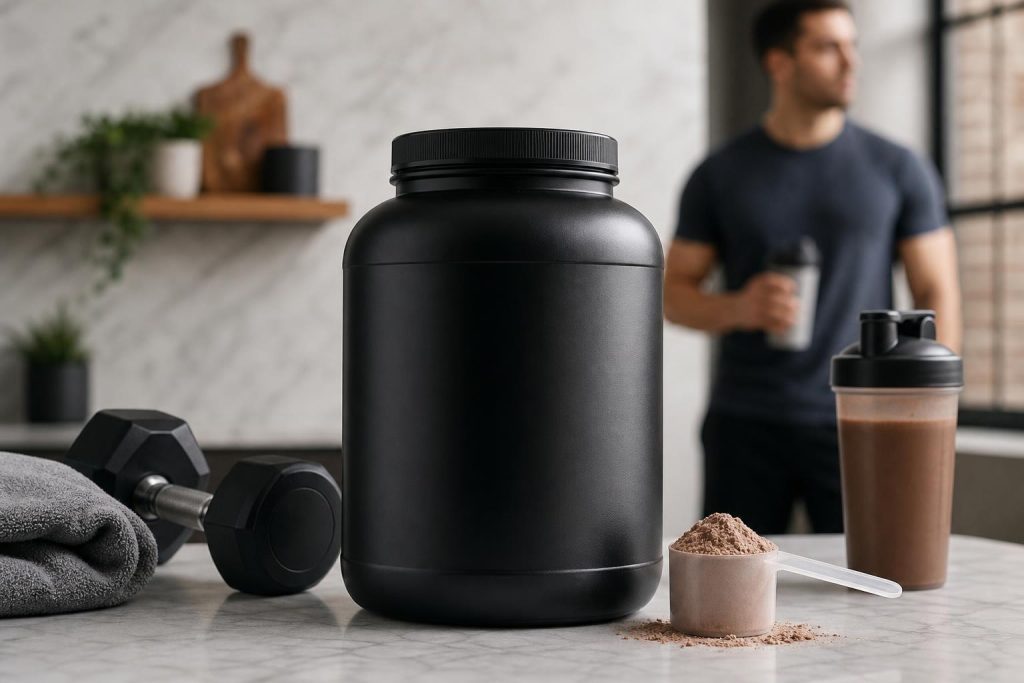
Most men don’t lose muscle because they skip the gym. They lose it because they don’t eat enough protein while cutting calories — and the research on this is unambiguous. A landmark study published in the American Journal of Clinical Nutrition found that higher protein intake during caloric restriction preserved significantly more lean mass compared to lower protein diets, even when total calories were matched. If fat loss is the goal — however you’re getting there — protein isn’t optional. It’s the foundation. And among all the protein sources available, whey protein isolate consistently earns its place at the top of the stack.
Whey isolate is the most refined form of whey protein, processed to remove the majority of fat and lactose, leaving a product that’s typically 90% or more pure protein by weight. That matters for two reasons: bioavailability and digestion speed. Whey isolate is absorbed rapidly by the body, which makes it particularly effective at stimulating muscle protein synthesis in the critical post-exercise window. Research comparing fast- versus slow-digesting proteins has confirmed that rapid amino acid delivery — exactly what isolate provides — produces a more robust anabolic response after resistance training. For men trying to hold onto muscle while eating in a deficit, that window is not one to waste.
Leucine content is the other reason whey isolate stands out. Leucine is the key amino acid that triggers the mTOR signaling pathway — the cellular switch that initiates muscle protein synthesis. Whey isolate delivers roughly 2.5 to 3 grams of leucine per 25-gram serving, which consistently clears the leucine threshold needed to maximally stimulate MPS. A study in the Journal of Physiology demonstrated that leucine-rich proteins like whey produced significantly greater rates of muscle protein synthesis compared to leucine-poor protein sources at equivalent total doses. This isn’t marketing language — it’s mechanistic biology that translates directly into better outcomes when you’re training hard and eating less.
What the Research Actually Says About Whey and Body Composition
The clinical data on whey protein and body composition is robust enough to move past anecdote. A meta-analysis of 14 randomized controlled trials published in the Journal of the American College of Nutrition found that whey protein supplementation resulted in significantly greater reductions in body fat and greater preservation of lean mass compared to control groups — particularly when combined with resistance training. The effect was amplified in populations eating in a caloric deficit, which is the exact condition most men pursuing fat loss find themselves in.
Satiety is another underappreciated benefit. Protein is the most satiating macronutrient, and whey appears to be especially effective at suppressing appetite hormones. Research published in Nutrition & Metabolism showed that whey protein reduced ghrelin — the primary hunger-signaling hormone — more effectively than other macronutrients, leading to lower calorie intake over the course of a day. For men managing a caloric deficit, that appetite-blunting effect has real-world value, particularly during the hours when cravings tend to peak.
This is also where whey isolate becomes especially relevant for men using GLP-1 receptor agonists like semaglutide or tirzepatide. These medications dramatically reduce appetite and total food intake, which creates a high risk of inadequate protein consumption. When calories drop significantly — often to 1,400–1,800 calories per day on GLP-1 therapy — protein needs don’t drop with them. Emerging clinical data on GLP-1 users indicates that a substantial portion of weight lost on these medications comes from lean mass, not just fat — a problem that strategic protein intake can directly mitigate. A whey isolate shake becomes one of the most efficient tools to hit a 130–160 gram daily protein target when appetite makes whole-food sources feel impossible.
How to Use Whey Isolate Effectively
Timing and dose both matter, though not in the obsessive way supplement marketing would have you believe. The most defensible strategy, based on the current evidence, is to prioritize total daily protein intake — research supports a target of 1.6 to 2.2 grams per kilogram of body weight for men engaged in resistance training — and then use whey isolate to fill the gaps where whole food sources fall short. Post-training is the most logical window, but a morning shake, a between-meal supplement, or even a pre-bed option with casein added are all valid approaches depending on your schedule and goals.
Quality matters more than most men realize. Not all whey isolates are equal. Third-party tested products — those certified by NSF, Informed Sport, or Labdoor — give you confidence that what’s on the label is actually in the tub and that you’re not ingesting undisclosed contaminants or inflated protein numbers via amino spiking. Flavor and mixability are secondary to purity and leucine content, but they matter for long-term compliance. A product you’ll actually use every day beats a theoretically superior product that sits untouched in the cabinet.
For most men, one to two scoops per day — roughly 25 to 50 grams of supplemental protein — is sufficient to bridge dietary gaps without over-relying on shakes over whole foods. Chicken, eggs, beef, Greek yogurt, and cottage cheese should still form the backbone of your protein intake. Whey isolate is a tool, not a replacement for a sound nutrition strategy.
The Takeaway
Whey protein isolate has earned its reputation through decades of clinical research, not supplement industry hype. For men focused on losing fat without sacrificing muscle — whether through disciplined dieting, structured training programs, or the assisted route of GLP-1 therapy — it remains one of the few supplements with a genuine, well-documented impact on body composition outcomes. Hit your daily protein target, train with purpose, and use whey isolate to make both of those things easier. That’s not a complicated formula, but it’s one that consistently works.