Here is a number that should get your attention: in clinical trials lasting 68 to 72 weeks, men and women using semaglutide lost roughly 10% or more of their skeletal muscle mass — an amount researchers describe as equivalent to approximately 20 years of age-related muscle loss. That is not a side effect buried in fine print. That is a physiological consequence of rapid, significant weight reduction that demands a serious, strategic response from anyone on this medication.
To be clear: semaglutide is a genuinely powerful tool for fat loss and metabolic health. It improves blood glucose, lowers blood pressure, reduces visceral fat, and helps men shed weight that years of dieting failed to move. A real-world clinical study of 43 obese patients found that after 24 weeks on semaglutide, participants lost an average of 9.9 kg — and fat mass accounted for the majority of that loss at 15.6%, while skeletal muscle loss was a comparatively modest 4.8%. Grip strength and skeletal muscle index remained largely preserved. That is a relatively favorable outcome — but it does not happen automatically, and it did not happen in isolation. Every patient in that study received concurrent lifestyle intervention.
The central challenge with semaglutide is the same one that confronts any aggressive caloric restriction strategy: your body does not distinguish cleanly between fat and lean tissue when it is running a significant energy deficit. The medication suppresses appetite dramatically, which is the mechanism that drives fat loss — but that same suppression means many users are eating far less protein, moving less due to fatigue, and inadvertently creating the conditions for muscle breakdown. Semaglutide and similar incretin-based therapies have been shown to cause rapid loss of lean mass averaging approximately 6 kg, a figure researchers compare to a decade or more of normal aging. Left unaddressed, that kind of lean mass erosion does not just affect how you look. It reduces your resting metabolic rate, increases your risk of weight regain when the medication stops, and over time contributes to the very sarcopenia and frailty that make aging dangerous.
The Two Levers That Determine How Much Muscle You Keep
The research is consistent and unambiguous on what drives the difference between men who preserve muscle during weight loss and those who do not: protein intake and resistance training. These are not optional lifestyle add-ons. Leading obesity researchers now argue that all patients receiving incretin-mimetic drugs should be enrolled in comprehensive treatment programs that prioritize adequate protein, micronutrient intake, and resistance training — not as a suggestion, but as a clinical standard of care.
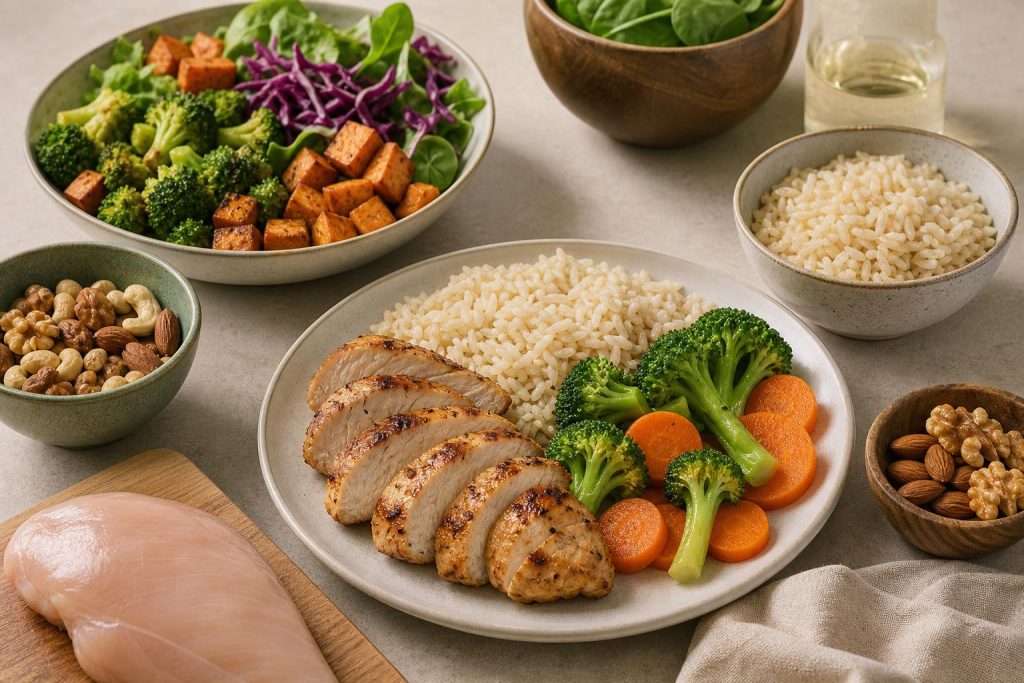
On the nutrition side, the problem semaglutide creates is a cruel irony: the drug works by making you feel full, which means the men who need protein the most are often the least interested in eating it. If you are consuming 1,200 calories per day and most of those are coming from whatever small amounts of food feel tolerable, you are almost certainly under-fueling muscle protein synthesis. The current evidence supports targeting somewhere between 1.6 and 2.2 grams of protein per kilogram of body weight daily — prioritizing leucine-rich sources like eggs, chicken, Greek yogurt, cottage cheese, and whey protein. If solid food is a struggle, a high-quality protein shake becomes less of a convenience and more of a medical necessity. Micronutrients matter too: deficiencies in vitamin D, magnesium, and B12 are common during significant caloric restriction and can impair muscle function even when protein intake is adequate.
On the training side, the evidence for resistance exercise as a muscle-preservation strategy during pharmacological weight loss is compelling. Supervised resistance training programs lasting more than 10 weeks have been shown to produce lean mass gains of approximately 3 kg and strength improvements of around 25% in both men and women — more than enough to offset the lean mass losses associated with semaglutide therapy if implemented properly. The practical implication is straightforward: three to four sessions of progressive resistance training per week, built around compound movements — squats, deadlifts, rows, presses — is the single most effective intervention available to protect your muscle while the medication does its job on fat.
What Happens at the Muscle Level — and What’s Coming Next
It is worth understanding the biology driving muscle loss during weight loss, because it points toward emerging solutions that may eventually change the standard of care. Research into the myostatin-activin-follistatin system has identified the key molecular players that regulate muscle preservation during negative energy balance. Myostatin and activins promote muscle protein degradation, while follistatin acts as a natural brake on that process. During aggressive caloric restriction, this system can tip toward catabolism — which is precisely the state semaglutide-induced appetite suppression can create.
Several experimental compounds — including Bimagrumab, Trevogrumab, and Garetosmab — are being studied as adjuncts to incretin therapy specifically because they inhibit myostatin and activin signaling, with early data suggesting they may preserve or even increase muscle mass while enhancing fat loss. These are not available outside of clinical trials yet, but the direction of pharmacological development is clear: the future of obesity pharmacotherapy likely involves drugs that protect muscle as aggressively as they strip fat.
A secondary analysis from the SLIM LIVER study, which tracked semaglutide users over 24 weeks using MRI-measured psoas muscle volume, found that despite a 9.3% reduction in psoas muscle volume, physical function — measured by gait speed and chair rise time — was maintained or slightly improved. The prevalence of slow gait speed dropped from 63% to 46%. That distinction matters: losing some muscle volume does not automatically translate to losing functional capacity, especially when overall body weight is dropping and movement becomes easier. But it is also not a reason for complacency — functional preservation under clinical study conditions with monitoring is not the same as ignoring muscle health entirely.
The Takeaway
Semaglutide can be a legitimate and powerful tool for fat loss. The men who get the best outcomes — more fat gone, more muscle kept, better long-term metabolic health — are the ones who treat the medication as one component of a complete strategy, not the whole plan. That means eating enough protein even when you are not hungry, training with weights consistently even when the scale is moving without it, and understanding that the goal is not just a lower number — it is a leaner, stronger, more resilient body that performs better for decades to come. The drug creates the caloric conditions for fat loss. Everything else is up to you.
Scientific References
-
Mechanick, Butsch, Christensen et al. (2025).
Strategies for minimizing muscle loss during use of incretin-mimetic drugs for treatment of obesity..
Obesity reviews : an official journal of the International Association for the Study of Obesity.
View on PubMed → -
Locatelli, Costa, Haynes et al. (2024).
Incretin-Based Weight Loss Pharmacotherapy: Can Resistance Exercise Optimize Changes in Body Composition?.
Diabetes care.
View on PubMed → -
Stefanakis, Kokkorakis, Mantzoros et al. (2024).
The impact of weight loss on fat-free mass, muscle, bone and hematopoiesis health: Implications for emerging pharmacotherapies aiming at fat reduction and lean mass preservation..
Metabolism: clinical and experimental.
View on PubMed → -
Xiang, Ding, Zhang et al. (2023).
Clinical effectiveness of semaglutide on weight loss, body composition, and muscle strength in Chinese adults..
European review for medical and pharmacological sciences.
View on PubMed → -
Ditzenberger, Lake, Kitch et al. (2025).
Effects of Semaglutide on Muscle Structure and Function in the SLIM LIVER Study..
Clinical infectious diseases : an official publication of the Infectious Diseases Society of America.
View on PubMed →