Here’s a number that should get your attention: in a landmark study published in the New England Journal of Medicine, men on aggressive calorie restriction lost nearly 25% of their total weight as lean muscle mass. Not fat — muscle. The kind of tissue that keeps your metabolism running, your joints protected, and your physique looking like you actually work out. Losing it isn’t just an aesthetic problem. It’s a metabolic one, and it compounds over time in ways most men don’t appreciate until it’s too late.
Whether you’re deep into a fat loss phase, recovering from an injury, aging past 40, or using any tool in your arsenal to shed weight — the rules for preserving muscle are the same. They’re rooted in biology, backed by decades of research, and frankly, not that complicated once you understand what’s actually driving the loss in the first place.
Why Your Body Eats Its Own Muscle
Muscle loss — technically called muscle protein catabolism — happens when your body breaks down muscle tissue faster than it rebuilds it. This can be triggered by a caloric deficit, inadequate protein intake, inactivity, illness, or simply the hormonal shifts that come with aging. After age 30, men lose roughly 3 to 5 percent of muscle mass per decade in a process called sarcopenia — and that rate accelerates if you’re dieting aggressively or not training consistently.
The core problem during a calorie deficit is that your body becomes opportunistic. When energy is scarce, it will cannibalize muscle for gluconeogenesis — essentially converting amino acids from your muscle tissue into glucose for fuel. This is particularly pronounced when protein intake is low and resistance training is absent. Your body has no hormonal signal to protect that tissue, so it sacrifices it. The goal of any intelligent muscle-preservation strategy is to send the opposite signal: this muscle is being used, it is needed, do not touch it.
Hormones play a starring role here. Testosterone, IGF-1, and growth hormone all stimulate muscle protein synthesis. Cortisol — chronically elevated by sleep deprivation, aggressive restriction, and stress — does the opposite. Research has consistently shown that high cortisol environments accelerate muscle breakdown, which is why the guy who crash diets on 1,200 calories while running daily often ends up skinny-fat rather than lean and muscular.
The Non-Negotiables: Protein and Resistance Training
If there are two levers that matter above all others, they are protein intake and resistance training. Everything else — sleep, supplementation, meal timing — is secondary infrastructure. Get these two right and you’ve handled the vast majority of the muscle preservation equation.
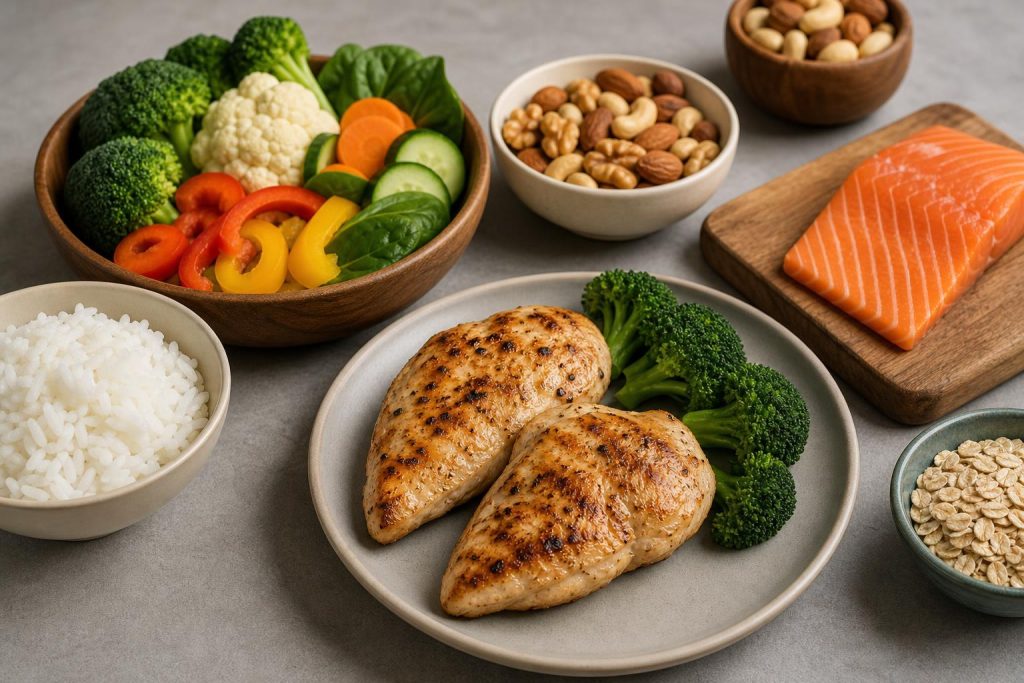
On the protein side, the evidence is unambiguous. A 2012 meta-analysis in the Journal of the International Society of Sports Nutrition found that intakes of 1.6 to 2.2 grams of protein per kilogram of body weight per day were optimal for preserving and building lean mass, especially in a caloric deficit. For a 200-pound man, that’s roughly 145 to 200 grams of protein daily — a target most men dramatically underestimate. Spreading that intake across three to four meals matters too. Research on muscle protein synthesis shows that the body can only use roughly 30 to 40 grams per sitting to maximally stimulate muscle building, making distribution across the day more effective than loading all your protein into one or two meals.
Resistance training is the other half of the equation — and it’s non-negotiable. Lifting weights sends a direct anabolic signal to your muscles, telling your body that this tissue is essential. Studies comparing dieters who resistance trained versus those who didn’t found that the lifting group preserved significantly more lean mass even at identical calorie deficits. You don’t need to be in the gym six days a week. Two to three full-body or split sessions per week, focused on compound movements — squats, deadlifts, presses, rows — provide the mechanical stimulus your muscles need to survive a cut.
One underappreciated detail: the severity of your caloric deficit directly predicts how much muscle you lose. Aggressive deficits of 1,000 or more calories per day significantly increase muscle catabolism. Research suggests that a moderate deficit of 300 to 500 calories per day, combined with high protein and resistance training, allows for fat loss while preserving nearly all lean tissue. Patience here is not weakness — it’s strategy.
Sleep is also doing more work than most men give it credit for. During deep sleep, growth hormone is released in its largest daily pulse. Cut sleep short and you blunt that anabolic signal while simultaneously elevating cortisol. One controlled study found that men who slept 5.5 hours per night lost significantly more muscle and less fat than those who slept 8.5 hours — even on identical diets. Seven to nine hours isn’t a luxury. It’s recovery infrastructure.
Creatine monohydrate is the one supplement with enough evidence behind it to mention in the same breath as diet and training. Meta-analyses confirm it enhances strength output and supports lean mass retention, particularly in older men and during periods of reduced caloric intake. Three to five grams per day is the clinically validated dose — no loading phase required.
The Takeaway
Muscle loss is not inevitable. It’s largely a function of decisions — how much protein you eat, whether you lift, how aggressively you cut, and how well you sleep. The men who preserve the most muscle during fat loss phases aren’t doing anything exotic. They’re eating enough protein to fuel synthesis, lifting consistently enough to give their body a reason to hold on to that tissue, and recovering well enough for the hormonal environment to support it. That’s the entire framework. Nail those fundamentals and the physique you’re working toward becomes dramatically more achievable — and more durable.