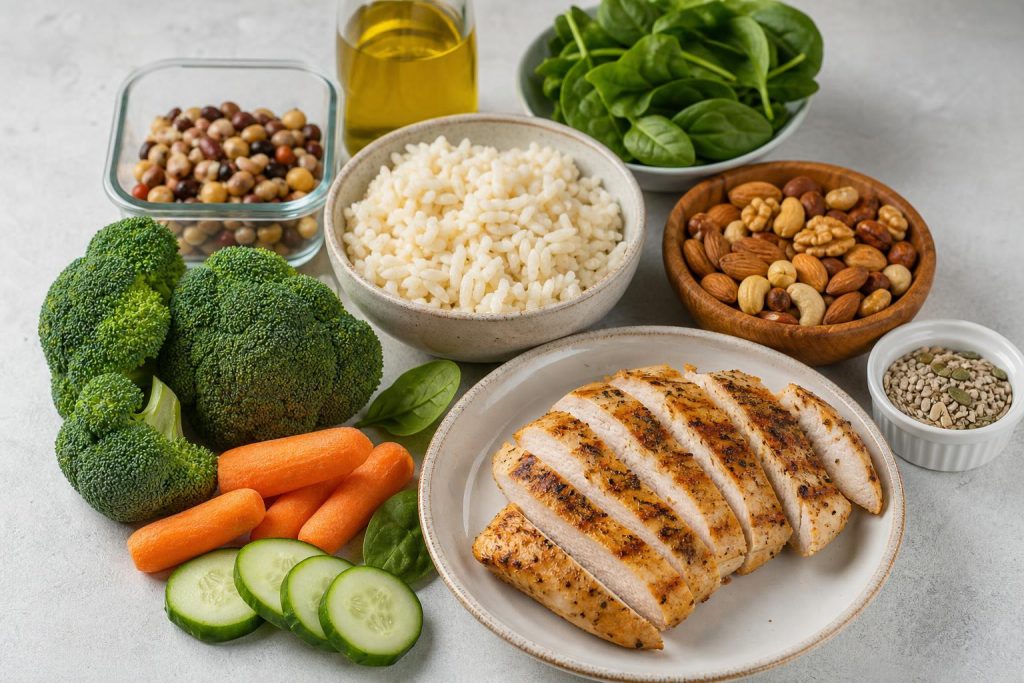
Muscle doesn’t disappear overnight — but it retreats steadily when you’re not paying attention. Research published in Antioxidants identifies the core drivers of muscle wasting as low-grade systemic inflammation, disrupted protein homeostasis, mitochondrial dysfunction, and declining satellite cell activity. These aren’t just concerns for elderly men. They’re active processes in any man who undertates, overtrains without recovering, or simply ages without a deliberate counterstrategy. If you’re cutting calories to lose fat, dealing with chronic stress, or just getting older, your muscle mass is under pressure right now.
The good news is that the science on fighting muscle loss is remarkably clear. It comes down to three levers — protein, resistance training, and inflammation control — and pulling all three consistently is what separates men who stay lean and strong from those who slowly shrink over the years.
Protein Is Your First Line of Defense
When calories drop — whether you’re intentionally dieting, using a GLP-1 medication that suppresses appetite, or just eating less because life got busy — your body faces a choice: use dietary protein to maintain muscle, or cannibalize it. Without sufficient protein intake, the answer is almost always the latter.
The International Society of Sports Nutrition recommends consuming a source of high-quality protein as close as possible to the beginning and completion of exercise to reduce amino acid oxidative losses and initiate muscle protein remodeling. For men in a caloric deficit or under significant training stress, aiming for 0.7 to 1.0 grams of protein per pound of bodyweight daily is a practical, well-supported target. Sources matter too — complete proteins from eggs, lean meats, fish, and dairy provide the full spectrum of essential amino acids your muscle fibers need to repair and grow.
Timing isn’t everything, but it isn’t nothing either. Getting 30 to 40 grams of high-quality protein within a couple of hours of your training session — either before or after — gives your body the raw material it needs when muscle protein synthesis rates are most elevated. If your appetite is blunted by medication or fatigue, a quality protein shake with leucine is a practical bridge, not a shortcut.
Resistance Training Is Non-Negotiable
No dietary strategy alone will preserve muscle mass the way mechanical loading does. Lifting weights sends a direct anabolic signal to muscle tissue — one that overrides the catabolic pressure of a caloric deficit when the stimulus is sufficient. Research on spaceflight-induced muscle atrophy — where astronauts experience accelerated muscle loss and sarcopenia under microgravity — reinforces just how dependent muscle mass is on regular mechanical stress. Remove the load, and muscle wastes, regardless of nutrition. Apply the load consistently, and the body has a compelling reason to hold onto it.
For most men, three to four sessions of progressive resistance training per week is enough to provide that stimulus. Progressive overload — gradually increasing the weight, volume, or intensity over time — is the key variable. You don’t need to train like a powerlifter. Compound movements like squats, deadlifts, rows, and presses, performed with intention and tracked over weeks and months, are the foundation of any effective muscle-preservation strategy.
Control Inflammation or It Will Control You
Chronic low-grade inflammation is one of the most underappreciated drivers of muscle loss in men. The Antioxidants review on sarcopenia highlights how inflammatory signaling disrupts muscle protein homeostasis and accelerates the breakdown of muscle tissue — a process that worsens with age, poor sleep, high stress, and poor diet quality. This isn’t abstract biology. It’s the reason men who are chronically stressed, sleep-deprived, or eating a highly processed diet find it harder to hold onto muscle even when they’re training.
The practical levers here are straightforward: prioritize sleep (7 to 9 hours), manage stress through whatever works for you, and eat a diet rich in whole foods, antioxidants, and omega-3 fatty acids. Creatine monohydrate, one of the most studied supplements in sports science, has also demonstrated meaningful support for muscle preservation and strength, particularly in men over 40.
The Takeaway
Muscle loss is not inevitable — it’s a problem with known solutions. Hit your protein targets daily, lift with progressive intent at least three times a week, and address the lifestyle factors that quietly drive inflammation. Whether you’re cutting fat, managing a health condition, or simply trying to stay strong as you age, these fundamentals don’t change. The science is consistent. The strategy is simple. The only variable is execution.
Scientific References
-
Sims, Kerksick, Smith-Ryan et al. (2023).
International society of sports nutrition position stand: nutritional concerns of the female athlete..
Journal of the International Society of Sports Nutrition.
View on PubMed → -
Little, Llorián-Salvador, Tang et al. (2020).
Macrophage to myofibroblast transition contributes to subretinal fibrosis secondary to neovascular age-related macular degeneration..
Journal of neuroinflammation.
View on PubMed → -
Capri, Conte, Ciurca et al. (2023).
Long-term human spaceflight and inflammaging: Does it promote aging?.
Ageing research reviews.
View on PubMed → -
Barbiera, Pelosi, Sica et al. (2020).
Nutrition and microRNAs: Novel Insights to Fight Sarcopenia..
Antioxidants (Basel, Switzerland).
View on PubMed → -
Bowers et al. (1995).
[Anabolic steroids]..
SIDAhora : un proyecto del Departamento de Publicaciones del PWA Coalition, NY.
View on PubMed →