When researchers at Yale published findings showing that semaglutide users lost significantly more lean mass alongside fat compared to lifestyle intervention alone, it raised an uncomfortable question: are GLP-1 users eating in a way that supports their long-term health — or just eating less? The difference matters enormously, and it comes down to meal structure.
If you’ve landed here looking for a GLP-1 meal plan PDF you can download and actually use, you’re asking the right question. Appetite suppression is a tool. What you put on the plate while that tool is working is what determines whether you come out the other side leaner and stronger — or lighter but metabolically compromised.
Why Meal Planning on GLP-1 Is Different (But Not as Complicated as You Think)
GLP-1 receptor agonists like semaglutide (Ozempic, Wegovy) and tirzepatide (Mounjaro, Zepbound) work partly by slowing gastric emptying and reducing appetite signals in the brain. Clinical trials consistently show 10–15% total body weight loss over 68 weeks, but that weight includes both fat and muscle — and the ratio depends heavily on protein intake and resistance training.
The core challenge is this: when you’re not hungry, you naturally eat less of everything, including protein. But research on protein during caloric restriction consistently demonstrates that intakes around 1.2–1.6 grams per kilogram of body weight are necessary to preserve lean mass. On a drug that kills your appetite, hitting that target requires deliberate planning — not guesswork.
A practical GLP-1 meal plan centers on three non-negotiables: high protein at every meal, fiber-rich vegetables to support satiety and gut health, and moderate healthy fats to slow digestion without triggering nausea. Refined carbohydrates and high-fat processed foods are the most common culprits behind GLP-1 side effects like nausea and GI discomfort, largely because they interact poorly with slowed gastric motility.
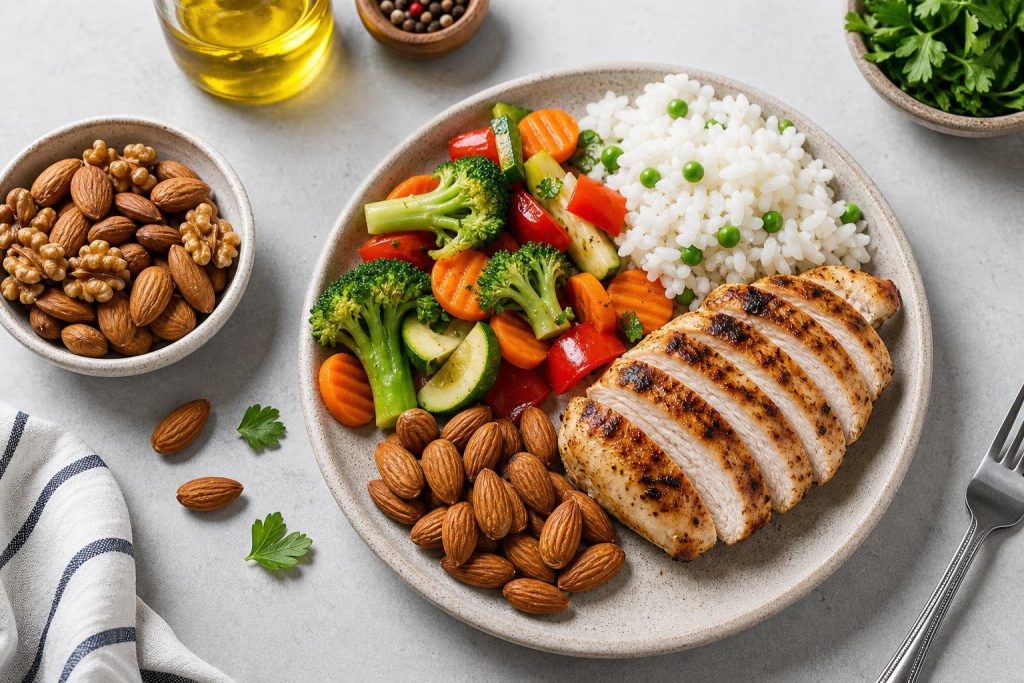
A typical day on a well-structured GLP-1 meal plan might look like this: a morning meal built around 30–40 grams of protein — eggs with Greek yogurt or a protein shake with cottage cheese — followed by a midday meal of grilled chicken or canned salmon over leafy greens with olive oil and legumes. Dinner centers on a lean protein source like turkey, cod, or lean beef with roasted vegetables and a small serving of complex carbohydrates like quinoa or sweet potato. The goal is roughly 120–150 grams of protein daily, distributed across meals rather than loaded into one sitting, because muscle protein synthesis responds best to evenly spaced protein doses of around 25–40 grams.
How to Build Your Own GLP-1 Meal Plan PDF
The most effective approach is building a template you can print, save, or load onto your phone — and repeat weekly with minor variations to prevent monotony. Start with your protein anchor for each meal, then build the rest of the plate around it. Think of vegetables as your volume food: they fill space in the stomach, support the microbiome, and provide micronutrients that many GLP-1 users become deficient in as overall food intake drops.
Hydration deserves its own mention. Even mild dehydration impairs metabolism and cognitive function, and GLP-1 users often under-drink simply because their appetite suppression extends to thirst cues. Aim for at least 2.5–3 liters of water daily, with electrolytes if you’re in a significant caloric deficit.
For a free downloadable template, StayEvolved has developed a printable 7-day GLP-1 meal plan PDF structured around these principles — with meal-by-meal protein targets, grocery lists, and simple prep instructions. It’s built for real life: meals that take under 30 minutes, ingredients available at any grocery store, and enough flexibility to adapt around injection days when appetite is lowest.
The plan works whether you’re on week two of semaglutide or month six of tirzepatide. It also works if you’re not on any medication at all — because the principles of high-protein, fiber-forward, minimally processed eating apply universally to anyone pursuing fat loss and metabolic health.
The Takeaway
A GLP-1 medication changes your appetite. Your meal plan determines what you do with that change. Download the template, anchor every meal around protein, stay ahead of your hydration, and treat the reduced hunger as an advantage — not a free pass to eat less of everything indiscriminately. The men who get the best results from these medications are the ones who eat smarter, not just less.