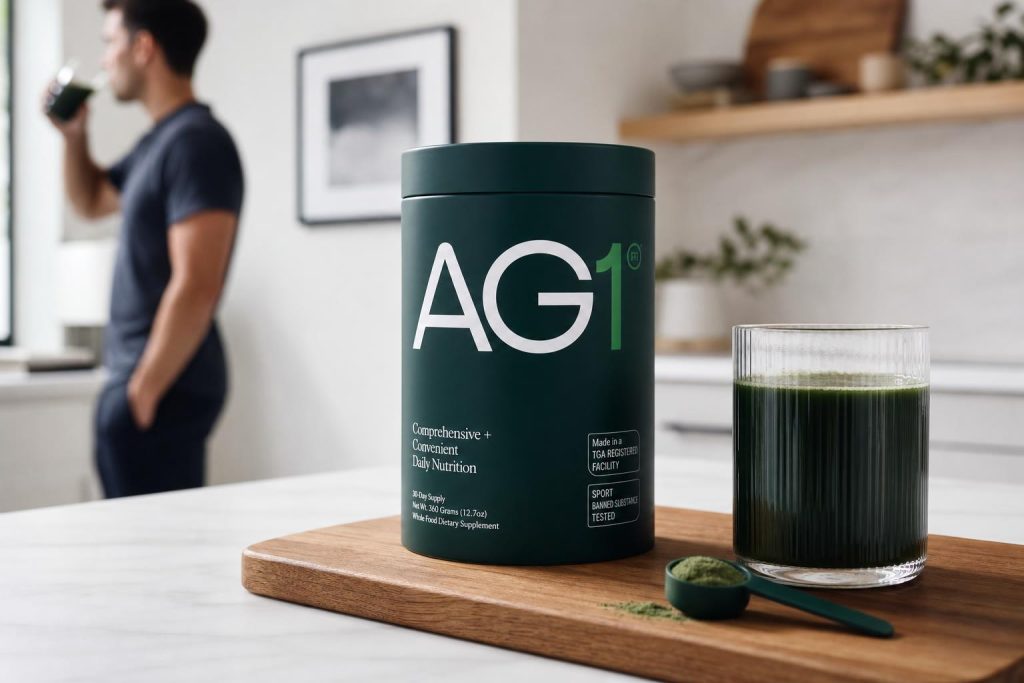
Most men eating a reasonably clean diet still fall short on several key micronutrients — and the research backs this up. A landmark analysis published in Nutrition Journal found that adults consuming the recommended number of daily servings of fruits and vegetables still failed to meet adequate intake levels for vitamins D, E, and potassium. Add caloric restriction, high training volume, or appetite suppression into the mix, and the gaps widen considerably. That’s the real-world problem AG1 — formerly known as Athletic Greens — is trying to solve. Whether it actually does that job well is a more complicated question.
AG1 has become one of the most aggressively marketed supplements in the health and fitness space. One scoop per day, mixed into water, promises 75 vitamins, minerals, and whole-food-sourced nutrients. At roughly $99 per month for a subscription, it’s not cheap. The question isn’t whether AG1 has a flashy ingredient list — it clearly does. The question is whether the doses are meaningful, the bioavailability is real, and the product is worth its premium price tag for men who are already putting serious effort into their diet and training.
What AG1 Actually Contains — and What the Research Says
The AG1 formula is built around a handful of legitimate nutritional targets. It contains 700mg of vitamin C, meaningful doses of B vitamins including B12 at 29mcg, zinc at 15mg, and a suite of adaptogenic herbs including ashwagandha. Vitamin D comes in at 400 IU — a dose that many experts now consider insufficient as a standalone intervention. Research published in the American Journal of Clinical Nutrition suggests most adults require between 1,500 and 2,000 IU daily to maintain serum 25(OH)D levels in the optimal range. AG1’s contribution matters, but it won’t get you there alone.
The formula also leans heavily on a proprietary greens blend featuring spirulina, chlorella, wheatgrass, and broccoli flower powder. These are genuinely bioactive compounds. Studies on spirulina have demonstrated anti-inflammatory properties and modest improvements in blood lipid profiles. Chlorella has shown some capacity for heavy metal chelation and antioxidant activity. The challenge is that AG1 doesn’t disclose the individual quantities within these blends — a standard industry practice with proprietary formulas that makes it impossible to assess whether the doses are clinically relevant or merely label-dressing.
The digestive enzyme and probiotic complex is another notable component. AG1 includes 7.2 billion CFU of Lactobacillus acidophilus and Bifidobacterium bifidum, alongside digestive enzymes including bromelain and papain. Evidence supports probiotic supplementation for gut microbiome diversity and nutrient absorption efficiency, which indirectly supports everything from immune function to hormonal balance — all relevant to men focused on body composition and performance.
Who Benefits Most From a Daily Greens Supplement
AG1 isn’t a magic bullet, but it’s not snake oil either. The men most likely to see a genuine return on their investment fall into a few clear categories. If you’re eating in a meaningful caloric deficit — whether that’s a disciplined cut, intermittent fasting, or appetite suppression from any source including GLP-1 receptor agonists like semaglutide or tirzepatide — your micronutrient intake takes a proportional hit alongside your calories. Research on GLP-1 users specifically has raised concerns about reduced dietary variety and total micronutrient intake due to significantly decreased food consumption. A comprehensive greens supplement becomes functionally more relevant in that context.
Men training at high volume — particularly those doing concurrent cardio and resistance training — also have elevated demands for B vitamins, magnesium, and antioxidants. Sweat losses and metabolic demands during intense exercise increase micronutrient turnover in ways a standard diet may not compensate for. Separately, men eating a predominantly animal-based or carnivore-style diet may find value in AG1’s plant-sourced phytonutrients and fiber-associated compounds they’re otherwise missing. None of these groups need AG1 specifically, but they do have genuine nutritional gaps that a well-formulated greens product can help address.
The honest counterargument is that for men eating a genuinely diverse whole-food diet — plentiful vegetables, lean proteins, legumes, and fruit — AG1 represents a largely redundant nutritional investment. The foundational research on micronutrient adequacy consistently points back to food-first strategies. Epidemiological data has repeatedly shown that whole food sources of vitamins and minerals produce better health outcomes than supplemental equivalents, likely due to synergistic phytochemical interactions that no powder can fully replicate. AG1 positions itself as a complement to good nutrition, not a replacement for it — and that framing is accurate.
On taste and practicality, AG1 scores reasonably well. The flavor is earthy but palatable, especially with cold water. The single-scoop daily routine is genuinely convenient for men who travel frequently or whose schedules make consistent meal planning difficult. These aren’t trivial factors — the best supplement protocol is the one you’ll actually stick to.
The Takeaway
AG1 is a well-formulated, premium-priced greens supplement that does a credible job addressing common micronutrient gaps. Its strengths are real — a broad spectrum of vitamins and minerals, a meaningful probiotic blend, and bioactive plant compounds that support inflammation management and gut health. Its weaknesses are also real — proprietary blend opacity, a vitamin D dose that likely needs reinforcing, and a cost that demands honest evaluation of your actual dietary baseline. If your diet is already rich in diverse whole foods, AG1 is probably redundant. If you’re eating in a prolonged deficit, training hard, or simply failing to hit your vegetable targets consistently, it offers genuine insurance. Treat it as exactly that — nutritional insurance, not a foundation. Build your foundation with food first, and let the supplement fill the gaps that remain.