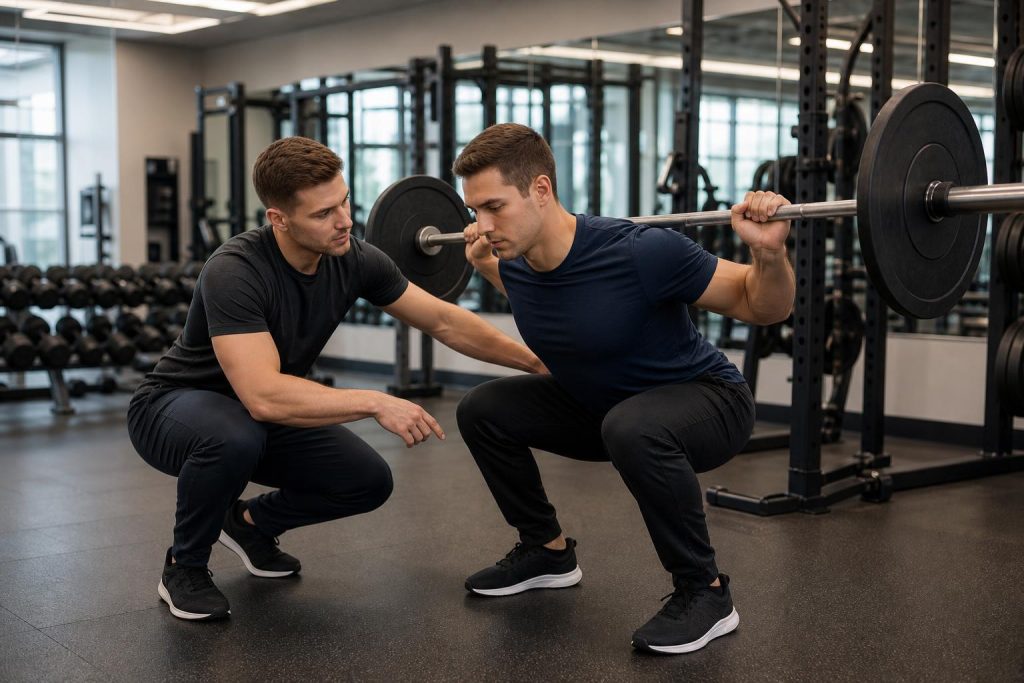
Here’s a number that should reshape how you think about your workouts: a single set of squats activates over 200 muscles simultaneously, while a leg extension recruits primarily one. That’s not an argument against isolation work — it’s an argument for understanding when each tool earns its place. Research published in the Journal of Strength and Conditioning Research confirms that multi-joint compound movements produce significantly greater anabolic hormone responses than single-joint exercises, which has direct implications for anyone trying to build muscle, burn fat, or preserve lean mass while in a caloric deficit.
Whether you’re hitting the gym cold, dialing in your nutrition alongside a GLP-1 medication, or somewhere in between, the compound-versus-isolation debate is one worth settling — because getting it wrong means leaving results on the table.
Why Compound Movements Should Anchor Your Program
Compound exercises — squats, deadlifts, bench press, overhead press, rows, pull-ups — recruit multiple muscle groups and joints working in concert. This mechanical demand translates into a larger metabolic cost per rep, a more robust testosterone and growth hormone response, and greater total muscle fiber recruitment. A landmark study in the European Journal of Applied Physiology demonstrated that compound lower-body lifts like squats produced significantly higher acute testosterone responses compared to isolated leg press variations — a hormonal environment that favors muscle retention and fat oxidation.
For men in a caloric deficit — regardless of how that deficit is achieved — this matters enormously. When you’re eating less, your body is primed to shed both fat and muscle. Compound lifts send a powerful anabolic signal that tells your body to protect lean tissue. They also burn more calories per session and improve insulin sensitivity more effectively than isolation work alone. A 2018 review in Obesity Reviews found that resistance training — particularly high-load, multi-joint training — is one of the most effective interventions for preserving fat-free mass during weight loss. That finding applies whether you’re cutting through caloric discipline, a structured diet protocol, or appetite suppression from a GLP-1 receptor agonist like semaglutide or tirzepatide.
The practical prescription: build your sessions around three to five compound lifts per week. A squat or hinge pattern (deadlift, Romanian deadlift), a horizontal push (bench or dumbbell press), a horizontal pull (barbell or cable row), and a vertical pull (pull-up or lat pulldown) cover the majority of your muscle mass with maximum efficiency. Train these movements with progressive overload — adding weight, reps, or sets over time — and you’ve built the foundation every other training decision should sit on top of.
Where Isolation Work Earns Its Place
Isolation exercises — curls, tricep pushdowns, lateral raises, leg curls, cable flyes — often get dismissed as vanity work, but that framing is too simplistic. Research in the Journal of Human Kinetics shows that isolation movements produce superior activation in target muscles when compared to compound alternatives for the same muscle group, making them valuable for addressing weak points, improving mind-muscle connection, and accumulating volume without excessive systemic fatigue.
That last point is critical for men managing recovery — whether due to high training frequency, age, or the physiological adjustments that accompany significant caloric restriction. When your central nervous system is already taxed by heavy compound work, adding isolation movements to the end of a session allows you to stimulate additional hypertrophy in specific muscles without burying your recovery capacity. Men using GLP-1 medications, who often experience reduced caloric intake and may need to manage energy levels carefully, benefit particularly from this strategic stacking — heavy compounds first, targeted isolation work as a finishing layer.
Lateral raises fill out shoulders that rows and presses miss at the outer head. Leg curls reinforce hamstring integrity that deadlifts alone don’t fully address. Bicep curls build the peak that pull-ups develop but don’t isolate. Used intelligently — two to four isolation movements per session, placed after compound work — they sharpen and complete what the big lifts started.
The Takeaway
The answer was never compound or isolation — it’s compound then isolation. Anchor every session in multi-joint movements that drive hormonal output, protect lean mass, and maximize metabolic return. Build your accessory work around the gaps those lifts leave behind. This hierarchy holds whether you’re a competitive lifter, a man quietly transforming his body through disciplined nutrition, or someone using every tool available including medication. The physiology doesn’t change. Neither should the approach.