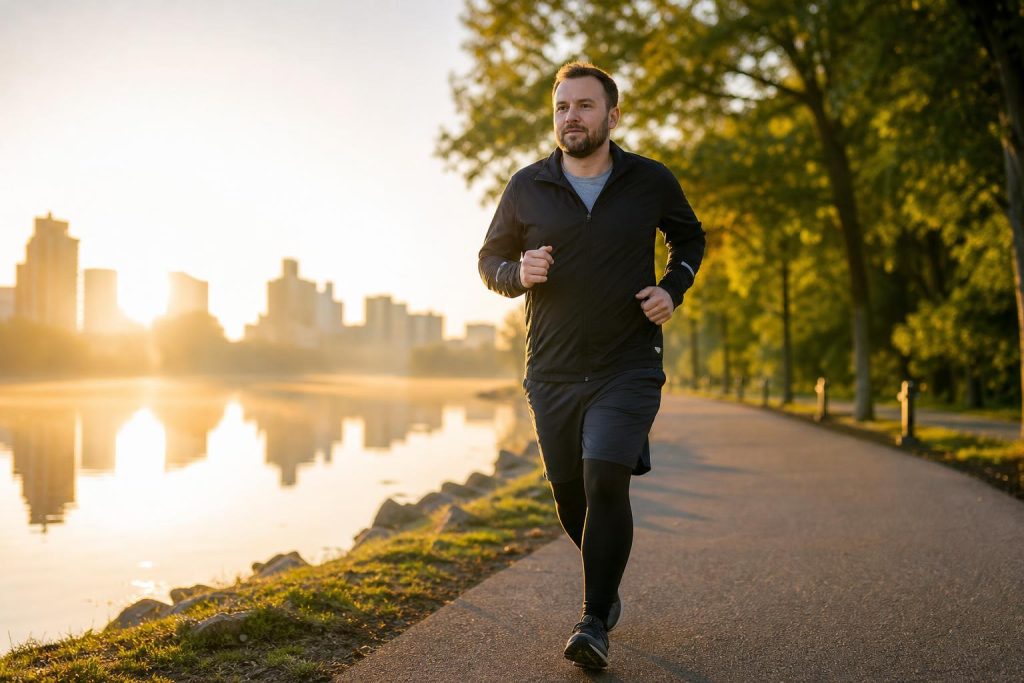
Losing a significant amount of weight is one of the most powerful things a man can do for his long-term health. But for many men — whether they’re dropping 40 pounds through diligent training and dieting, using a GLP-1 medication like semaglutide, or combining multiple strategies — one concern quietly dominates the conversation: what happens to the skin when the fat underneath it disappears?
This isn’t a vanity issue. It’s a legitimate physiological question, and the research backs up that concern. Studies examining skin elasticity after major weight loss consistently show that the speed of fat loss, age, total weight lost, and lean mass preserved all significantly influence whether skin rebounds or sags. The good news is that most of these variables are within your control — if you act deliberately.
Why Skin Loses Its Snap — And What’s Actually Happening Beneath the Surface
Skin isn’t a passive envelope. It’s a living organ composed largely of collagen and elastin fibers that constantly remodel based on mechanical signals, nutritional status, and hormonal environment. When fat accumulates over years, the skin gradually stretches and the underlying collagen architecture reorganizes to accommodate the expanded volume. When fat loss happens — particularly rapid fat loss — the skin doesn’t always have time or the biological resources to contract accordingly.
Research published in the journal Skin Pharmacology and Physiology confirms that collagen synthesis is the key determinant of skin elasticity and that it declines with age, poor nutrition, and UV exposure. This means a 45-year-old man losing 60 pounds faces a meaningfully different physiological challenge than a 28-year-old losing the same amount — not an impossible one, just different. Collagen turnover slows, skin thickness decreases, and the dermis becomes less responsive to remodeling signals. Understanding this is the first step toward doing something about it.
The rate of weight loss matters enormously here. Men pursuing aggressive caloric deficits — whether through severe restriction, GLP-1-driven appetite suppression, or extended fasting protocols — can lose fat faster than the skin’s remodeling cycle allows. Evidence suggests that gradual weight loss of 0.5 to 1 pound per week gives dermal tissue more opportunity to adapt compared to aggressive losses of 2 or more pounds weekly. If you’re on a GLP-1 and weight is coming off quickly, this is worth discussing with your prescriber — modulating intake to slow the pace slightly can make a real difference in skin outcomes.
The Muscle Mass Factor Is Non-Negotiable
Here’s where most loose skin conversations go wrong: they focus almost entirely on skin care products, hydration, and collagen supplements while ignoring the single most impactful variable — how much lean muscle mass sits beneath the skin during and after fat loss.
Muscle volume physically fills the space vacated by fat. A man who loses 50 pounds while simultaneously building or preserving substantial lean mass will have dramatically better skin appearance than one who loses the same weight through diet alone. Research on body recomposition consistently shows that resistance training during a caloric deficit preserves lean tissue and changes body composition in ways that cardio-only approaches cannot replicate. This is true whether you’re running a modest deficit through clean eating or whether an appetite-suppressing medication is doing much of the heavy lifting on the intake side.
The practical implication is direct: lift heavy, lift consistently, and treat resistance training as non-negotiable during any fat loss phase. Compound movements — squats, deadlifts, presses, rows — create the strongest anabolic signal for muscle preservation. Aim for two to four sessions per week, progressive overload over time, and don’t let cardio dominate your training approach to the point that it crowds out strength work.
Protein intake is the other half of this equation. High-protein diets during caloric restriction have been shown to significantly attenuate lean mass loss while promoting fat oxidation. A target of 0.7 to 1.0 grams of protein per pound of body weight daily is supported by the evidence base for men in a deficit. This also matters for skin directly — the amino acids leucine, glycine, and proline are essential substrates for collagen synthesis, meaning adequate protein is literally building material for dermal repair.
Nutrition, Collagen Support, and What Actually Works
Beyond total protein, specific micronutrients play documented roles in skin structural integrity. Vitamin C is a required cofactor for collagen synthesis — without adequate vitamin C, the enzymatic process that cross-links collagen fibers is impaired. Clinical evidence shows that vitamin C status directly influences collagen production in the dermis, making dietary intake from whole food sources — citrus, bell peppers, strawberries — or supplementation a sensible priority during active fat loss phases.
Hydration is consistently underestimated. Skin turgor and elasticity depend on adequate fluid status, and dehydration — which can occur in men using GLP-1 medications due to reduced food and fluid intake — measurably impairs skin mechanical properties. Electrolyte balance matters here too, particularly sodium and potassium. Aim for consistent hydration rather than sporadic large intakes.
Collagen peptide supplementation has moved from the supplement fringe to having a legitimate evidentiary base. A randomized controlled trial found that hydrolyzed collagen supplementation improved skin elasticity and dermal collagen density in adults over the course of 12 weeks. The effect sizes are modest but real, and the safety profile is favorable. Ten to 20 grams daily of hydrolyzed collagen peptides, taken alongside a vitamin C source to maximize synthesis, represents a reasonable adjunct — not a replacement for the fundamentals, but a useful tool in the stack.
Sleep and stress management round out the picture in ways that are easy to dismiss but physiologically important. Cortisol — chronically elevated in men who are sleep-deprived or under sustained stress — directly degrades collagen and impairs skin repair mechanisms. Research confirms that poor sleep impairs skin barrier function and delays recovery, which compounds over months of a fat loss phase. Seven to nine hours of sleep isn’t a luxury; it’s a structural requirement for the tissue remodeling you’re asking your body to perform.
The Takeaway
Loose skin during weight loss is a real concern, but it’s far more manageable than most men realize. The strategy isn’t complicated — it’s just disciplined. Lose fat at a sustainable pace, prioritize resistance training to preserve and build the muscle that fills the skin, eat adequate protein and micronutrients to support collagen synthesis, stay well hydrated, and protect your sleep. Whether you’re using a GLP-1 medication, following a structured diet, or simply grinding through a training and eating plan you’ve built yourself, these principles apply equally. The men who come out of a major fat loss phase looking lean and tight rather than deflated are the ones who treated the whole system — not just the number on the scale.