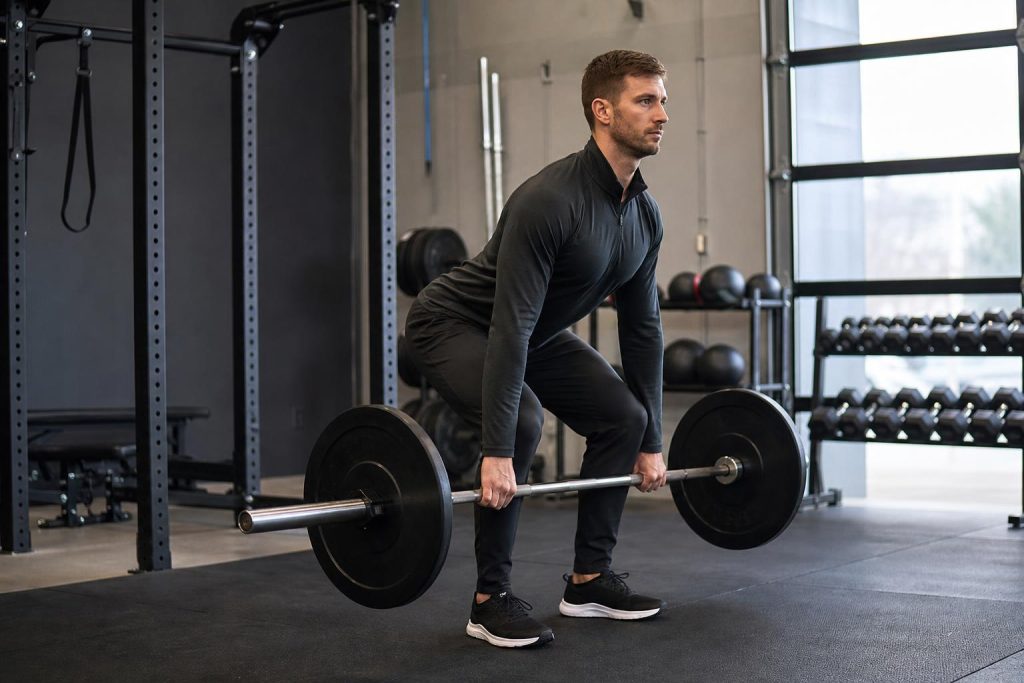
If you could only master one movement pattern for the rest of your training life, the hip hinge would be the most defensible choice. It’s the mechanical foundation of the deadlift, the Romanian deadlift, the kettlebell swing, and the good morning — exercises that collectively recruit more total muscle mass than almost any other movement category. And when it comes to the twin goals most men are chasing — losing fat while holding onto (or building) muscle — research consistently shows that compound, multi-joint movements driving the greatest hormonal and metabolic response are the ones worth prioritizing.
The hip hinge is deceptively simple in concept and notoriously difficult to execute well. At its core, it’s a posterior weight shift — loading the hamstrings and glutes through a forward trunk lean while keeping the spine neutral and the knees minimally bent. That’s it. But the downstream effects of training this pattern correctly are profound: significant caloric expenditure during the session, elevated post-exercise oxygen consumption, and a hormonal environment that favors muscle retention even in a caloric deficit. Studies on resistance training and body composition have repeatedly demonstrated that lower-body compound lifts are among the most effective tools for preserving lean mass during fat loss phases — which is the central challenge for any man serious about recomposition.
Why the Hip Hinge Produces Results Most Exercises Can’t Match
The posterior chain — glutes, hamstrings, spinal erectors, and to a significant extent the lats and upper back — represents the largest and most metabolically active group of muscles in the body. When you load these muscles through a properly executed hip hinge, you’re not just burning calories in the moment. You’re stimulating muscle protein synthesis in tissues that have a disproportionately large effect on resting metabolic rate. Research on skeletal muscle mass and basal metabolic rate confirms that each pound of muscle you preserve or add raises your daily energy expenditure — making fat loss progressively more sustainable over time.
There’s also a hormonal argument. Heavy compound movements that recruit large muscle groups are associated with acute spikes in testosterone and growth hormone. A landmark study from the early 1990s found that exercises like the deadlift and squat produced significantly greater acute hormonal responses than isolation exercises — a finding that has held up in subsequent research. For men in a caloric deficit — whether through disciplined eating, intermittent fasting, or GLP-1 medications that suppress appetite — these hormonal signals are protective. They tell the body to spare muscle and preferentially oxidize fat, which is exactly the outcome you’re training toward.
The kettlebell swing deserves special mention as a hip hinge variation with a uniquely powerful fat-loss profile. Because the swing is ballistic — meaning the load is accelerated through a dynamic range of motion — it creates a cardiovascular demand that pure strength work doesn’t. Research published in the Journal of Strength and Conditioning Research found that kettlebell swings elevated heart rate to levels comparable to aerobic training while simultaneously loading the posterior chain. This dual metabolic and mechanical stimulus makes swings one of the most time-efficient tools in a fat-loss program.
How to Actually Learn and Load the Hip Hinge
Most men fail the hip hinge not because they lack strength but because they default to squatting. The distinction matters: a squat is a knee-dominant movement where the hips and knees flex simultaneously. A hip hinge is hip-dominant — the knees soften slightly, but the primary movement is the hips pushing back as the torso leans forward. A simple diagnostic is the wall test: stand about a foot from a wall, soften your knees, and push your hips back to touch the wall without rounding your lower back or letting your knees travel forward significantly. If you can do that cleanly, you understand the pattern. If your knees drift toward the wall or your back rounds immediately, you need to drill the movement before loading it.
The progression for most men should run from the bodyweight Romanian deadlift to the dumbbell or trap bar deadlift, then to the conventional barbell deadlift or loaded kettlebell swing depending on goals. Trap bar deadlifts are particularly well-suited for men newer to hinging because the neutral grip and center-of-gravity positioning reduce technique demands while still delivering a significant posterior chain stimulus. For men dealing with lower back sensitivity — common in those who’ve spent years in sedentary jobs — starting with the single-leg Romanian deadlift can rebuild patterning while exposing and addressing left-right imbalances.
From a programming standpoint, two to three hip hinge sessions per week is sufficient for most men pursuing fat loss with muscle retention. Sets in the four-to-six rep range at higher loads drive the hormonal and strength adaptations that protect muscle tissue during a deficit. Sets in the eight-to-twelve rep range accumulate more total volume and metabolic stress. Combining both — heavier deadlifts early in a session followed by higher-rep Romanian deadlifts or swings — covers both bases efficiently. Rest periods of 90 to 180 seconds between heavy sets preserve performance without unnecessarily extending session length.
Nutrition around hinge-focused sessions follows the same principles as any strength training block: adequate protein is non-negotiable. A 2017 systematic review reinforced that protein intakes of 1.6 grams per kilogram of body weight represent the minimum effective dose for maximizing muscle protein synthesis in trained men — with some evidence supporting intakes up to 2.2 grams per kilogram during aggressive cuts. Whether your caloric deficit comes from meal planning, carbohydrate cycling, or appetite suppression through medication, protein should be the last macronutrient to get cut.
The Takeaway
The hip hinge isn’t a trend or a niche technique — it’s one of the fundamental ways the human body is designed to produce force. Mastering it unlocks the posterior chain, drives the kind of hormonal response that protects muscle in a deficit, and creates a metabolic demand that cardio machines simply can’t replicate at the same time. If your current training program doesn’t include at least one hip hinge variation trained consistently and progressively, you’re leaving the most valuable tool in the gym largely unused. Learn it, load it, and let the compounding effects take care of the rest.