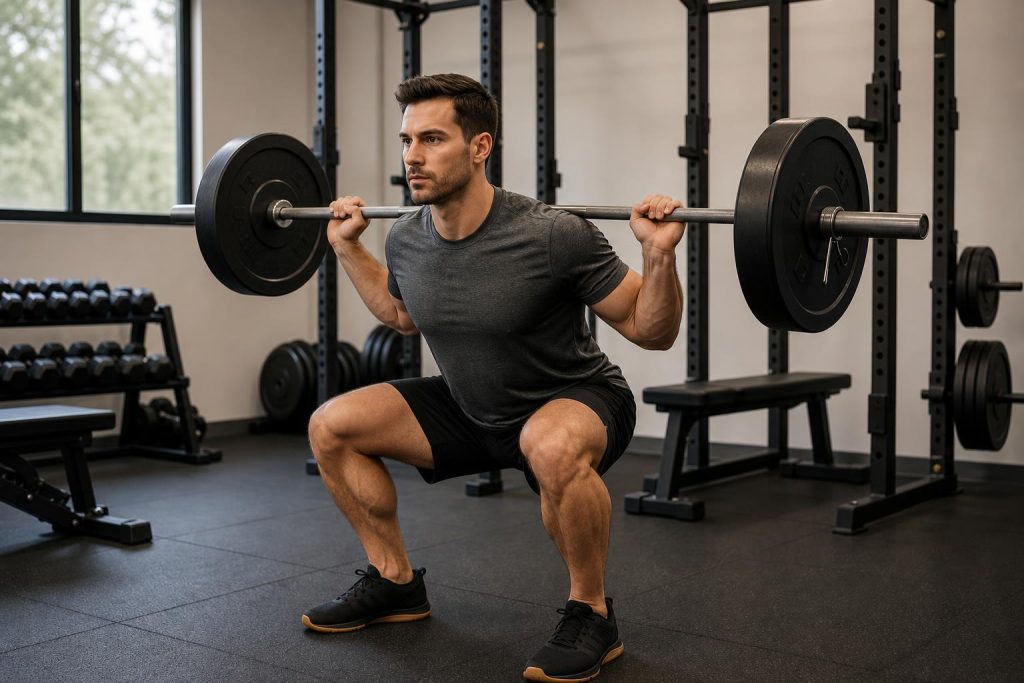
Why Squat Form Matters More When You’re on GLP-1
If you’re using semaglutide, tirzepatide, or another GLP-1 medication for weight loss, you’re in a powerful metabolic state—but you’re also at risk. Research shows GLP-1 users lose 15-22% body weight over 68 weeks, but up to 25-30% of that loss can be lean muscle mass if training and nutrition aren’t optimized.
Proper squat form isn’t just about injury prevention—it’s about mechanical tension, the primary driver of muscle protein synthesis. Studies confirm that high-tension resistance training preserves muscle during caloric deficit, and the squat is one of the most mechanically efficient ways to create that tension across your largest muscle groups (quads, glutes, hamstrings, core).
Perfect form under load = maximum muscle retention while you’re losing fat on GLP-1.
The Five-Point Squat Setup: Foundation for Body Recomposition
1. Stance Width and Foot Angle
Start with feet shoulder-width apart (roughly 8-10 inches between heels for most people). Point toes 5-15 degrees outward. This stance activates glutes and quads evenly—critical for preserving lower-body muscle mass during GLP-1-induced weight loss.
2. Neutral Spine and Core Bracing
Before descending, take a deep breath into your belly (not your chest) and brace your core as if expecting a punch. Core tension during compound lifts increases intra-abdominal pressure, reducing injury risk and improving force transfer. This is non-negotiable, especially when appetite suppression makes it harder to fuel your training.
3. Shoulder Blade Retraction (Back Squat)
If you’re doing a back squat, pull your shoulder blades down and back. Position the bar on your mid-traps, not your neck. This creates a stable “shelf” and protects your shoulders—crucial if you’re training frequently to preserve muscle on a caloric deficit.
4. Knee Tracking Over Toes
As you descend, knees should track over your second and third toes. They should not cave inward (valgus collapse) or shoot excessively forward. Proper knee alignment ensures equal tension through the quad, protecting your joints while maximizing muscle recruitment—the key to body recomposition.
5. Depth and Range of Motion
Research demonstrates that full-range-of-motion squats (hip crease below parallel) produce significantly greater muscle activation and protein synthesis stimulus than partial squats. Aim for hip crease at or slightly below knee line if mobility allows. If you can’t reach depth safely, address mobility first—don’t compromise form.
The Descent and Ascent: Controlling Mechanical Tension
The descent should take 2-3 seconds, maintaining tight bracing throughout. Your chest stays upright relative to your torso angle, weight distributed evenly across your midfoot and heel. You’re not shifting weight to your toes—that’s a red flag for knee strain.
At the bottom, maintain tension; don’t “relax” into the hole. Drive through your midfoot and heels to ascend, extending hips and knees simultaneously (not hips first, which indicates weak quads or forward lean issues).
Controlled eccentrics (lowering phase) produce 20% greater hypertrophic stimulus than concentrics alone—a critical advantage when your appetite is suppressed and overall training volume is lower on GLP-1.
Load and Repetition Ranges for Muscle Preservation on GLP-1
Your goal on GLP-1 isn’t to hit new PRs; it’s to preserve muscle while losing fat. This means:
- Load: 70-85% of your 1RM (the weight where 6-10 reps is challenging but achievable with good form)
- Rep range: 6-12 reps per set, 3-4 sets per muscle group per week
- Frequency: 2-3 squat sessions per week (back squat, front squat, or goblet squat) if calories allow; once weekly minimum to maintain strength and muscle
Meta-analysis shows resistance training at 65-85% 1RM with 6-35 reps optimizes muscle retention in hypocaloric conditions. GLP-1 users often operate in 500-750 kcal deficits; this rep range is your best insurance against lean mass loss.
Nutrition and Protein: Fueling Squats While on GLP-1
Here’s the challenge: GLP-1 suppresses appetite, but intense squat training demands protein and carbs. Research confirms 0.7-1.0g protein per pound of body weight daily preserves muscle during resistance training and caloric deficit.
Practical approach on GLP-1:
- Prioritize protein at each meal (25-40g per meal for most adults)
- Pre-squat: 20-30g carbs + 20g protein 60-90 minutes before training
- Post-squat: 30-40g protein + 20-40g carbs within 2 hours
- If appetite is severely suppressed, consider liquid sources: protein shakes, bone broth, Greek yogurt smoothies
Creatine monohydrate (5g daily) is one of few supplements with robust evidence for muscle preservation during caloric deficit—consider adding it if training intensity is high.
Common Form Mistakes GLP-1 Users Make
- Reducing volume too aggressively: Low appetite doesn’t mean low training volume. Maintain intensity; reduce frequency or reps only if fueling becomes impossible.
- Forward lean/quad dominance: Often caused by weak glutes or poor mobility. Add glute activation work (band pull-throughs, hip thrusts) 2-3x weekly.
- Knees caving inward: Sign of weak glute medius or poor cue execution. Focus on external rotation cues: “screw feet into ground.”
- Incomplete depth: Reduces stimulus. Invest 2-3 weeks in mobility work (90/90 stretches, couch stretch, world’s greatest stretch) before reducing squat depth.
Bottom Line
Perfect squat form on GLP-1 is your best tool for preserving muscle while losing fat. Master the five-point setup, control the descent and ascent, load in the 70-85% 1RM range for 6-12 reps, and prioritize protein—25-40g per meal. Train 2-3x weekly if fueling allows; once weekly minimum. This protocol optimizes muscle retention in hypocaloric conditions, turning your GLP-1 journey into true body recomposition—not just weight loss.
Next Step: Explore our complete GLP-1 training guide for comprehensive muscle preservation protocols, or read our nutrition guide for GLP-1 users on appetite suppression strategies.