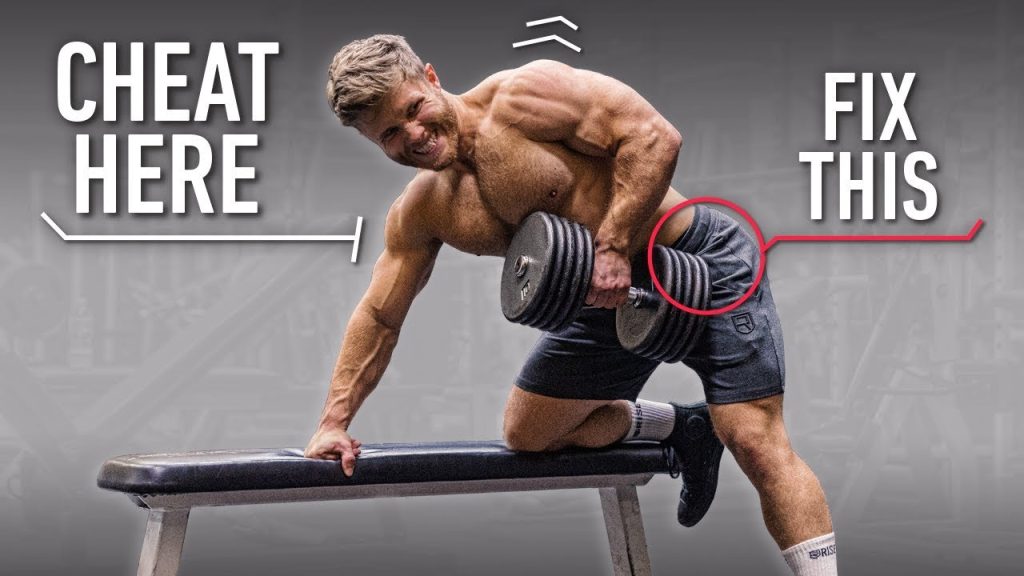
Video by Jeff Nippard on YouTube
Most men who train regularly have done a dumbbell row. Far fewer have done one correctly. That distinction matters more than most realize — research published in the Journal of Strength and Conditioning Research has consistently demonstrated that motor pattern quality and scapular control during rowing movements directly influence which muscles are recruited and how effectively they develop over time. In other words, sloppy rows don’t just leave gains on the table — they shift the mechanical load away from the muscles you’re targeting and toward structures that aren’t built to handle it.
The dumbbell row deserves more respect than it typically gets. It’s one of the most effective unilateral upper-body movements available, capable of building serious lat thickness, strengthening the rhomboids and mid-traps, and improving the kind of posterior chain resilience that keeps shoulders healthy under heavy pressing loads. Whether you’re in a caloric deficit trying to hold onto lean mass, deep into a hypertrophy block, or simply trying to move and feel better — getting this movement right pays dividends that compound over time.
Anatomy First: Know What You’re Actually Training
The primary movers in a dumbbell row are the latissimus dorsi, the middle trapezius, the rhomboids, and the posterior deltoid. The biceps and brachialis serve as synergists, meaning they assist the pull but shouldn’t dominate it. One of the most common technical errors men make is allowing the biceps to take over — pulling with the arm rather than driving with the elbow and initiating the movement through scapular retraction. EMG analysis of rowing variations shows that scapular retraction prior to elbow flexion significantly increases mid-trap and rhomboid activation, meaning the setup phase of each rep is as important as the pull itself.
Understanding this anatomy reframes how you approach the exercise. You’re not trying to move a dumbbell from point A to point B. You’re trying to create a specific sequence of muscular events — first the shoulder blade moves, then the arm follows. When that sequence is reversed or skipped, the lats still fire to some degree, but the stabilizers and scapular retractors are largely bypassed, reducing total back development and increasing the risk of anterior shoulder irritation over time.
The Technique That Actually Works
Start in a staggered stance with one knee and hand braced on a bench — the classic supported position. Your spine should be roughly parallel to the floor with a neutral lumbar curve, not rounded or hyperextended. Before you even pick up the dumbbell, take a moment to actively depress and retract the shoulder blade of your working arm. Think about pulling the shoulder away from your ear and slightly toward your opposite hip pocket. This pre-activation creates the muscular environment the row needs to be effective.
With the dumbbell in hand, let it hang at full extension without allowing the shoulder to collapse forward or elevate. From here, initiate the pull by driving the elbow back and upward — not out to the side, which biases the posterior delt, and not straight back, which can prematurely engage the biceps. The elbow should travel at roughly a 45-degree angle relative to your torso. As the weight rises, focus on squeezing the shoulder blade in toward the spine at the top of the rep. That peak contraction is where a significant portion of the rhomboid and mid-trap stimulus lives, and most men rush through it or miss it entirely.
The descent is where muscle is built. Research on eccentric loading and hypertrophy consistently shows that controlled lowering phases produce greater mechanical tension and muscle damage — two key drivers of growth — compared to passive or fast lowering. A three-second eccentric on each rep of a dumbbell row transforms a mediocre set into a highly productive one. Let the weight travel back to full extension with control, feel the lat stretch at the bottom, and reset the scapula before the next rep.
For men focused on muscle preservation during periods of fat loss — whether through caloric restriction, a structured diet, or GLP-1-assisted weight management — unilateral movements like the dumbbell row are particularly valuable. They allow you to train with meaningful load and intensity without the systemic fatigue that heavier bilateral pulling can create, making them easier to recover from while still providing the mechanical stimulus your body needs to hold onto lean mass. Studies examining resistance training during energy restriction confirm that maintaining training volume and progressive overload is the primary variable protecting muscle tissue when calories are reduced.
Programming-wise, three to four sets of eight to twelve reps with a moderate load and strict form outperforms heavy, sloppy sets almost every time. If you can’t maintain scapular control and a neutral spine through the full set, the weight is too heavy. Ego-driven loads with compromised mechanics redistribute stress to the lower back, cervical spine, and bicep tendons — none of which are improved by the exercise. Choose a weight that lets you feel every rep, control the lowering phase, and finish with the same form you started with.
The Takeaway
The dumbbell row is not a complicated exercise, but it is a technical one. The difference between doing it and doing it well is the difference between a movement that builds a thick, resilient back and one that accumulates fatigue without delivering results. Anchor your setup, sequence the scapula before the arm, own the eccentric, and treat each rep as its own event. The men who train with that kind of intentionality don’t just look better — they stay in the game longer, get hurt less, and build the kind of functional strength that actually transfers to life outside the gym.