Most men chasing fat loss make the same critical mistake: they obsess over the scale and ignore what’s happening beneath it. When calories drop — whether through disciplined dieting, GLP-1 medications like semaglutide, or aggressive cardio — the body doesn’t just burn fat. It burns muscle too. Research published in Diabetes, Obesity and Metabolism found that participants on semaglutide lost roughly 39% of their total weight loss from lean mass — a figure alarming enough to reframe how any man in a caloric deficit should think about resistance training. The Romanian deadlift isn’t just a gym exercise. For anyone trying to stay strong while losing weight, it’s a survival tool.
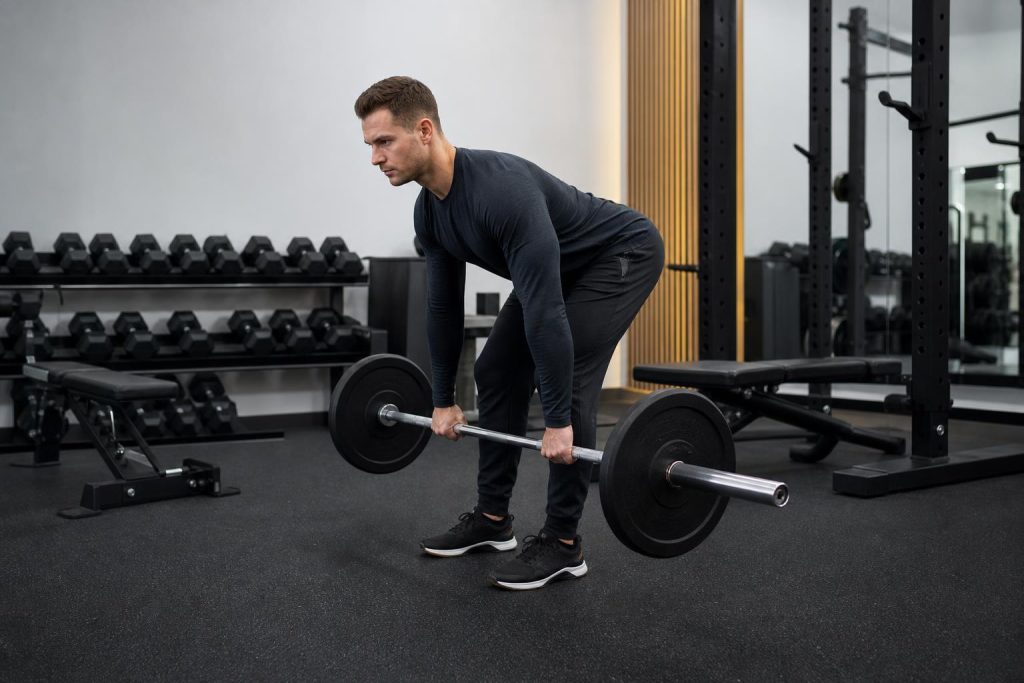
The Romanian deadlift, or RDL, is a hip-hinge movement that targets the posterior chain — your hamstrings, glutes, spinal erectors, and to a meaningful degree, your upper back and core. Unlike the conventional deadlift, the bar never touches the floor. The movement begins from a standing position, bar in hand, and involves a controlled hip hinge that drives the hips back while maintaining a neutral spine, stretching the hamstrings under load, then driving through the hips to return upright. It sounds simple. Executed correctly, it’s one of the most effective compound movements for building and preserving lean mass in the lower body — precisely the muscle groups most men lose first when dieting hard.
Why the Romanian Deadlift Is Built for Muscle Preservation
The mechanism that makes the RDL particularly valuable during fat loss comes down to the nature of the stimulus it provides. The movement emphasizes the eccentric phase — the lowering portion — where the hamstrings are lengthened under significant tension. A 2020 meta-analysis in the Journal of Strength and Conditioning Research confirmed that eccentric-dominant training produces greater muscle hypertrophy and strength gains than concentric-only protocols, largely because the mechanical tension during the stretch phase is a powerful trigger for muscle protein synthesis. When you’re in a caloric deficit, this kind of mechanical signal tells the body in no uncertain terms that the muscle is needed — and should be spared.
The RDL also loads the hamstrings in a lengthened position, which research is increasingly recognizing as a superior stimulus for muscle growth. A 2022 study in the Journal of Human Kinetics demonstrated that exercises loading muscles at longer lengths produce significantly greater hypertrophic adaptations compared to those loading at shorter lengths — even when total volume is equated. This makes the RDL mechanically ideal not just for building the hamstrings, but for holding onto them when the body is under caloric stress.
For men using GLP-1 receptor agonists — or anyone eating at a substantial deficit — the stakes are especially high. Reduced appetite means reduced protein intake unless you’re deliberate about it. Lower caloric intake without adequate resistance training accelerates muscle catabolism. A 2021 review in Obesity Reviews emphasizes that resistance exercise is the most effective non-pharmacological intervention for mitigating lean mass loss during energy restriction. The RDL isn’t the only tool in that arsenal, but given its compound nature, its loading demand, and its ability to be progressively overloaded, it belongs at the foundation of any preservation-focused training program.
How to Perform the Romanian Deadlift Correctly
Setup matters more than most men realize. Stand with feet hip-width apart, barbell held with an overhand grip just outside your thighs. Brace your core — not just sucked-in abs, but true intra-abdominal pressure like you’re about to take a punch. Retract your shoulder blades slightly and create tension through your lats by imagining you’re trying to bend the bar around your legs. This protects the spine throughout the movement.
Initiate the descent by pushing your hips back — not by bending your knees first. Think of your hips as a hinge, not a squat. The bar travels close to the body, nearly grazing your thighs and shins as it descends. Your spine stays neutral throughout; the moment your lower back rounds, you’ve gone too far. The depth of the movement is determined entirely by your hamstring flexibility and your ability to maintain that neutral spine — not by how far the bar travels. For most men, the bar reaches mid-shin. Some will feel a hard stop at the knees. Both are valid. Drive through the hips — not by jerking upright, but by squeezing the glutes and pushing the floor away — to return to the starting position.
For muscle preservation during a cut, the rep range sweet spot sits between 6 and 10 repetitions per set, with enough load to make the last two reps genuinely challenging. Research from Brad Schoenfeld and colleagues confirmed that mechanical tension — not just metabolic stress — is the primary driver of hypertrophy, and you can only generate meaningful mechanical tension if the load is sufficient. Three to four working sets, twice per week, integrated into a broader lower-body or full-body training program, is a reasonable starting structure. Progress the weight as tolerated. Progressive overload remains the single most important variable for retaining muscle during a deficit, and the RDL accommodates it cleanly.
Common errors worth correcting immediately: squatting the weight down rather than hinging, hyperextending the lower back at lockout (which compresses the lumbar spine rather than engaging the glutes), and allowing the bar to drift forward away from the body. The bar should feel like it’s sliding along your legs throughout the descent. If it drifts, your posterior chain is losing the leverage it needs to control the load.
Protein intake amplifies everything the RDL does. A landmark meta-analysis in the British Journal of Sports Medicine found that protein intakes beyond 1.62 grams per kilogram of body weight per day maximized muscle gains in resistance-trained individuals — and during a deficit, many coaches push that ceiling closer to 2.2 grams per kilogram to account for increased protein oxidation. The resistance stimulus without the protein substrate is like building a house without materials. Both are non-negotiable.
The Takeaway
The Romanian deadlift earns its place in any fat-loss program not because it burns the most calories in the gym, but because of what it protects outside of it. Muscle is metabolically active tissue. It drives your resting metabolic rate, supports joint integrity, and determines what you look like when the fat comes off. Losing it during a cut — regardless of how you’re creating that deficit — means arriving at your goal weight weaker, softer, and metabolically slower than when you started. The RDL, done consistently, loaded progressively, and supported by adequate protein, is one of the most evidence-aligned moves you can make to prevent exactly that. The science supports it. The mechanics support it. Now you just have to load the bar.