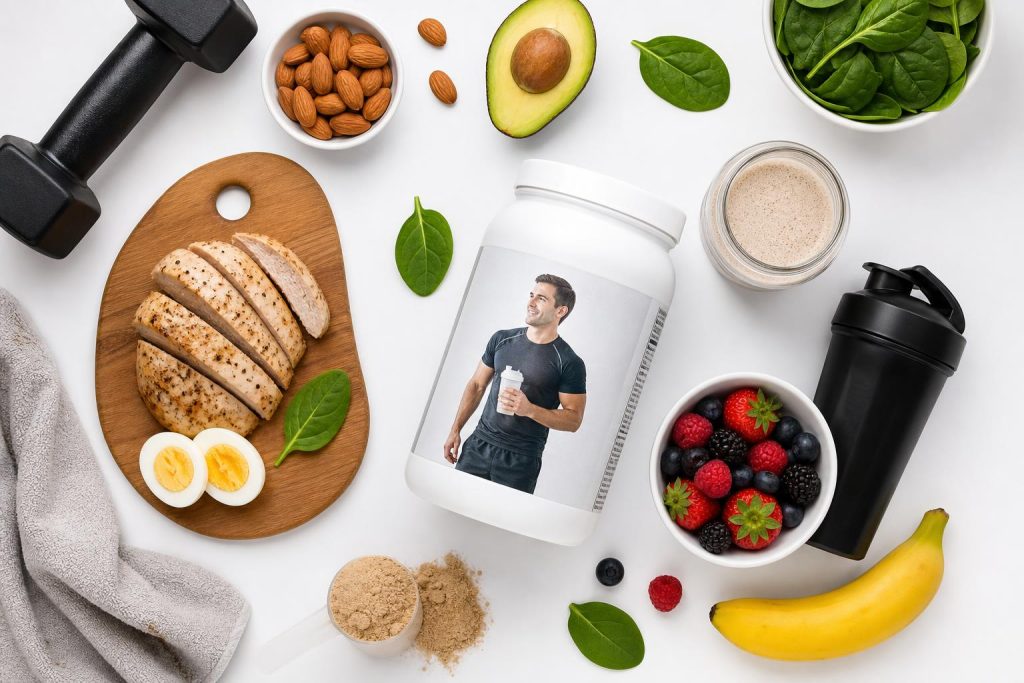
Here’s a number worth sitting with: in clinical trials, patients on semaglutide lost an average of 15% of their total body weight — but research published in Diabetes Care found that nearly 40% of that weight loss came from lean mass, not fat. That’s muscle — the metabolic engine that keeps your body burning calories, supporting your joints, and making you feel like a functional human being. For any man using Ozempic or Wegovy to lose weight, that statistic should change how you think about protein.
But this isn’t just a GLP-1 story. Whether you’re on a semaglutide protocol, running a calorie deficit on your own, or training hard and trying to recompose your body, the challenge is the same: eating less while preserving — or building — lean muscle tissue is one of the hardest things to do in health and fitness. Protein supplementation is one of the most effective, most studied, and most practical tools available to make that happen. The question isn’t whether you should use it. It’s which type actually works, how much you need, and when to take it.
Why Protein Becomes Critical When You’re Eating Less
GLP-1 receptor agonists like semaglutide work partly by suppressing appetite and slowing gastric emptying. The result is that most users naturally eat significantly less — sometimes uncomfortably less. While that drives the scale down, it also creates a nutritional gap that can accelerate muscle loss if not addressed deliberately. The same problem exists for anyone in an aggressive calorie deficit, regardless of how they got there.
A landmark meta-analysis in the British Journal of Nutrition confirmed that higher protein intake during caloric restriction significantly preserves lean body mass compared to standard protein consumption. The operative word is “higher” — most men eating at a deficit fall well short of what the research supports. The commonly cited RDA of 0.8 grams per kilogram of body weight is a floor for sedentary adults, not a target for men trying to stay muscular while losing fat. Most sports nutrition researchers now recommend between 1.6 and 2.4 grams per kilogram of body weight daily for men in a caloric deficit, with some evidence suggesting even higher intakes — up to 3.1 g/kg — may benefit those doing resistance training while cutting.
For a 200-pound man, that translates to roughly 145–220 grams of protein per day. Hit that through whole food alone when your appetite is suppressed, and you’ll quickly understand why supplementation isn’t optional — it’s strategic.
Whey, Casein, or Plant-Based: What the Evidence Actually Says
Not all protein supplements are created equal, and the differences matter more than marketing suggests. Whey protein concentrate and isolate remain the gold standard for most men, and the research is overwhelmingly clear on why. Whey is a complete protein with a high leucine content — leucine being the branched-chain amino acid that acts as the primary trigger for muscle protein synthesis. Studies show that whey protein stimulates greater acute muscle protein synthesis compared to casein and soy, particularly in the post-exercise window. For men prioritizing muscle preservation on a reduced-calorie diet, that anabolic signaling is exactly what you need.
Whey isolate specifically deserves mention for men on GLP-1 medications. Because it’s processed to remove most of the fat and lactose, it’s easier on a digestive system that’s already dealing with slower gastric motility — a common side effect of semaglutide. It also tends to be lower in calories per serving, which helps when total intake is constrained. A quality whey isolate providing 25–30 grams of protein per serving with minimal fillers is a practical, efficient choice.
Casein protein has a different but equally valuable role. It digests slowly, releasing amino acids steadily over four to seven hours. Research has shown casein’s slow-release profile makes it superior at reducing muscle protein breakdown over extended periods, making it ideal as a before-bed protein source. For men sleeping seven to eight hours and effectively fasting overnight, a casein shake before sleep can provide continuous amino acid delivery during what would otherwise be a catabolic window.
For men following plant-based diets or those who are lactose intolerant, pea protein and rice protein blends have emerged as legitimate alternatives. A study in the Journal of the International Society of Sports Nutrition found pea protein supplementation produced equivalent gains in muscle thickness to whey protein over an eight-week resistance training program. The key with plant proteins is ensuring you’re using a blend — pea protein alone is low in methionine, while rice protein is low in lysine. Combined, they approach a complete amino acid profile comparable to animal-based options. If you’re going plant-based, look for products that explicitly blend multiple sources and provide at least 25 grams per serving.
Collagen protein, despite its popularity, should not be your primary supplement. It lacks tryptophan entirely and has a poor leucine content, meaning it won’t effectively trigger muscle protein synthesis. It has value for joint and connective tissue health, but it’s a complement — not a replacement — for whey, casein, or a complete plant blend.
Timing matters too, though it’s less critical than total daily intake. Getting protein distributed across meals — rather than front-loading or back-loading the majority of it — tends to produce better anabolic outcomes. Research from the University of Texas found that evenly distributing 30 grams of protein across three meals stimulated muscle protein synthesis roughly 25% more effectively than consuming the same total protein in skewed amounts. For men using Ozempic who may only feel hungry once or twice a day, protein shakes become an important tool for hitting that distribution without forcing uncomfortable large meals.
The practical implication: a morning whey shake of 30 grams, a whole-food protein-centered lunch, and a casein shake before bed gives you a clean, evidence-backed protein structure that works within a suppressed appetite and a busy schedule alike. If you’re lifting weights — and you should be, regardless of whether you’re on a GLP-1 or not — consuming 20–40 grams of high-quality protein within a few hours of training further supports muscle repair and growth.
The Takeaway
Protein supplementation isn’t a magic bullet, but when you’re eating less — for any reason — it becomes one of the most important nutritional decisions you can make. The research is consistent: adequate protein preserves lean mass during weight loss, supports muscle growth with resistance training, and protects your metabolism from the slowdown that comes with aggressive dieting. For men on Ozempic, the stakes are higher because appetite suppression makes hitting protein targets through food alone genuinely difficult. For everyone else, the principle is the same — the deficit that burns fat will also burn muscle if protein intake doesn’t compensate. A quality whey isolate as your daily driver, casein before bed, and a plant-based blend if dairy isn’t your thing: these aren’t complicated choices. They’re just the right ones, backed by two decades of solid science.