Here’s a number that should get your attention: in a landmark study published in Diabetes Care, continuous glucose monitoring helped participants reduce time spent in hyperglycemia by over 40% compared to standard finger-stick testing — and the participants weren’t just type 1 diabetics. They were people managing metabolic dysfunction the same way millions of men are trying to manage it today. Whether you’re on a GLP-1 medication like semaglutide or tirzepatide, running a strict ketogenic diet, training for body composition, or simply trying to understand why your energy crashes at 3 p.m. every afternoon, your blood glucose is telling you a story. The Dexcom G7 is one of the clearest ways to read it.
Continuous glucose monitors were once exclusively the domain of insulin-dependent diabetics. That world has shifted dramatically. The wearable CGM market is projected to surpass $15 billion by 2028, driven largely by metabolically conscious consumers who don’t have diabetes but understand that blood sugar regulation sits at the intersection of fat loss, muscle building, cognitive performance, and long-term disease prevention. The Dexcom G7 — the company’s most advanced consumer-facing device to date — has emerged as the gold standard in this space. But is it actually worth wearing? And what does it give you that your bathroom scale, your macros app, or your GLP-1 prescription can’t?
This review digs into the science, the practical experience, and the honest limitations of the G7, with a particular focus on what it offers men who are serious about their metabolic health — regardless of which tools they’re using to get there.
What the Dexcom G7 Actually Does (and Why That Matters Metabolically)
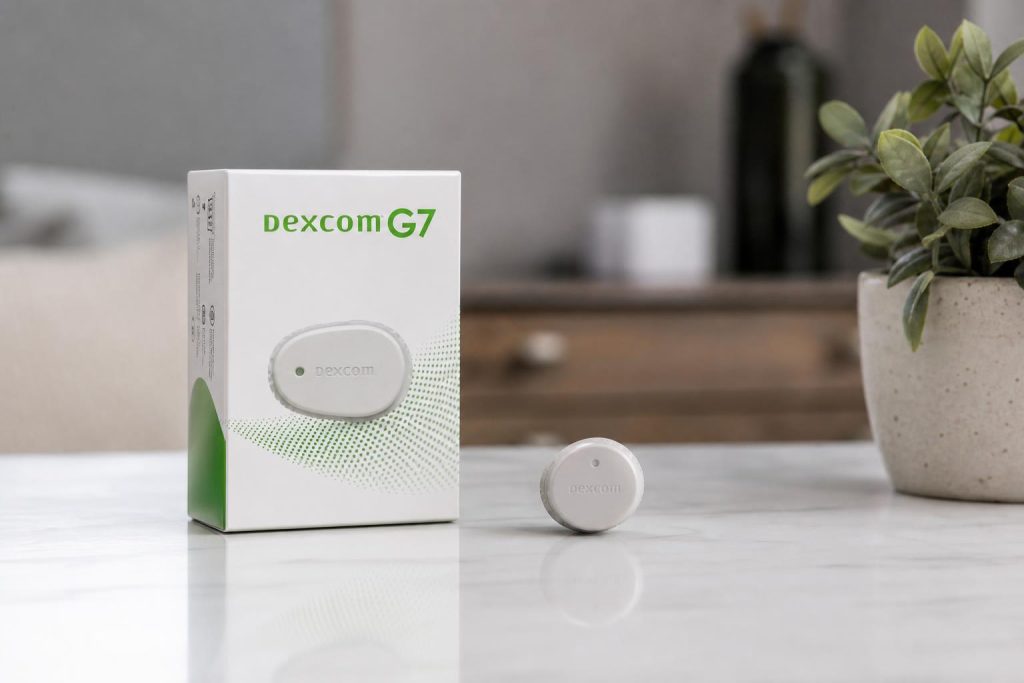
The Dexcom G7 is a small, round sensor — about the size of a quarter — that adheres to the back of your upper arm and measures interstitial glucose every five minutes, continuously, for up to 10 days. Unlike previous generations that required a separate transmitter, the G7 integrates everything into one patch, making it significantly more compact and comfortable than its predecessor, the G6. It connects via Bluetooth to your smartphone and delivers real-time glucose readings, trend arrows indicating whether your glucose is rising or falling (and how fast), and customizable alerts for high and low thresholds. The warmup period — once a 2-hour ordeal — has been cut to just 30 minutes.
Why does any of this matter if you’re not diabetic? Because glucose regulation is not a binary issue. Research published in PLOS Biology demonstrated that even in healthy adults, postprandial glucose spikes can vary enormously from person to person eating identical meals — and that these spikes correlate with increased hunger, fat storage signaling, and downstream metabolic dysfunction. What the Dexcom G7 provides is visibility into a process your body is running 24 hours a day, seven days a week, that you otherwise have zero insight into.
For men pursuing fat loss, this is particularly relevant. The conventional wisdom — eat less, move more, track calories — is accurate as far as it goes, but it ignores the hormonal architecture underlying weight regulation. Chronic glucose spikes trigger elevated insulin secretion. Chronically elevated insulin suppresses lipolysis, the process by which your body mobilizes stored fat for energy. Studies in the American Journal of Clinical Nutrition have shown that postprandial insulin response — not just caloric intake — is a meaningful predictor of fat accumulation, particularly visceral fat. Knowing how your meals, your training, your sleep, and your stress affect your glucose levels gives you leverage over that process in a way that calorie counting alone does not.
The accuracy of the G7 is clinically meaningful. Dexcom reports a mean absolute relative difference (MARD) of 8.2% in their pivotal trial — a metric that describes how closely CGM readings track against blood glucose drawn from a vein. For context, anything under 10% is considered clinically acceptable, and the G7 consistently performs at or near the top of available CGM devices. There’s no calibration required with a finger stick, and the readings are cleared by the FDA for use in insulin dosing decisions — a level of regulatory scrutiny that speaks to its reliability.
The GLP-1 Connection: How CGM and These Medications Work Together
If you’re using a GLP-1 receptor agonist — semaglutide (Ozempic, Wegovy), tirzepatide (Mounjaro, Zepbound), or another agent in this class — you’re already benefiting from a mechanism that profoundly influences glucose regulation. GLP-1 medications work by mimicking the glucagon-like peptide-1 hormone your gut naturally produces after eating. They stimulate insulin secretion in a glucose-dependent manner, suppress glucagon release, slow gastric emptying, and reduce appetite through central nervous system pathways. The metabolic effects are significant: clinical trials of semaglutide published in the New England Journal of Medicine showed average body weight reductions of 14.9% over 68 weeks, alongside meaningful improvements in fasting glucose and HbA1c.
But here’s what even many prescribing physicians don’t routinely discuss with GLP-1 patients: the medication changes your glucose dynamics in ways that are difficult to perceive subjectively. Gastric emptying slows, which means carbohydrates are absorbed more gradually — blunting postprandial spikes but also potentially extending the window of glucose elevation. Appetite suppression can lead men to under-eat protein and micronutrients, which affects muscle protein synthesis and, in turn, resting metabolic rate. And because GLP-1 medications suppress hunger signals, users often can’t rely on traditional hunger and fullness cues to self-regulate, which makes understanding the actual metabolic response to food more important, not less.
A CGM like the Dexcom G7 fills that gap. A 2022 study in Diabetes, Obesity and Metabolism found that CGM use in patients on GLP-1 therapy was associated with greater engagement in dietary behavior changes and improved glycemic outcomes compared to those relying on standard lab testing alone. The feedback loop that continuous monitoring creates — eat a meal, see the glucose response, adjust accordingly — is fundamentally behavioral. It turns abstract metabolic concepts into concrete, real-time data that drives action.
For men on GLP-1 therapy who are also focused on preserving or building muscle — which should be a priority given that these medications can accelerate lean mass loss alongside fat loss — the G7 provides an additional layer of insight. Resistance training acutely lowers blood glucose by increasing glucose uptake in skeletal muscle through GLUT4 translocation, an insulin-independent pathway. Research in the Journal of Applied Physiology has documented this effect clearly. Watching your glucose drop during and after a lifting session on the G7 isn’t just interesting — it reinforces the physiological argument for training even when the appetite suppression of GLP-1s makes eating (and thus fueling workouts) feel like a chore.
Real-World Performance: What Wearing the G7 for 10 Days Actually Teaches You
The device itself is genuinely well-designed. Insertion is handled by a simple spring-loaded applicator that takes about three seconds and causes minimal discomfort — far less than most men expect. The sensor sits flush against the skin, and during normal daily activity including gym sessions, showers, and even swimming, adhesion holds well. The companion Dexcom G7 app is clean and intuitive, presenting glucose as a continuous line graph overlaid with your alert thresholds and annotatable with meals, exercise, and insulin if applicable. Third-party integration with Apple Health, Google Fit, and popular apps like Levels (which offers a premium overlay experience for CGM data) expands the analytical capability considerably.
What does 10 days of data actually reveal? For most men who’ve never worn a CGM, the findings are humbling. White rice, even in modest portions, can spike glucose to 160-180 mg/dL in individuals who would never describe themselves as metabolically impaired. Stress — measurable through elevated cortisol — consistently drives glucose upward even without any carbohydrate intake, a phenomenon known as a stress-induced glucose spike that has been well-documented in the psychoneuroendocrinology literature. Sleep deprivation, even one bad night, measurably worsens glucose tolerance the following day. And conversely, a 20-minute walk after dinner attenuates postprandial spikes dramatically — a simple, free intervention that CGM data makes viscerally real in a way that reading about it never quite does.
For men following specific dietary protocols — ketogenic, low-carbohydrate, or time-restricted eating — the G7 provides confirmation and calibration. If you’re eating keto and your glucose is consistently sitting in the 70-90 mg/dL range with minimal postprandial excursions, you have objective confirmation that your approach is working metabolically. If you’re eating what you believe to be a clean diet and seeing unexplained spikes, the data points you toward hidden carbohydrate sources, portion sizes, or meal timing issues that wouldn’t surface any other way.
There are limitations worth acknowledging honestly. Interstitial glucose lags behind blood glucose by approximately 5-10 minutes, which means rapid changes — like during high-intensity exercise — can appear blunted or delayed. The G7 can read falsely low during intense cardio due to local tissue effects near the sensor site. And while the device is cleared for non-adjunctive use (meaning you don’t need to confirm readings with a finger stick), occasional correlation with a traditional glucometer remains useful for calibrating your intuition about where the numbers actually land. Cost is also a legitimate barrier: without insurance coverage, the G7 runs approximately $349 for a single sensor kit (one sensor plus transmitter), and ongoing use requires purchasing sensors that retail at roughly $89-$109 per 10-day sensor. For men using it as a short-term diagnostic tool — 30 to 90 days to understand their glucose patterns — the investment calculus looks different than for someone considering indefinite wear.
Accessibility has improved meaningfully. Dexcom now offers the G7 through its direct-to-consumer platform without a prescription requirement in many U.S. states, and several telehealth companies have partnered with CGM manufacturers to offer bundled programs that include physician oversight, nutritional guidance, and CGM data interpretation. For men on GLP-1 therapy, many insurance plans that cover GLP-1 medications for diabetes or obesity will also cover CGM devices, though the specifics require verification with your insurer and prescriber.
The Takeaway
The Dexcom G7 is not a magic solution. It doesn’t replace sound nutrition, consistent training, adequate sleep, or appropriate medical care. But it is, for the right man at the right moment, a genuinely transformative tool — one that converts the invisible machinery of your metabolism into a readable signal you can actually act on.
For men on GLP-1 medications, it bridges the gap between the pharmacological effect and the behavioral changes needed to sustain results long-term. For men optimizing through diet and training alone, it provides the kind of personalized metabolic feedback that was once available only in research settings. For anyone who has wondered whether their approach to eating, training, or recovery is actually working at the cellular level — the G7 answers that question in real time, every five minutes, for 10 days straight.
The most powerful thing a CGM does isn’t measure your glucose. It changes your relationship with food and lifestyle choices by making abstract consequences immediate and concrete. That behavioral shift — seeing the spike, understanding the cause, making a different choice — is worth more than any single reading the sensor produces. If you have the resources and the curiosity, wearing one for even a single month will almost certainly change how you think about your metabolic health permanently.