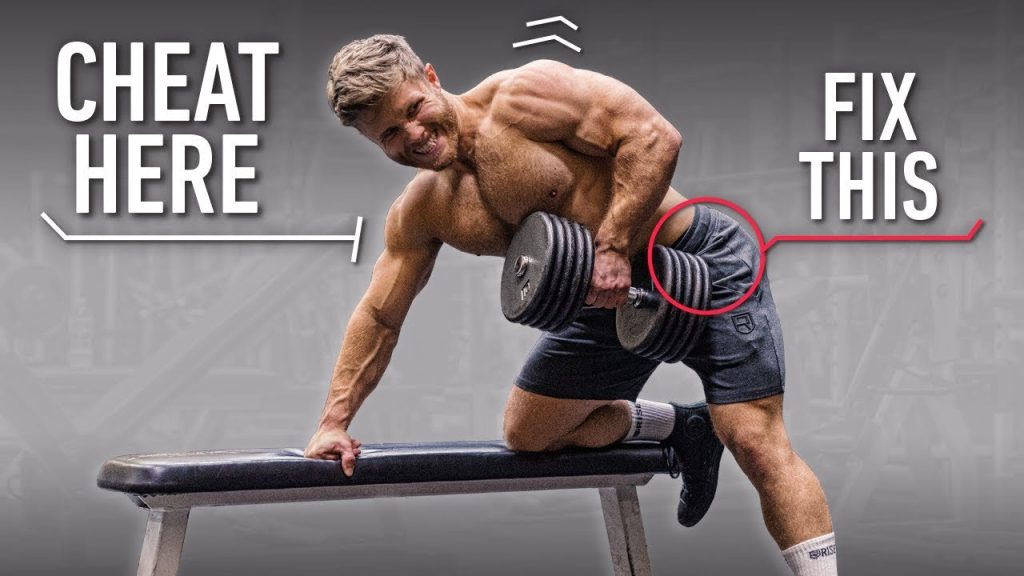
Video by Jeff Nippard on YouTube
Most men who train consistently have done a dumbbell row at some point. Far fewer have done it correctly. That distinction matters more than most gym-goers realize — because research published in the Journal of Strength and Conditioning Research consistently shows that technique variation dramatically alters which muscles are actually recruited during rowing movements. Pull with the wrong mechanics and you’re largely training your biceps and rear deltoids while the latissimus dorsi — the muscle that gives your back its width and power — barely fires. Do it right, and the dumbbell row becomes one of the most efficient tools for building and preserving lean back mass you can put in a training program.
This matters whether you’re a dedicated lifter chasing hypertrophy, a man trying to maintain muscle during an aggressive fat-loss phase, or someone who just wants a stronger, more functional back. Muscle preservation during caloric deficits is a genuine physiological challenge. Studies show that resistance training is one of the most effective interventions for attenuating lean mass loss during weight loss, and compound pulling movements like the dumbbell row are foundational to that protection. Getting the technique right isn’t just about aesthetics — it’s about making every set count.
The Anatomy of an Effective Row
Before you pick up a dumbbell, understanding what you’re actually trying to accomplish changes how you approach the movement. The primary target is the latissimus dorsi, the broad muscle spanning from the lower thoracic spine to the upper arm. Supporting players include the rhomboids, middle and lower trapezius, rear deltoids, and the deep spinal erectors. The biceps act as secondary movers — they help complete elbow flexion, but they should never be the limiting factor.
The most common mistake is initiating the row with the elbow rather than the shoulder blade. When you lead with the arm, the bicep does the early work and the lat never reaches peak activation. The corrective cue that changes everything is this: before you pull anything, retract your scapula. Electromyographic research confirms that scapular retraction prior to humeral movement significantly increases trapezius and rhomboid activation, creating the stable base from which the lat can fully contract. Think of it as rowing your elbow back toward your hip — not pulling your hand toward your armpit.
Your setup is equally critical. For a standard single-arm dumbbell row using a bench for support, your stance should be staggered, your spine neutral, and your torso roughly parallel to the floor or just slightly angled upward. Rounding the lumbar spine under load is a fast track to injury; research on lumbar loading during free-weight exercises makes clear that spinal flexion under tension dramatically increases disc shear force. Keep a long, flat back from tailbone to crown, brace your core as if you’re about to take a punch, and then move only from the shoulder joint.
The grip matters too. A neutral grip — palm facing your torso — allows for a natural arc of elbow travel that keeps the lat in a mechanically advantageous position throughout the full range. Pronating the grip (palm down) tends to shift more stress into the posterior delt and upper trap, which isn’t necessarily wrong, but it changes the training stimulus. For general back development and muscle preservation, neutral is typically the more productive default.
Programming Dumbbell Rows for Muscle Preservation and Growth
Knowing how to row is one thing. Knowing how to program it intelligently across a training cycle is what separates the men who continually make progress from those who spin their wheels. A landmark meta-analysis in the Journal of Strength and Conditioning Research found that training volume — total weekly sets per muscle group — is one of the strongest predictors of hypertrophy, with most evidence pointing toward 10 to 20 working sets per week for intermediate lifters as an effective range for the back musculature.
For men in a fat-loss phase specifically, the goal shifts slightly. You’re no longer just trying to build — you’re trying to preserve what you’ve built against the catabolic headwinds of a caloric deficit. In that context, intensity becomes more important than ever. Research supports maintaining relative training intensity (load and proximity to failure) during caloric restriction as a key variable in preserving lean tissue. This means your rows should still be challenging. Dropping to lighter weights because you’re eating less is a mistake that accelerates muscle loss.
A practical approach for most training levels is to run dumbbell rows in the 8 to 12 repetition range for hypertrophy, or 5 to 8 for those prioritizing strength. The last two reps of each set should require genuine effort — not grinding-your-teeth failure on every set, but close enough that the muscle experiences meaningful mechanical tension. Controlled tempo on the eccentric (lowering) phase, roughly two to three seconds, adds time under tension without requiring you to add weight, and evidence suggests slower eccentrics can enhance muscle damage and subsequent hypertrophic response when periodized intelligently.
Single-arm rows also offer a functional benefit that bilateral machine rows cannot: they challenge anti-rotation core stability. When you’re rowing with one arm, your obliques and deep stabilizers are working to keep your spine from rotating toward the working side. This translates directly to athletic performance, posture, and the kind of real-world strength that matters outside the gym. For men who sit at desks for long hours, the postural reinforcement alone — strengthening the rhomboids and mid-traps against the forward pull of chronic flexion — is worth the inclusion of this movement on its own terms.
Frequency is straightforward: most men will respond well to training the back two times per week, with rows featured in at least one of those sessions. Pairing them with a horizontal push (bench press, push-up variations) on the same day balances the pressing volume and reduces the cumulative shoulder stress that builds when chest work dominates a program.
The Takeaway
The dumbbell row is not a complicated movement, but it is a precise one. The difference between a row that genuinely develops and preserves back muscle and one that just fatigues your arms comes down to scapular mechanics, spinal position, and the willingness to train with honest intensity. Whether your goal is to add mass, hold onto the muscle you have during a cut, or simply build a stronger, more functional posterior chain, this movement delivers — but only when you execute it with the attention it deserves. Set up right, initiate from the shoulder blade, and let the lat do the work it was built to do.