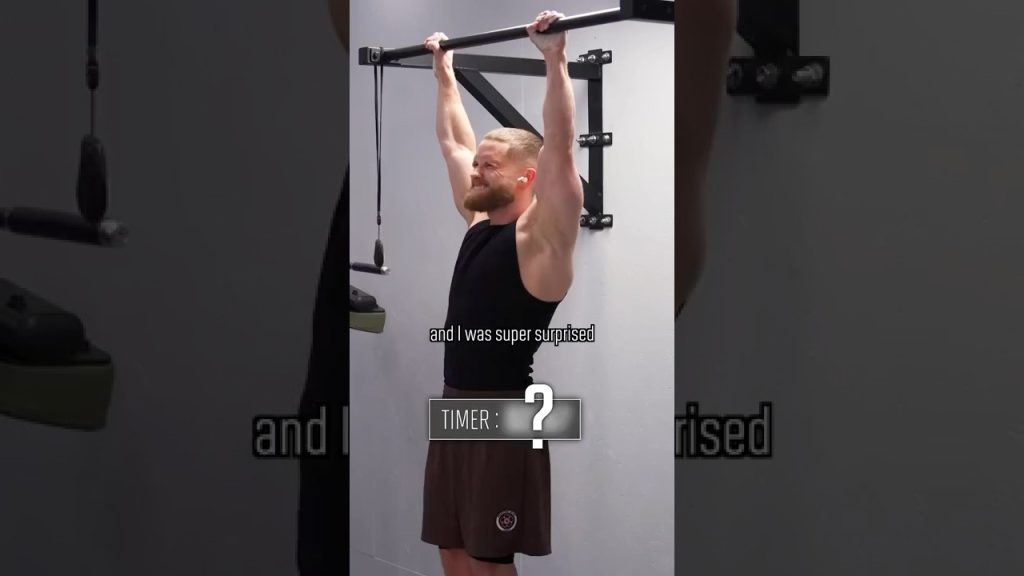
Video by Jeff Nippard on YouTube
In 2022, a landmark study published in the Journal of Strength and Conditioning Research confirmed what strength coaches have known for decades: grip strength is one of the most reliable predictors of overall muscular health, longevity, and functional capacity in men. More striking, research from the British Medical Journal tracking over 140,000 adults found that each 5-kilogram decrease in grip strength was associated with a 17% increased risk of cardiovascular mortality. Your hands, it turns out, are a window into your entire physiological system — and the farmer’s carry is the single best tool for training what they measure.
The farmer’s carry — walking a set distance while holding heavy weights at your sides — looks deceptively simple. There are no complex movement patterns to memorize, no machines to adjust, no coaching cues that require years of practice to internalize. You pick up something heavy and you walk. But underneath that simplicity lies one of the most comprehensive training stimuli available to any man pursuing fat loss, muscle preservation, metabolic health, or raw athletic performance. It simultaneously challenges your grip, your forearms, your traps, your core, your cardiovascular system, and your postural muscles in a way that almost no other single exercise can replicate.
This guide breaks down the science and the execution — how to actually perform the farmer’s carry correctly, why grip strength matters more than most men realize, and how to integrate this movement to protect and build muscle whether you’re cutting calories aggressively, training around an injury, or just looking to add a high-return exercise to your existing program.
Why Grip Strength Is a Proxy for Whole-Body Muscle Health
Before getting into the mechanics of the carry itself, it’s worth understanding why grip strength deserves serious attention beyond its role in the gym. The forearm flexors and hand muscles are among the most densely innervated in the body, meaning the neuromuscular demands of grip training have systemic effects that extend well beyond the hand and wrist. Research published in the American Journal of Preventive Medicine demonstrated that grip strength independently predicts lean mass retention, metabolic rate, and insulin sensitivity — all critical factors for men trying to lose fat without sacrificing the muscle they’ve worked to build.
This connection makes intuitive sense when you think about what grip strength actually represents. It reflects the integrity of your tendons, the density of your connective tissue, the efficiency of your nervous system, and the total volume of functional muscle mass you carry. Men with strong grips tend to be men who train consistently and move their bodies under load — and that sustained mechanical loading is precisely what signals the body to hold onto muscle tissue rather than catabolize it during a caloric deficit.
This is particularly relevant for any man in an aggressive fat loss phase — whether that’s through careful caloric restriction, a low-carbohydrate protocol, or the appetite reduction that comes with GLP-1 receptor agonists like semaglutide or tirzepatide. When calories drop significantly, the body faces a choice: burn fat or burn muscle. Studies consistently show that resistance training, especially exercises involving heavy loaded carries, sends a powerful anti-catabolic signal that tips that balance toward fat oxidation and muscle preservation. The farmer’s carry is one of the most efficient ways to deliver that signal while also burning a significant number of calories in the process.
There is also the issue of sarcopenia — the progressive loss of skeletal muscle mass that accelerates after age 35 and becomes clinically significant in most men by their mid-40s. A review in the Journal of Cachexia, Sarcopenia and Muscle identified grip strength testing as one of the primary diagnostic tools for sarcopenia precisely because it tracks so closely with total body muscle mass and function. Integrating grip-intensive exercises like the farmer’s carry is not just about performance — it’s about maintaining the physiological substrate that keeps your metabolism elevated, your joints healthy, and your body resilient as you age.
How to Execute the Farmer’s Carry with Proper Technique
The farmer’s carry is forgiving in a way that Olympic lifts are not, but sloppy execution still limits results and increases injury risk — particularly to the lower back, shoulders, and wrists. Getting the technique right from the start means you can load heavier, walk farther, and extract the full benefit from every set.
Start with equipment selection. Farmer’s carry handles — dedicated implements with thick, neutral-grip handles — are the gold standard because they allow you to load heavy and maintain a natural wrist position throughout the walk. If your gym doesn’t have these, dumbbells work well for most men. Kettlebells are a reasonable alternative but the offset center of mass changes the stimulus slightly and can be harder on the wrist at heavier loads. Trap bars can be used for a bilateral version, though you lose some of the unilateral stability demand that makes single-implement carries so valuable.
For setup, stand between the weights with your feet hip-width apart. Hinge at the hips to reach the handles — do not round your lower back to get there. This is not a deadlift, but the initial pick-up follows the same spine-neutral principle. Brace your core hard, think about creating intra-abdominal pressure as if you’re about to take a punch, and drive through your heels to stand tall. Your shoulders should be pulled back and down — retracted and depressed — so the weight is not pulling you into a forward-rounded posture. Your grip should be firm but not white-knuckled; squeezing maximally from the start will fatigue your forearms within 20 meters.
Once upright, take controlled, deliberate steps. Your stride length should be shorter than normal walking — roughly 60 to 70 percent of your natural stride — which keeps you from rotating your hips excessively. Your gaze should be forward, your chin slightly tucked, and your breathing steady. Many men make the mistake of holding their breath for the entire carry, which limits duration and spikes blood pressure unnecessarily. Instead, breathe through your nose on the walk, exhaling slowly through pursed lips to maintain core tension without fully releasing it. Think of the exhale as a pressure valve, not a full release.
Your core is not a passive observer during this movement. The off-center loading of a single-arm carry in particular creates a strong lateral flexion demand on the obliques and quadratus lumborum — the deep muscles that stabilize the spine from side to side. Electromyographic research has confirmed that single-arm farmer’s carries produce significantly greater core muscle activation than bilateral carries, making them a particularly potent anti-lateral-flexion training tool. If you’ve been struggling with lower back resilience or want to build the kind of core strength that actually transfers to sport and daily life, the unilateral variation deserves a prominent place in your program.
When you reach the end of your carry distance, place the weights down with the same spine-neutral discipline you used to pick them up. Fatigue at the end of a heavy set is when most injuries occur — dropping the weights or bending carelessly to set them down undoes the careful setup at the beginning.
For load selection, a commonly cited benchmark from strength coaches is that intermediate to advanced men should be able to carry their bodyweight in each hand — so a 185-pound man should work toward carrying 185 pounds per hand — for 30 to 50 meters. That is an advanced standard. Beginners should start at 25 to 35 percent of bodyweight per hand and focus entirely on posture and breathing before chasing load. Research on loaded carry progression suggests that progressive overload in carries is best achieved by alternating between increasing distance at a fixed load and increasing load at a fixed distance — rather than trying to increase both simultaneously.
Programming the Farmer’s Carry for Muscle Preservation and Grip Development
How you program the farmer’s carry depends entirely on what you’re trying to accomplish. For pure grip strength development, shorter carries with near-maximal loads — 20 to 30 meters with weights that challenge you significantly by the halfway mark — are most effective. The grip is essentially working at isometric near-maximum intensity for the duration, which is one of the most potent stimuli for forearm hypertrophy and grip endurance. Studies on isometric hand strength training confirm that sustained high-intensity gripping produces both neural adaptations and muscular hypertrophy in the intrinsic hand muscles and forearm flexors within six to eight weeks of consistent training.
For metabolic conditioning and fat loss without muscle sacrifice, longer carries at moderate loads — 40 to 80 meters with a weight you can sustain for the full distance — combined with short rest periods of 60 to 90 seconds create a conditioning effect that elevates heart rate substantially while maintaining the mechanical loading signal that preserves muscle. Research on concurrent training — combining resistance and cardiovascular stimulus in the same session — consistently shows that loaded carries occupy a particularly favorable position in this spectrum because the cardiovascular demand emerges from the resistance work rather than being a separate modality that might interfere with muscle protein synthesis signaling.
For men focused primarily on muscle preservation during a caloric deficit — which includes anyone doing extended fat loss phases, those recovering from illness, or GLP-1 users managing rapid weight loss — the priority is keeping mechanical loading high enough to send a clear retention signal without creating so much total training volume that recovery is compromised. In this context, two to three sessions per week of farmer’s carries, programmed either at the end of a strength session as a finisher or as a standalone loaded carry day, has been shown to be sufficient to preserve lean mass when protein intake is adequate. The threshold for protein that supports this is approximately 1.6 to 2.2 grams per kilogram of bodyweight daily, as meta-analytic data from the British Journal of Sports Medicine clearly establishes — the carry provides the stimulus, but protein provides the raw material.
A practical weekly structure for a man combining strength training with farmer’s carries might look like this: on lower body training days, finish with two to three sets of bilateral farmer’s carries for 40 meters at 50 to 60 percent of bodyweight per hand. On upper body days, use single-arm carries for two to three sets at slightly lighter loads, emphasizing the anti-lateral-flexion core demand. On conditioning days or as a standalone workout, program carry complexes — walking lunges with dumbbells, followed immediately by farmer’s carries, followed by suitcase carries — for sustained metabolic output. This kind of variety also prevents the adaptation plateau that occurs when any single carry variation is repeated without modification for more than four to six weeks.
One often-overlooked programming consideration is the suitcase carry — a single-arm variation where one hand holds the weight and the other remains free. This variation is arguably even more demanding on the lateral core than the single-arm farmer’s carry because the asymmetry is more pronounced and the temptation to lean toward the loaded side creates a constant corrective demand on the contralateral obliques. EMG data supports its use as a core exercise in its own right, not just a grip accessory movement. Alternating between bilateral farmer’s carries for heavy grip work and unilateral suitcase carries for core development gives you comprehensive stimulus across multiple movement patterns without adding significant time to your sessions.
Grip-specific accessories can amplify your results when used intelligently. Fat Gripz — rubber attachments that increase the diameter of any barbell or dumbbell handle — force greater motor unit recruitment in the forearm and hand musculature by making the grip less mechanically advantageous. Research on thick-bar training shows measurable improvements in grip strength and forearm size within eight weeks when thick grips are incorporated two to three times per week. Using them on lighter farmer’s carry sets, or on accessory pulls like rows and deadlifts, creates a grip training stimulus without requiring dedicated isolation work like wrist curls that most men find tedious and abandon.
The Takeaway
The farmer’s carry earns its reputation as one of the most efficient exercises in existence because it delivers on multiple fronts simultaneously — grip strength, muscle preservation, core stability, cardiovascular conditioning, and postural resilience — with a movement so basic that almost anyone can learn it in a single session. The science connecting grip strength to longevity, lean mass retention, and metabolic health is not circumstantial; it represents some of the most robust observational and mechanistic data in exercise physiology.
If you take nothing else from this guide, take this: pick up something heavy, stand tall, and walk. Do it consistently, load it progressively, and vary the implements and distances enough to keep the stimulus fresh. Whether you’re in a fat loss phase, building muscle, coming back from time off, or simply trying to stay strong and functional as the years accumulate, the farmer’s carry belongs in your program. Your grip is telling a story about your health — give it something worth saying.