When researchers tracked men through significant caloric deficits, they found something alarming: without the right resistance training stimulus, up to 25% of weight lost could come from lean muscle mass rather than fat. A 2017 review published in Obesity Reviews confirmed that preserving skeletal muscle during fat loss requires both adequate protein intake and targeted mechanical loading — and few exercises deliver that mechanical loading as efficiently as the Romanian deadlift.
Whether you’re cutting calories through discipline alone, following a structured fat-loss protocol, or using a GLP-1 medication like semaglutide to manage appetite, the challenge is identical: your body doesn’t want to give up fat without also sacrificing muscle. The Romanian deadlift, when performed correctly, sends a powerful anabolic signal to the posterior chain — your hamstrings, glutes, and lower back — muscles that are critical for metabolic health, insulin sensitivity, and functional strength.
Why the Romanian Deadlift Is Different from Every Other Hinge
Most men confuse the Romanian deadlift with its conventional cousin, but the distinction matters enormously. The Romanian deadlift is an eccentric-dominant movement, meaning the muscle is lengthened under load throughout most of the range of motion. Research published in the Journal of Strength and Conditioning Research has demonstrated that eccentric loading produces significantly greater muscle hypertrophy and strength adaptations compared to concentric-only training, largely because it causes more mechanical tension and controlled micro-damage that drives muscle protein synthesis.
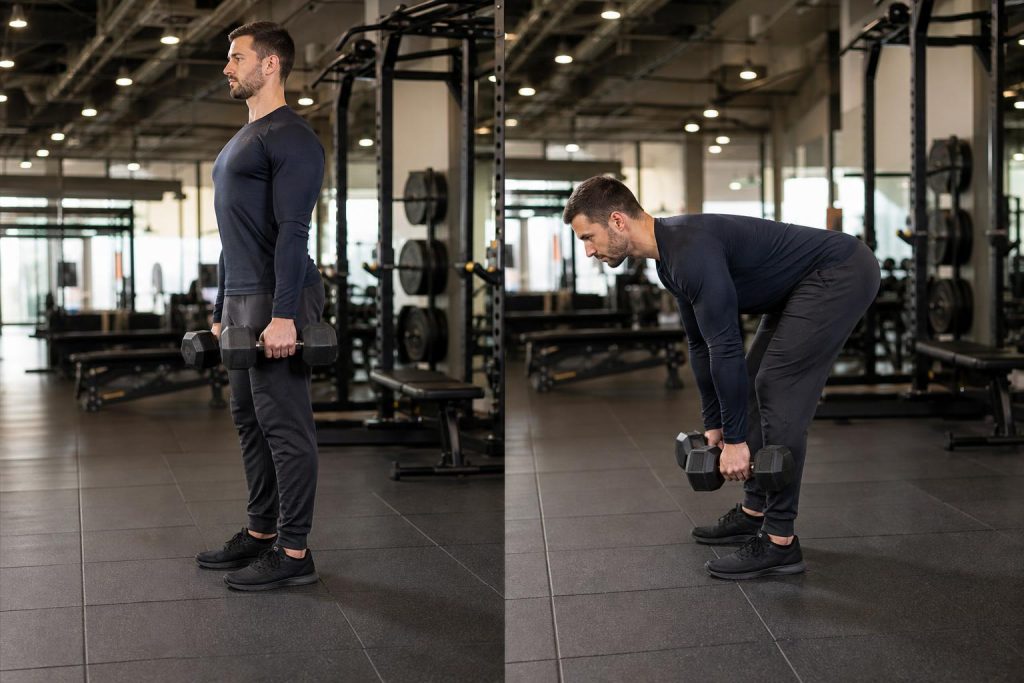
To perform it correctly, start standing with a barbell at hip height — either lifted from the floor or pulled from a rack. Your grip should be just outside hip-width, feet shoulder-width apart. The movement begins by pushing your hips backward, not by bending your knees. This distinction is everything. As your hips travel behind your heels, the barbell descends along your thighs — it should maintain contact with your legs throughout the entire descent. Your back stays neutral, your chest stays proud, and your knees maintain a soft, slight bend that doesn’t change throughout the lift. You descend until you feel a deep stretch in the hamstrings — typically just below the knee for most men — then drive the hips forward to return to standing. Squeezing the glutes at lockout completes the rep.
The load range for muscle preservation purposes sits in the moderate-to-heavy zone: three to four sets of six to ten repetitions with a two to three second lowering phase. A landmark meta-analysis in the Journal of Strength and Conditioning Research found that this rep range, combined with proximity to muscular failure, produces near-maximal hypertrophic response regardless of absolute load — a critical finding for men who are training while in a caloric deficit and may not have peak strength available.
Muscle Preservation During Fat Loss: The Science Behind the Stimulus
The posterior chain muscles targeted by the Romanian deadlift — particularly the hamstrings and gluteus maximus — are among the largest muscle groups in the human body. Maintaining their mass during fat loss has metabolic consequences that extend well beyond aesthetics. Research in the American Journal of Clinical Nutrition has shown that greater skeletal muscle mass correlates with improved insulin sensitivity, higher resting metabolic rate, and better glucose disposal — all outcomes that directly affect long-term body composition and metabolic health.
For men using GLP-1 receptor agonists, this becomes particularly relevant. These medications are highly effective at reducing appetite and driving caloric restriction, but clinical trial data from the STEP program revealed that a meaningful portion of weight lost on semaglutide included lean mass, not just fat. The solution isn’t to abandon the medication — it’s to pair the caloric deficit with the kind of mechanical stimulus that tells your body muscle is non-negotiable. The Romanian deadlift does exactly that. But this same principle applies to any man in a caloric deficit: without progressive resistance training, you’re not just losing fat.
Protein intake amplifies the training effect significantly. A 2017 study in the American Journal of Clinical Nutrition found that men in a caloric deficit who consumed 2.4 grams of protein per kilogram of bodyweight per day not only preserved more lean mass than those at 1.2 g/kg, but actually gained muscle while losing fat — a finding that underscores how tightly training and nutrition are intertwined. Aim to consume a protein-rich meal or shake containing at least 30 to 40 grams of high-quality protein within two hours of your Romanian deadlift session to maximize muscle protein synthesis.
Programming the Romanian deadlift two days per week, separated by at least 48 hours of recovery, gives the hamstrings adequate stimulus without outpacing your body’s ability to recover — especially important when operating in a caloric deficit. Many men make the mistake of only incorporating it as an accessory movement with light weight. Treat it as a primary lift. Load it progressively. Track it. The difference in muscle retention over a 12-week fat-loss phase will be visible.
The Takeaway
The Romanian deadlift isn’t a flashy exercise, but the research behind it is unambiguous. It applies the specific kind of mechanical tension — eccentric, high-load, multi-joint — that signals your body to hold onto muscle when calories are low. Whether you’re managing your deficit through meal prep, intermittent fasting, or appetite-suppressing medication, this movement belongs in your program as a non-negotiable. Master the hip hinge, load it progressively, pair it with adequate protein, and you won’t just lose weight — you’ll come out leaner, stronger, and metabolically healthier on the other side.