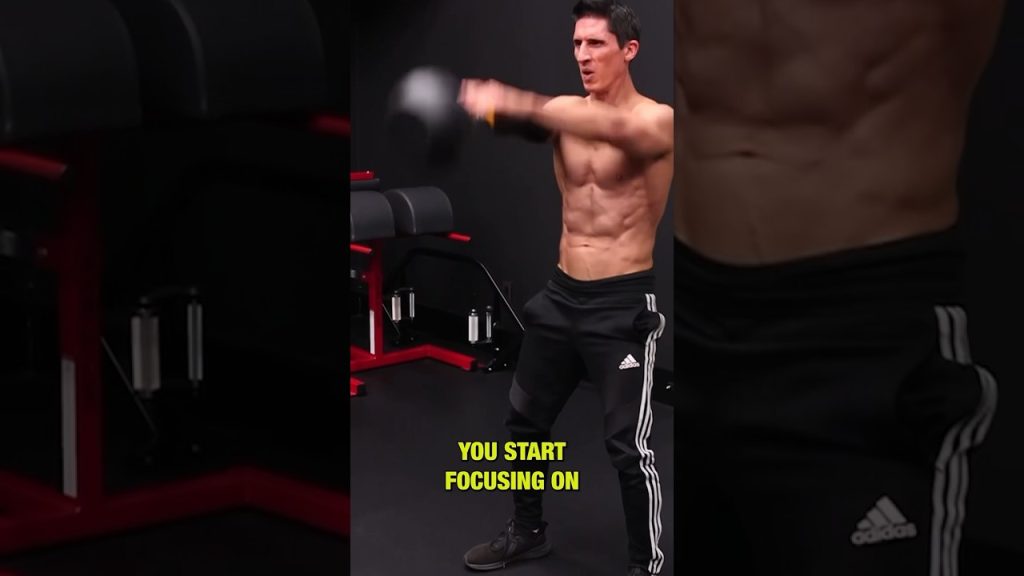
Video by AthleanX on YouTube
When researchers at the University of Connecticut analyzed compound lower-body movements for their ability to activate the quadriceps, glutes, and core simultaneously under load, the goblet squat consistently outperformed leg press variations and matched or exceeded barbell back squat muscle activation in untrained and intermediate lifters. That finding matters enormously if you’re losing weight and trying to hold onto every ounce of muscle you’ve built — because research published in Obesity Reviews confirms that resistance training is one of the most effective tools for preserving lean mass during caloric restriction, and the goblet squat is arguably the most accessible, form-friendly, high-yield move in that toolkit.
Fat loss without muscle retention is just becoming a smaller, weaker version of yourself. The goal — whether you’re grinding through a disciplined cut, managing appetite with a GLP-1 medication, or simply cleaning up your diet — is to lose the fat and keep the muscle. That requires mechanical tension on the muscles through progressive resistance training, and the goblet squat delivers that tension in a way that’s forgiving enough for beginners and demanding enough to challenge experienced lifters when loaded properly.
Why the Goblet Squat Works So Well for Body Composition
The goblet squat was popularized by strength coach Dan John as a teaching tool, but its utility goes far beyond instruction. By holding a kettlebell or dumbbell at chest height — the goblet position — the lifter’s center of mass shifts forward and slightly up, which naturally encourages an upright torso, deeper hip flexion, and greater knee tracking over the toes. This mechanical setup does something critical: it loads the quads, glutes, and adductors without demanding the thoracic mobility or spinal loading tolerance that a barbell back squat requires.
EMG studies on squat variations show that front-loaded squat patterns recruit the vastus medialis and rectus femoris at rates comparable to the front squat, which is significant because quad mass is closely tied to resting metabolic rate, insulin sensitivity, and long-term mobility. Men losing weight need those quads. The goblet squat also engages the anterior core isometrically throughout every rep, meaning you’re building trunk stability simultaneously — an often-overlooked benefit that carries over to virtually every other lift and athletic movement.
From a hormonal standpoint, compound movements that recruit large muscle groups trigger a more robust anabolic hormone response than isolation exercises. Research has demonstrated that multi-joint lower body exercises elevate testosterone and growth hormone acutely post-exercise, and while the absolute magnitude of these spikes is debated, the signal they send to muscle tissue during a caloric deficit is meaningful. You’re telling your body to hold onto lean mass even while burning fat for fuel.
Mastering Goblet Squat Form: What Actually Matters
Good form on the goblet squat comes down to a handful of non-negotiables, and understanding why each cue exists makes it far easier to apply consistently under fatigue. Start by selecting a kettlebell or dumbbell that challenges you but allows full depth — typically somewhere between 25 and 60 pounds depending on your training history. Hold the weight at sternum height with both hands cupping the top of the kettlebell or gripping the dumbbell vertically. Your elbows should point down and slightly inward, not flared out like you’re about to take flight.
Feet should be set slightly wider than hip-width, with toes turned out 15 to 30 degrees depending on your hip structure. There is no universal foot angle — your anatomy determines your optimal stance. Before descending, take a deep breath into your belly, brace your core as if you’re about to absorb a punch, and then push your knees out in the direction of your toes as you sit down between your heels. The cue “sit down, not forward” helps maintain an upright torso and prevents the forward lean that collapses the goblet squat into a poor approximation of a good morning.
Depth is where most men shortchange themselves. Research comparing partial and full-depth squats found that full-depth squats — thighs at or below parallel — produce significantly greater muscle hypertrophy in the quads and glutes over time. The goblet squat’s front-loaded nature makes full depth more accessible than most barbell variations because it counterbalances your bodyweight and allows the hips to drop without the torso collapsing. At the bottom, your elbows should brush or nearly brush the inside of your knees — this is an instant feedback cue. If your elbows are crashing into your thighs before you reach depth, your stance is too narrow or your hip mobility needs work.
Drive up through the full foot — not just the heel, not just the ball — and lock out at the top with your glutes actively squeezed. Exhale at the top of the rep. Reset your brace before the next rep rather than bouncing through multiple reps with compromised intra-abdominal pressure. This matters more than most lifters appreciate: proper intra-abdominal pressure management during resistance training has been shown to reduce lumbar stress and improve force transmission through the kinetic chain, which translates to safer, more effective reps across a training session.
For programming during a fat loss phase, three to four sets of eight to fifteen reps two to three times per week is a reliable starting framework. Progressive overload — gradually increasing the weight or reps over weeks — is the non-negotiable driver of continued adaptation. If you’ve been using the same 35-pound kettlebell for six weeks, you’re maintaining at best. Muscle retention requires a stimulus that the body perceives as worth adapting to, even when calories are restricted. Studies on resistance training during caloric restriction consistently show that progressive overload preserves significantly more lean mass than steady-state or bodyweight-only training.
One underrated modification worth knowing: the pause goblet squat. Holding the bottom position for two to three seconds under load dramatically increases time under tension for the quads and glutes, improves positional awareness, and exposes mobility restrictions you might otherwise compensate around. It’s a simple manipulation that adds intensity without adding weight — useful during phases where you’re managing recovery or simply don’t have access to heavier equipment.
The Takeaway
The goblet squat isn’t a beginner exercise you eventually graduate from — it’s a tool that scales with you. As a front-loaded compound movement, it builds and preserves quad, glute, and core muscle with a learning curve low enough that you can execute it well from the first session. During a fat loss phase, that combination is exactly what you need: a high-yield stimulus that protects your lean mass while your diet handles the deficit. Master the form, apply progressive overload consistently, and the goblet squat will be one of the most productive investments you make in your body composition for years to come.