Here’s a number that should get your attention: men on GLP-1 receptor agonists like semaglutide can lose up to 40% of their total weight loss as lean muscle mass if they don’t resistance train. A 2022 analysis published in Obesity Reviews confirmed that without structured resistance exercise, GLP-1-driven caloric deficits accelerate muscle catabolism at a rate that rivals aggressive crash dieting. But here’s the thing — that same threat applies to any man running a serious caloric deficit, whether he’s on medication, doing keto, or simply grinding through a 500-calorie-per-day shortfall the old-fashioned way. The enemy of body composition isn’t fat loss. It’s fat loss without a plan to protect what’s underneath.
Resistance bands might not look like serious equipment. They don’t make noise when you drop them. They don’t require a spotter, a squat rack, or a gym membership. But the science behind their effectiveness is surprisingly robust. A 2019 meta-analysis in the Journal of Human Kinetics found that elastic resistance training produces comparable gains in strength and muscle thickness to free weight training across multiple muscle groups — including the quads, hamstrings, and upper body pushing and pulling patterns. The mechanism is mechanical tension, and bands deliver it in a way that’s uniquely suited to home training: constant resistance throughout the range of motion, with peak tension occurring at the top of the lift where muscles are most capable of handling load.
This article is a complete guide to building an effective resistance band program at home — one designed around the physiological demands of men who are actively losing fat, whether through GLP-1 therapy, dietary interventions, or plain disciplined effort. The protocol covered here is built to preserve muscle, stimulate metabolic adaptation, and keep training sustainable during periods of reduced caloric intake.
Why Resistance Training During Fat Loss Is Non-Negotiable
The human body is remarkably poor at distinguishing between intentional fat loss and famine. When you’re in a sustained caloric deficit — regardless of how you got there — your body responds by downregulating metabolic rate, increasing muscle protein breakdown, and elevating cortisol. Research published in Obesity in 2017 demonstrated that men who combined caloric restriction with resistance training preserved significantly more fat-free mass compared to diet-only groups, even when total weight loss was similar. The training group also showed better retention of resting metabolic rate — a critical factor for long-term weight management.
For men on GLP-1 medications specifically, this matters even more. Semaglutide and tirzepatide suppress appetite so effectively that many users drop into substantial caloric deficits without experiencing traditional hunger cues. That’s the mechanism — and it works. But protein synthesis requires adequate amino acid availability and mechanical stimulus. If appetite suppression is pulling protein intake below 1.6 grams per kilogram of body weight, and the man isn’t training, the math on muscle retention gets ugly fast. A comprehensive review in the British Journal of Sports Medicine established that resistance training combined with protein intakes of 1.6–2.2 g/kg/day maximizes lean mass accretion even during energy restriction — a target every fat-loss phase should hit.
Even if you’re not on medication, the principle holds. Aggressive cutting without training produces a softer, metabolically compromised version of you. Resistance bands give you a tool to apply that mechanical tension in your living room, hotel room, garage, or backyard — with no excuses left standing.
One more note on why bands specifically make sense during appetite-suppressed or low-energy training phases: the reduced joint stress. A 2019 study in the Journal of Strength and Conditioning Research found that elastic resistance significantly reduces compressive forces on joints compared to free weights at equivalent resistance levels. When you’re training in a depleted state — lower glycogen, potentially lower training motivation — joint-friendly loading reduces injury risk and keeps training consistent, which is ultimately the variable that matters most.
Building the Program: Frequency, Structure, and the Right Band Setup
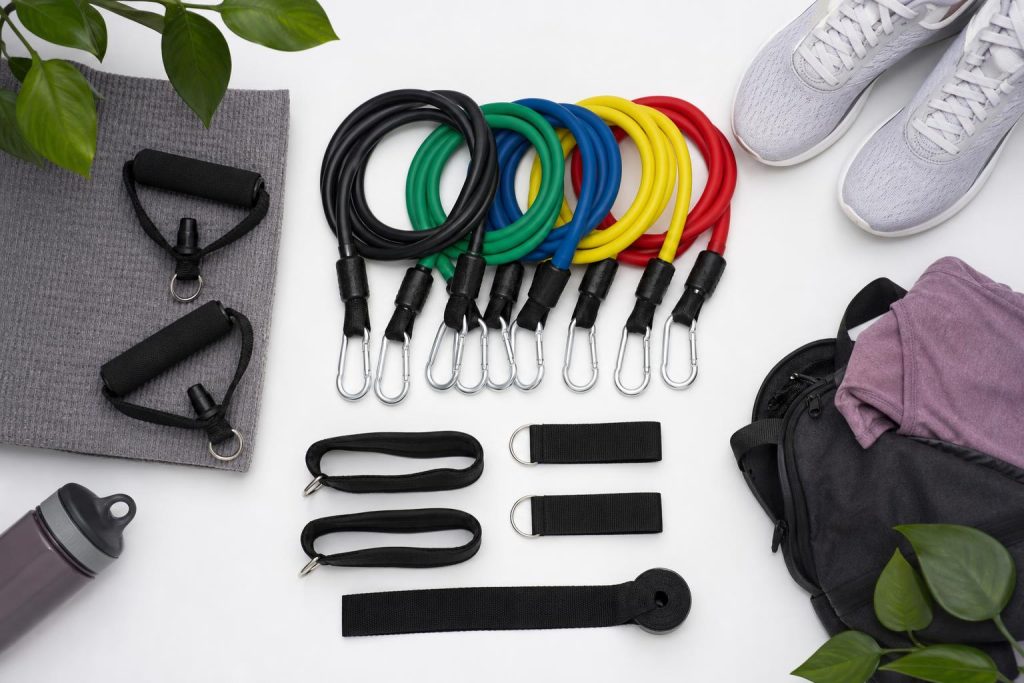
Before the exercises, you need the right tools. A quality resistance band set should include a range from light (10–15 lbs resistance) to heavy (50–80 lbs), ideally in tube bands with handles for upper body pressing and rowing movements, and flat loop bands for lower body work. Brands worth considering include Serious Steel, Rogue Monster Bands, and the widely used set by Fit Simplify — all of which offer validated resistance ratings. A door anchor and ankle straps dramatically expand the exercise library and are worth the small additional investment. Expect to spend $30–$80 for a complete setup that will outlast years of training.
For structure, three to four days of full-body resistance training per week is the evidence-supported sweet spot for men during fat loss phases. A landmark study in the Journal of Strength and Conditioning Research showed that training each muscle group twice per week produced superior hypertrophy outcomes compared to once-per-week splits when volume was equated — meaning full-body training at moderate frequency beats a traditional bro-split for men trying to maintain muscle while losing fat. The reason is muscle protein synthesis (MPS): stimulating MPS twice per week maintains a more consistently anabolic environment than a single weekly stimulus followed by six days of catabolism.
Each session should take 35 to 50 minutes. Keep rest periods between 60 and 90 seconds to maintain metabolic demand without sacrificing strength output. The goal is not to be winded — it’s to provide sufficient mechanical tension per set to signal the body that this muscle tissue is needed. That’s the survival signal that overrides catabolism.
Here’s how a session should be structured. Open with a compound hinge pattern — a band deadlift or Romanian deadlift. Anchor the band under both feet, hinge from the hips with a neutral spine, and drive through the posterior chain. This movement trains the glutes, hamstrings, and lower back — the largest muscles in the body and the ones most responsible for metabolic tissue mass. Follow with a horizontal pull: a bent-over band row, with the band anchored under the feet, driving the elbows back toward the hips and pausing at peak contraction. Three sets of 10–15 reps here, with a controlled eccentric on every rep.
After the pull comes a push. Band chest press performed lying on the floor with the band looped behind the upper back, pressing up with both hands simultaneously, challenges the pectorals and anterior deltoids through the full pressing range. The band’s ascending resistance curve actually makes this movement harder at the top — the lockout position — which is where free weights go slack. That’s not a limitation of bands; it’s a physiological advantage. Peak force in the fully shortened position recruits additional high-threshold motor units.
A complete session template on a given day might look like: band Romanian deadlift (3×12), band bent-over row (3×12), band chest press (3×10), band squat (3×15), band overhead press (3×10), band bicep curl (2×15), and band pallof press for core anti-rotation (2×12 per side). That’s approximately 17 total working sets, which aligns well with the 10–20 weekly sets per muscle group recommendation supported by Schoenfeld and Krieger’s 2016 dose-response analysis in the Journal of Strength and Conditioning Research.
Progressive overload is the engine of adaptation. With bands, you have several levers: increase resistance by using a heavier band or doubling up two bands, increase reps, slow the eccentric phase to 3–4 seconds, shorten rest periods, or add a pause at peak contraction. A man who tracks these variables and progresses them over eight to twelve weeks will see measurable changes in muscle retention, strength, and body composition — regardless of whether he’s on semaglutide, eating keto, or simply training hard and sleeping well.
Nutrition Anchors That Make the Training Work
Training without adequate protein is like building a house without cement. The bands provide the stimulus. Protein provides the raw material. For men in active fat loss phases — especially those experiencing appetite suppression — hitting protein targets requires intentionality. The current evidence, synthesized in the 2017 British Journal of Sports Medicine review cited earlier, recommends 1.6 to 2.2 grams of protein per kilogram of body weight per day as the optimal range for supporting muscle protein synthesis during resistance training. For a 200-pound (91 kg) man, that’s 145 to 200 grams of protein daily.
For GLP-1 users who are eating less total food volume, protein should be the non-negotiable macronutrient. If you’re eating two meals a day due to reduced appetite, both meals should be protein-forward — think ground beef, eggs, Greek yogurt, cottage cheese, salmon, chicken thighs, or a quality whey isolate shake. Carbohydrates and fats can flex around protein, not the other way around. A 2022 paper in Nutrients specifically examining dietary strategies during GLP-1-assisted weight loss reinforced that high-protein diets attenuated lean mass losses by approximately 30% compared to standard protein intakes — a meaningful difference that compounds over months of use.
Creatine monohydrate deserves a mention here because it remains the most evidence-supported ergogenic supplement in existence. Meta-analyses going back two decades confirm creatine supplementation increases strength output, supports lean mass retention, and may even have protective effects on satellite cell activity during caloric restriction. Three to five grams per day is the established effective dose, and it’s inexpensive, safe, and effective for virtually every man regardless of training background. During fat loss phases — whether medication-assisted or not — creatine helps you train harder and recover better, two things that directly influence how much muscle you keep.
Sleep and recovery deserve equal weight in this conversation. Research published in the Annals of Internal Medicine showed that men who slept 5.5 hours versus 8.5 hours during a caloric deficit lost significantly more lean mass and significantly less fat — same deficit, worse body composition outcomes, simply due to sleep restriction. If you’re training with bands, eating enough protein, and running a caloric deficit but getting six hours of poor sleep, you’re undermining the entire effort. Seven to nine hours is the target, and it’s as important as the workout itself.
The Takeaway
Resistance bands are not a compromise. They are a legitimate, research-supported tool for building and preserving muscle — and during fat loss phases, whether you’re using GLP-1 medications, following a structured diet, or taking the long road through consistent training and eating, they give you a way to apply the mechanical tension your muscles need to survive the deficit intact.
The men who come out of a fat loss phase looking better — not just lighter — are the ones who kept training through it. They prioritized protein even when appetite was low. They slept. They progressed their program week over week, even if progress was measured in slower eccentrics and shorter rest periods rather than heavier weights. A $50 set of resistance bands and a 45-minute commitment three to four times per week is enough to make that happen. The science says so, and your future self will too.