Here’s a number that should change how you train: men who performed compound movements three times per week preserved significantly more lean mass during a caloric deficit than those who focused on isolation work — according to research published in the Journal of Strength and Conditioning Research. Whether you’re on a GLP-1 medication like semaglutide, running a calorie deficit through clean eating, or simply trying to get more out of every hour you spend in the gym, the question of compound versus isolation training isn’t just academic. It directly determines how much muscle you keep, how fast your metabolism runs, and whether the body you’re building actually functions the way you want it to.
The fitness industry has been arguing about this for decades, but the science has been quietly settling the debate. Both training styles have a role — but not equal roles, and not at equal times in your program. Understanding the difference, and when to prioritize each, is one of the highest-leverage decisions you can make as a man pursuing better health.
What the Research Actually Says About Compound Movements
Compound exercises — squats, deadlifts, bench press, rows, overhead press, pull-ups — recruit multiple muscle groups and joints simultaneously. The metabolic demand is substantially higher than isolation work. A heavy set of squats doesn’t just challenge your quads; it activates your hamstrings, glutes, core, and spinal erectors simultaneously, triggering a systemic hormonal response that isolation exercises simply cannot replicate at the same magnitude.
Studies measuring acute testosterone and growth hormone responses have consistently shown that multi-joint, large-muscle movements produce greater anabolic hormone release than single-joint exercises. This matters enormously for fat loss, because muscle tissue is metabolically active — the more you maintain and build, the higher your resting metabolic rate, and the more efficiently your body partitions nutrients toward muscle rather than fat storage.
For men in a caloric deficit — whether that deficit is driven by GLP-1 receptor agonists reducing appetite, a structured low-carb diet, or disciplined portion control — compound lifts serve as the primary signal telling the body to hold onto muscle. Without that signal, caloric restriction alone tends to produce weight loss that includes a problematic proportion of lean mass. Research on resistance training during energy restriction confirms that progressive overload through compound movements is the most reliable mechanism for preserving the muscle you’ve built while shedding body fat.
There’s also a practical efficiency argument. Most men don’t have unlimited time to train. A well-programmed compound session — squat, press, row, and a hinge movement — can hit every major muscle group in 45 minutes. It improves cardiovascular conditioning, builds functional strength, stimulates bone density, and creates the kind of systemic metabolic stress that drives real body composition change. This is the foundation. Everything else is built on top of it.
Where Isolation Work Earns Its Place
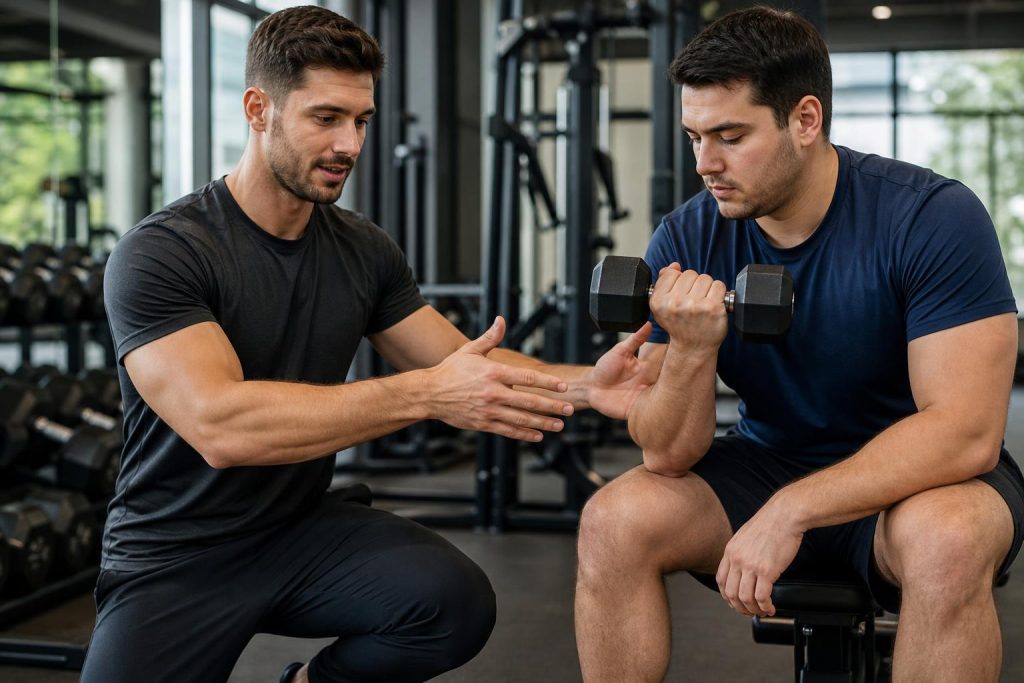
None of this means isolation exercises are a waste of time. Curls, lateral raises, tricep pushdowns, leg extensions, calf raises — these aren’t inferior so much as they’re specialized. Their value emerges when your foundation is already solid and you’re working to develop specific muscles that compound movements underdevelop, correct imbalances that increase injury risk, or add volume to lagging body parts without accumulating so much systemic fatigue that recovery becomes a problem.
Evidence on hypertrophy and training volume suggests that muscle growth responds well to accumulated mechanical tension and volume — and isolation work is an efficient way to add targeted volume without the central nervous system cost of another heavy compound session. If your biceps are lagging, adding two sets of curls at the end of a back workout costs very little recovery-wise and delivers direct stimulus. That’s the appropriate use case.
For men on GLP-1 medications specifically, there’s an additional consideration worth flagging. Reduced appetite from these drugs means reduced caloric intake, which means reduced protein availability if you’re not deliberate about it. Emerging research on GLP-1 receptor agonists and body composition highlights that muscle loss is a real risk during rapid weight reduction — making resistance training non-negotiable and making the prioritization of compound lifts even more critical. When calories are limited, your training needs to do more heavy lifting, literally and figuratively. In this context, isolation exercises remain useful as accessory work, but they should never crowd out the compound movements that are doing the essential preservation work.
A practical structure that works for most men: anchor every training session around one or two compound movements performed with progressive overload — meaning you’re adding weight, reps, or sets over time rather than just going through the motions. Then supplement with two to four isolation exercises targeting areas you want to develop or that compound movements miss. Keep your compound work early in the session when you’re fresh and can apply maximum effort. Save isolation work for the back half of the workout when precision matters more than raw horsepower.
Frequency matters too. Meta-analyses on training frequency and hypertrophy indicate that training each muscle group at least twice per week produces superior results compared to once-per-week approaches — a finding that further supports compound movements, since a squat and a deadlift both train the posterior chain, giving you overlap and redundancy that supports that twice-weekly stimulus without requiring endless isolation volume.
The Takeaway
The compound versus isolation debate is really a question of priorities, not either-or. Compound movements are the engine — they drive muscle preservation during fat loss, stimulate the hormonal environment for growth, and deliver the most metabolic return per hour invested. Isolation exercises are the fine-tuning — useful, often important, but never the foundation. Build your training week around squats, deadlifts, presses, and rows first. Then use isolation work to fill gaps. Whatever path you’re on — GLP-1, keto, intermittent fasting, or just lifting and eating clean — this hierarchy holds. The men who get the best results aren’t the ones who found a shortcut. They’re the ones who got the fundamentals right and stayed consistent long enough for the work to compound.