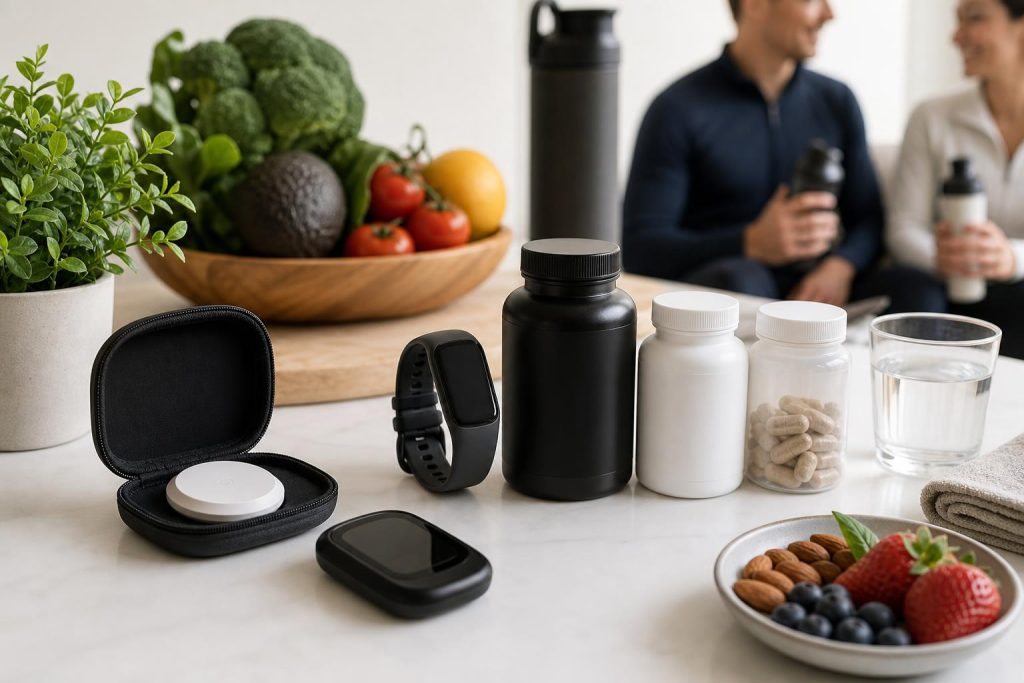
Most men have no idea what their blood sugar is doing between meals — and that ignorance is costing them results. A landmark study published in Nature Medicine found that glucose responses to identical foods varied dramatically between individuals, meaning the “healthy” meal your training partner swears by could be quietly spiking your blood sugar and derailing your fat loss. Continuous glucose monitors — CGMs — were once reserved for type 1 diabetics and endocrinologists’ offices. Today, they’re one of the most powerful metabolic feedback tools available to any man serious about his health, whether he’s on a GLP-1 medication like semaglutide, running a strict ketogenic protocol, or simply trying to lose fat and build muscle through clean eating and hard training.
The core value of a CGM isn’t about managing disease. It’s about understanding your own metabolic fingerprint. When you can see in real time how a bowl of white rice, a pre-workout supplement, or a post-lift protein shake affects your glucose, you stop guessing and start optimizing. For men on GLP-1 receptor agonists like Ozempic or Wegovy, this data becomes especially critical — these medications slow gastric emptying and blunt the appetite hormone ghrelin, but they don’t eliminate glucose variability. Knowing how your body responds while on a GLP-1 can help you time meals, prevent hypoglycemic episodes, and maximize the drug’s metabolic benefits alongside your lifestyle choices.
What CGMs Actually Measure — And Why It Matters for Fat Loss and Performance
A continuous glucose monitor is a small sensor — typically inserted just under the skin on the upper arm or abdomen — that measures interstitial glucose levels every one to five minutes and transmits the data wirelessly to your smartphone. Unlike a standard finger-prick test that gives you one static snapshot, a CGM gives you a movie. You see peaks, valleys, and the rate at which glucose rises and falls — a metric called glucose variability that research increasingly links to cardiometabolic risk, energy dysregulation, and impaired cognitive function even in non-diabetic individuals.
For fat loss specifically, chronically elevated postprandial glucose — the spike after eating — triggers prolonged insulin secretion, and elevated insulin is a powerful brake on fat oxidation. Your body cannot efficiently burn stored fat while insulin is high. This doesn’t mean carbohydrates are the enemy, but it does mean that understanding your personal glucose response to different carbohydrate sources, meal timing strategies, and training protocols gives you a metabolic edge that generic nutrition advice simply cannot. A CGM makes this visible. Men who have used CGMs have discovered surprising things: that their morning oatmeal with fruit triggered a sharper spike than they expected, or that a post-workout sweet potato caused almost no meaningful rise at all — because muscle glycogen depletion was absorbing glucose efficiently. Exercise significantly enhances insulin-mediated glucose uptake, and a CGM lets you see that phenomenon play out in real time.
For men focused on performance and muscle building, glucose stability matters too. Significant glucose crashes — dropping below roughly 70 mg/dL — correlate with fatigue, poor focus, and compromised training quality. If you’ve ever hit a wall mid-session and couldn’t figure out why, a CGM may answer the question definitively. Equally, understanding your fasted glucose trend in the morning gives insight into insulin sensitivity, cortisol patterns, and whether your recovery nutrition the night before is working for or against you.
The Best CGMs on the Market Right Now
The two dominant CGM systems available without a prescription for wellness use in the United States are the Dexcom Stelo and the Abbott Lingo, both launched in 2024 specifically for non-diabetic users. Before those, Levels Health and Supersapiens built subscription services around Abbott’s Libre sensor, which remains widely used globally. Here’s how the major options break down for a health-focused man.
The Dexcom Stelo is the first FDA-cleared CGM specifically designed for adults without diabetes. It wears for 15 days per sensor, integrates directly with Apple Health and Google Health Connect, and delivers clean, actionable data through a well-designed app. Dexcom’s sensor accuracy has long been considered best-in-class, and the Stelo carries that lineage. It’s available over the counter without a prescription at roughly $99 for a two-pack. For GLP-1 users, Dexcom’s compatibility with existing diabetes management infrastructure is a practical advantage if you ever move between clinical and wellness monitoring contexts.
The Abbott Lingo, built on the FreeStyle Libre 3 platform, is Abbott’s direct-to-consumer wellness offering. It wears for 14 days, offers one-minute glucose readings, and pairs with a coaching-forward app that provides personalized feedback based on your glucose patterns. Abbott’s Libre sensors have an enormous global evidence base behind them, and the Lingo platform translates that clinical data into accessible wellness insights. Pricing is comparable to the Stelo. If you’re already using Libre through a prescription, Lingo provides a seamless OTC transition.
Levels Health takes a different approach — it’s a software-first platform that sources Abbott Libre sensors and layers an advanced analytics experience on top of them, including food logging, metabolic scoring, and longitudinal trend analysis. Research supports the value of continuous feedback loops in sustaining behavior change, and Levels leans heavily into this principle. The membership model costs more over time, but for men who want deep analytical engagement with their glucose data rather than just raw numbers, it delivers meaningfully more context.
For men on GLP-1 medications, the most important practical consideration is hypoglycemia awareness. GLP-1 receptor agonists alone carry a low risk of true hypoglycemia, but when combined with other medications, prolonged caloric restriction, or intense exercise, glucose can dip into uncomfortable ranges. A CGM with low-glucose alerts — which both Stelo and Lingo provide — acts as an early warning system that gives you time to intervene before symptoms develop.
How to Actually Use CGM Data to Change Your Results
Wearing a CGM and ignoring the data is worse than useless — it creates anxiety without action. The goal is to run structured experiments over a two-to-four-week sensor period. Start with your current eating pattern as your baseline, noting your typical post-meal peak (ideally staying under 140 mg/dL in most wellness frameworks), your average fasting glucose (optimal range roughly 70–90 mg/dL for metabolically healthy individuals), and your overnight stability. Then systematically test variables: swap refined carbohydrates for whole food sources, adjust meal composition by adding fat or fiber before carbohydrates — a strategy shown to significantly blunt postprandial glucose spikes — and observe how resistance training versus cardio affects your glucose clearance rate.
Meal timing relative to exercise is one of the highest-leverage variables a CGM reveals. Consuming carbohydrates in the window surrounding a training session often produces a dramatically flatter glucose response than eating the same food at rest. This isn’t theoretical — you can watch it happen in your own data. Over weeks, the patterns that emerge become your personal metabolic playbook, more valuable than any generic diet template because it’s built entirely from your own biology.
The Takeaway
A CGM won’t replace hard training, smart nutrition, or consistent sleep — the foundational pillars of metabolic health remain exactly what they’ve always been. But as a diagnostic and feedback tool, continuous glucose monitoring gives men a level of metabolic self-awareness that was inaccessible to anyone outside a clinical setting just five years ago. Whether you’re optimizing around a GLP-1 prescription, dialing in your carb timing around lifting sessions, or simply trying to understand why your energy crashes every afternoon, the data is there. All you have to do is look at it.